Facts
Mohd. Rafiq was appointed as a Nursing Orderly by AIIMS on 18.08.1964 and confirmed with effect from 01.02.1965.
Source reference: paras. 2–3, pp. 2–3After remaining absent in 1979 due, according to him, to his wife’s illness, he reported for duty on 15.10.1979.
Source reference: paras. 2–3, pp. 2–3AIIMS alleged that he voluntarily submitted a resignation on that date, which was subsequently accepted; Rafiq contended that his signatures had been obtained on a document represented as a joining-related paper and that he had never intended to resign.
Source reference: paras. 2–3, pp. 2–3He made repeated representations dated 20.10.1979, 05.11.1979, 13.11.1979, 07.12.1979 and 20.12.1979 seeking permission to rejoin duty.
Source reference: paras. 4, 17, 51The industrial dispute was referred under Section 10 of the Industrial Disputes Act, 1947, and the Labour Court held that the resignation was not voluntary, directed reinstatement with continuity of service, and awarded 40% back wages.
Source reference: paras. 4, 8AIIMS challenged the finding on resignation, jurisdiction and back wages in W.P.(C) No. 2551/1999, while Rafiq challenged the restriction of back wages to 40% in W.P.(C) No. 2447/2000.
Source reference: para. 9During the writ proceedings, Rafiq died and his legal representatives were substituted.
Source reference: paras. 9–10, p. 4Issues
Whether the Labour Court had jurisdiction under the Industrial Disputes Act despite Rafiq being governed by the CCS (CCA) Rules, and whether it travelled beyond the terms of the industrial reference by examining the voluntariness of the alleged resignation?
Source reference: Issue No. I, paras. 23–32, pp. 10–14Whether the Labour Court’s finding that the alleged resignation dated 15.10.1979 was involuntary suffered from perversity, patent illegality or jurisdictional error warranting interference under Article 226 of the Constitution?
Source reference: Issue No. II, paras. 33–59, pp. 14–25Whether the Labour Court was justified in limiting back wages to 40%, or whether Rafiq’s legal representatives were entitled to full back wages and consequential benefits?
Source reference: Issue No. III, paras. 59–72, pp. 25–31Law Applied
The Court applied Section 10 of the Industrial Disputes Act, 1947 concerning reference of industrial disputes, and Section 2(s) concerning the definition of “workman”; the applicability of service rules such as the CCS (CCA) Rules does not, by itself, exclude the Industrial Disputes Act where the employee is a workman and the establishment is an industry.
Source reference: paras. 25–28Under Article 226, the High Court exercises supervisory rather than appellate jurisdiction and will not reappreciate evidence unless the tribunal’s finding is unsupported by evidence, perverse, patently illegal or jurisdictionally erroneous, as stated in Syed Yakoob v. K.S. Radhakrishnan, AIR 1964 SC 477, and Indian Overseas Bank v. I.O.B. Staff Canteen Workers’ Union, (2000) 4 SCC 245.
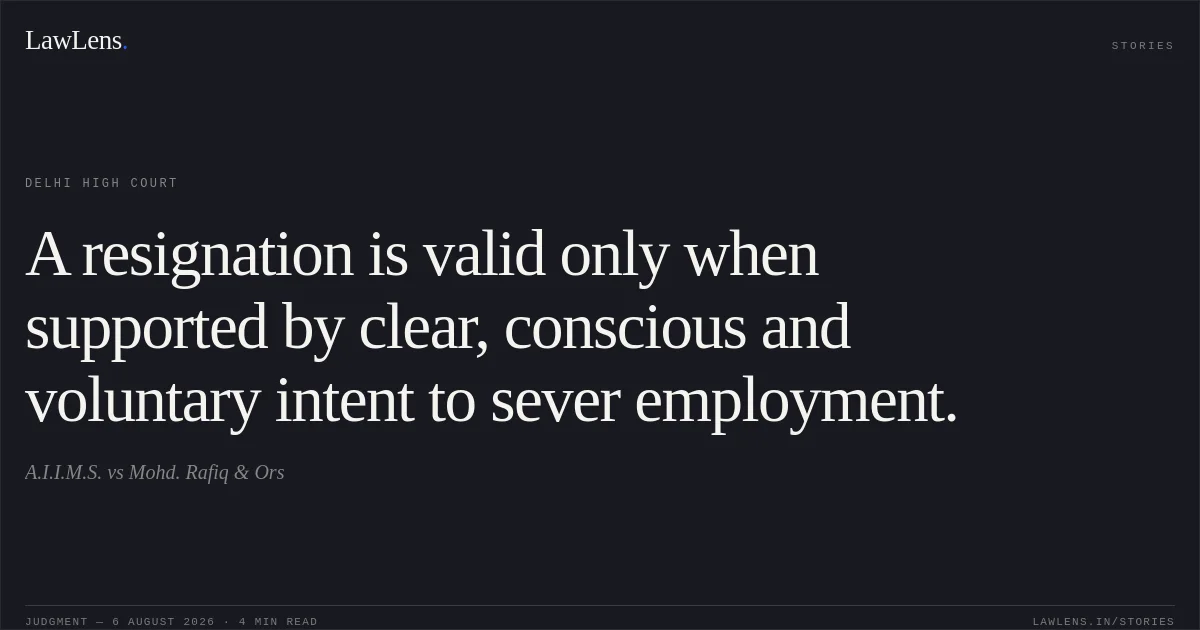
Source reference: paras. 33–36A resignation requires conscious, voluntary and unequivocal intention to relinquish employment; abandonment is a question of intention assessed from the surrounding circumstances, as held in G.T. Lad v. Chemicals & Fibres India Ltd., (1979) 1 SCC 590.
Source reference: paras. 49–50Where acceptance is required, resignation ordinarily becomes effective upon acceptance, and it may be withdrawn before acceptance, subject to the governing rules, as held in Raj Kumar v. Union of India, AIR 1969 SC 180.
Source reference: para. 54On back wages, Hindustan Tin Works (P) Ltd. v. Employees, (1979) 2 SCC 80, recognised full back wages as the normal rule following illegal termination, subject to gainful employment, while J.K. Synthetics Ltd. v. K.P. Agrawal, (2007) 2 SCC 433, and Deepali Gundu Surwase v. Kranti Junior Adhyapak Mahavidyalaya, (2013) 10 SCC 324, established that back wages are discretionary and must be determined on the facts, including pleadings and proof regarding gainful employment.
Source reference: paras. 61–65Reasoning
The Court held that determining whether Rafiq had voluntarily resigned was integral to deciding whether the cessation of employment was legal and justified; therefore, the Labour Court did not exceed the reference.
Source reference: paras. 29–32The CCS (CCA) Rules regulated service conditions but did not oust the Labour Court’s statutory jurisdiction under the Industrial Disputes Act.
Source reference: paras. 25–28On the merits, the Labour Court’s conclusion was supported by Rafiq’s consistent account, the evidence of the management witnesses, the contemporaneous representation dated 20.10.1979 found in AIIMS’s own records, and his repeated requests to resume duty.
Source reference: paras. 41–58This conduct was inconsistent with a conscious intention to sever employment.
Source reference: paras. 41–58The official noting dated 30.10.1979 also indicated that acceptance of the resignation was still under consideration, while no clear contemporaneous acceptance order was produced.
Source reference: paras. 41–58Since these findings were plausible and evidence-based, the High Court declined to reassess the evidence under Article 226.
Source reference: paras. 58–59However, the Labour Court had not explained why habitual absenteeism justified limiting back wages specifically to 40%.
Source reference: paras. 66–71At the same time, the absence of independent evidence proving complete unemployment and the prior record of absenteeism justified moulding the relief rather than awarding full back wages.
Source reference: paras. 66–71Holding
The Court rejected AIIMS’s jurisdictional and merits-based challenges and upheld the finding that Rafiq had not voluntarily resigned and had been illegally kept out of service.
It found the award of 40% back wages inadequately reasoned but declined to grant full back wages.
Source reference: paras. 71–72The Labour Court’s award was modified to provide 50% back wages from the date of illegal cessation until Rafiq’s superannuation in August 1996, together with continuity of service limited to computation of retiral and terminal benefits.
Source reference: paras. 71–72, 74W.P.(C) No. 2551/1999 filed by AIIMS was dismissed, while W.P.(C) No. 2447/2000 filed by Rafiq’s legal representatives was partly allowed.
Source reference: paras. 75–77AIIMS was directed to compute and release the monetary and retiral benefits within twelve weeks, failing which the outstanding amount would carry simple interest at 6% per annum from expiry of that period until payment.
Source reference: paras. 75–77Original Court PDF
A.I.I.M.S.vsMohd. Rafiq & Ors
Click to open original judgment
Original judgment, available to read, download and summarize on LawLens.in