Facts
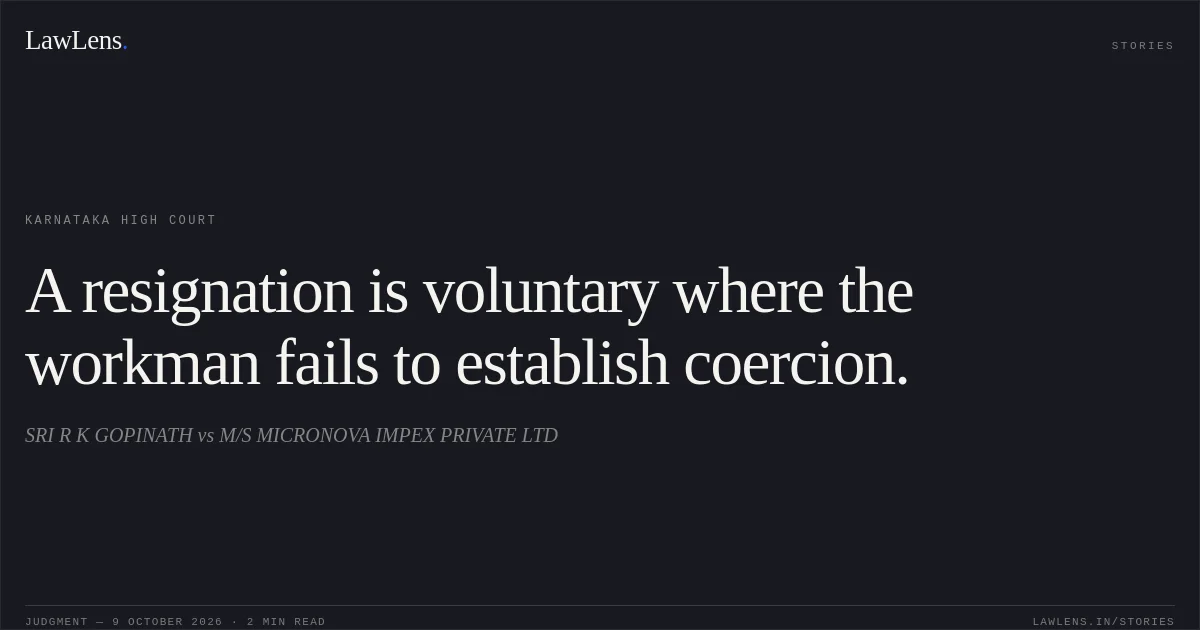
The petitioner worked for the respondent as a Stores In-charge/Store-Man from 6 July 2004. On 6 May 2013, the respondent transferred him from Bengaluru to Chennai; he sought leave extensions and cancellation of the transfer on health grounds, then submitted resignation letters dated 4 and 15 June 2013, which the respondent accepted on 18 June 2013.
Source reference: para. 2, 8He later alleged that his resignation had been obtained forcibly and raised an industrial dispute, including a claim concerning bonus, increments and other benefits. The Labour Court dismissed the reference. The petitioner challenged that award under Articles 226 and 227 of the Constitution.
Source reference: para. 3–4Issues
1. Whether the Labour Court erred in finding that the petitioner’s resignation was voluntary and not obtained forcibly.
Source reference: para. 9–12, 142. Whether the Labour Court’s treatment of the petitioner’s claim concerning retirement benefits required interference in the writ petition.
Source reference: para. 5(ii), 13Law Applied
The Court applied the principle that transfer is an incidence of service, particularly where the appointment order requires the employee to report at the place of transfer.
Source reference: para. 9–10It assessed whether the resignation was voluntary by reference to the evidence and surrounding circumstances, including whether the employee sought to withdraw it or complained of coercion.
Source reference: para. 10, 12The Court did not cite a specific statutory provision or precedent governing these questions; it exercised writ jurisdiction under Articles 226 and 227 of the Constitution.
Source reference: para. 1Reasoning
The appointment order required the petitioner to report at the place of transfer, and he had accepted that condition; the Court therefore treated the transfer to Chennai as an incidence of service.
Source reference: para. 9–10Although the petitioner alleged coercion, he did not seek withdrawal of either resignation, complain to the police or approach a higher authority alleging that his signatures had been forced. The Court also noted that he sought payment of benefits and received and encashed the amounts paid without protest. On that record, it upheld the Labour Court’s finding that the resignation was voluntary.
Source reference: para. 10–12As the Labour Court had not adjudicated the retirement-benefits claim, the High Court left the petitioner to pursue any available remedy before the appropriate forum.
Source reference: para. 13Holding
The Court held that the Labour Court’s finding on the voluntary nature of the resignation did not warrant interference.
It reserved liberty to the petitioner to pursue his retirement-benefits claim before the appropriate legal forum, if permitted by law, and dismissed the writ petition.
Source reference: para. 13–15Original Court PDF
SRI R K GOPINATHvsM/S MICRONOVA IMPEX PRIVATE LTD
Click to open original judgment
Original judgment, available to read, download and summarize on LawLens.in