Facts
The plaintiffs, being the children of Anita, a predeceased daughter of Mathurabai, claimed an interest in the suit lands and sought declaration of their share, partition, separate possession, and permanent injunction.
Source reference: para. 3They alleged that the revenue partition order dated 28 February 2019 had been passed without impleading them and in violation of natural justice.
Source reference: para. 3The defendants contended that the lands had been given to Mathurabai by her husband, Bhagir am, and that Mathurabai had voluntarily partitioned the lands on 18 December 2018, pursuant to which the parties were placed in possession and revenue entries were made.
Source reference: para. 4They also filed a counterclaim seeking declaration of title and injunction.
Source reference: para. 4The trial Court partly decreed the plaintiffs’ claim, holding them collectively entitled to a one-fourth share, and dismissed the defendants’ counterclaim.
Source reference: para. 5The first appellate Court affirmed that decision.
Source reference: para. 5The defendants thereafter preferred the present appeal under Section 100 of the Code of Civil Procedure.
Source reference: para. 2Issues
1. Whether the suit lands, upon Mathurabai’s death, devolved upon her surviving children and the children of her predeceased daughter in equal shares under Sections 15 and 16 of the Hindu Succession Act, 1956?
Source reference: para. 72. Whether the revenue partition order dated 28 February 2019 was binding upon the plaintiffs despite their non-impleadment and absence of any proved consent?
Source reference: para. 83. Whether the defendants’ applications under Order 41 Rule 27 and Order 6 Rule 17 of the CPC, concerning subsequent revenue proceedings, warranted interference by the appellate Court?
Source reference: paras. 9–104. Whether the second appeal raised any substantial question of law under Section 100 of the CPC?
Source reference: paras. 2, 11Law Applied
The Court applied Sections 15 and 16 of the Hindu Succession Act, 1956, under which the property of a female Hindu dying intestate devolves, in the first instance, upon her sons, daughters, and the children of any predeceased son or daughter, who inherit jointly in the prescribed manner.
Source reference: para. 7It also applied Section 178-A of the Madhya Pradesh Land Revenue Code, 1959, requiring that all concerned heirs be impleaded and given an opportunity of hearing before a partition is effected by the revenue authority.
Source reference: para. 8The Court relied on the principles of natural justice, particularly the rule against passing an adverse order without notice and hearing.
Source reference: para. 8It further held that revenue proceedings do not determine title and cannot override a civil Court’s adjudication of title and shares.
Source reference: para. 9Applications for production of subsequent evidence and amendment are governed by Order 41 Rule 27 and Order 6 Rule 17 of the CPC, respectively, while a second appeal under Section 100 CPC is maintainable only where a substantial question of law arises.
Source reference: paras. 2, 9–11Reasoning
The Court found that neither side had produced documentary evidence establishing whether Mathurabai had received the property from her mother or husband; consequently, Mathurabai was treated as the owner of the lands.
Source reference: para. 7On her death, the property devolved under Sections 15 and 16 of the Hindu Succession Act upon the relevant surviving children and the plaintiffs, as representatives of the predeceased daughter, resulting in a one-fourth share for each branch and a collective one-fourth share for the plaintiffs.
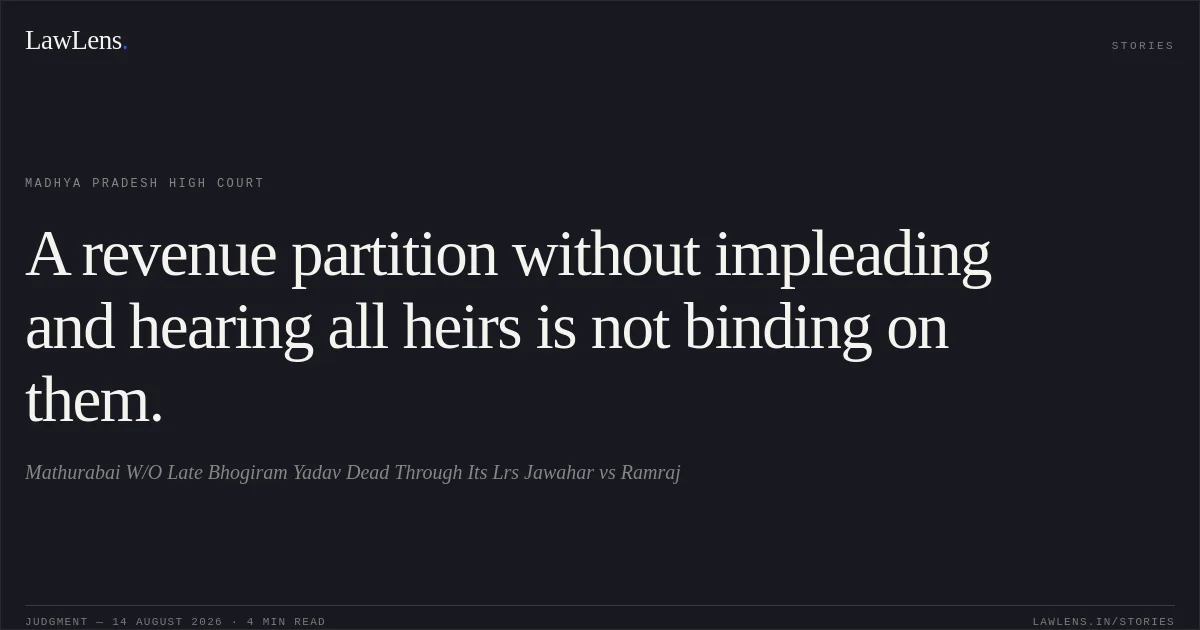
Source reference: para. 7The revenue partition order was held non-binding because the plaintiffs had not been impleaded, had not been heard, and had not given any proved consent to relinquish their shares.
Source reference: para. 8The mere recital in the revenue proceedings that the daughters did not wish to claim a share could not substitute for their participation or consent.
Source reference: para. 8The subsequent revenue orders also could not affect the civil adjudication of title and, in any event, were consistent with the judgments of the Courts below; therefore, rejection of the applications under Order 41 Rule 27 and Order 6 Rule 17 was justified.
Source reference: paras. 9–10Since the findings were based on a proper assessment of the oral and documentary evidence and no perversity or illegality was demonstrated, no substantial question of law arose.
Source reference: para. 11Holding
The High Court held that the plaintiffs were collectively entitled to a one-fourth share in the suit lands and that the revenue partition order dated 28 February 2019 was not binding upon them because it was passed without their impleadment or hearing.
The dismissal of the defendants’ counterclaim and the decree granting partition and separate possession to the plaintiffs were upheld.
Source reference: no citationThe applications under Order 41 Rule 27 and Order 6 Rule 17 CPC were correctly rejected, and the second appeal was dismissed in limine for raising no substantial question of law.
Source reference: para. 11Acts & Sections Cited
3 provisions across 2 statutes referred to in this judgment. Each provision opens on LawLens.
Code of Civil Procedure, 19081
Hindu Succession Act, 19562
Original Court PDF
Mathurabai W/O Late Bhogiram Yadav Dead Through Its Lrs JawaharvsRamraj
Click to open original judgment
Original judgment, available to read, download and summarize on LawLens.in