Facts
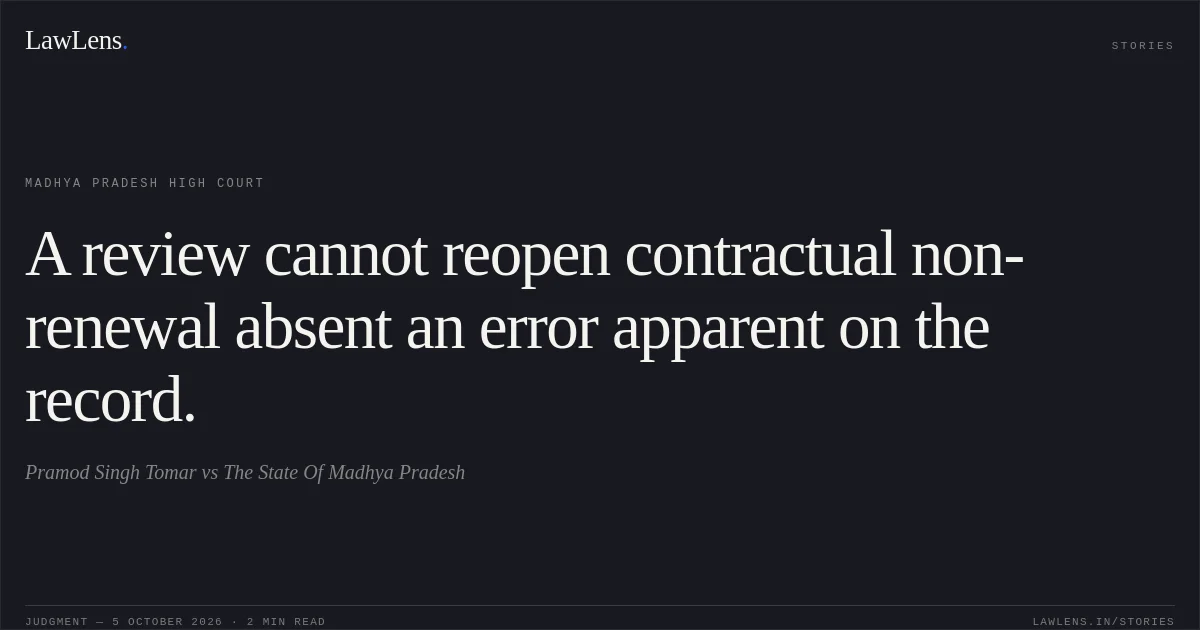
The petitioner, appointed as Additional Programme Officer in 2006, had his contract renewed periodically until 2024–25. Although show-cause notices concerning alleged irregularities in MGNREGA works were issued and answered, no departmental enquiry or finding of misconduct followed. His contract was not extended for 2025–26 by an order dated 28 January 2026.
Source reference: para. 2After the High Court dismissed his writ petition challenging the non-extension, he sought review of that decision, relying on K. Raghupathi v. State of U.P. and orders in favour of similarly situated employees.
Source reference: paras. 1–2The State opposed review, arguing that the petition sought a rehearing and disclosed no error apparent on the face of the record.
Source reference: para. 3Issues
1. Whether the petitioner established an error apparent on the face of the record, or another ground under Order XLVII Rule 1 CPC, warranting review of the order dismissing his writ petition.
Source reference: paras. 5, 15, 172. Whether K. Raghupathi or the treatment of other contractual employees disclosed a basis for review of the petitioner’s non-extension.
Source reference: paras. 12–16Law Applied
Section 114 and Order XLVII Rule 1 of the Code of Civil Procedure permit review on discovery of new and important matter or evidence, an error apparent on the face of the record, or another sufficient reason.
Source reference: paras. 7–9Under Kamlesh Verma v. Mayawati, review is not an appeal in disguise or a rehearing on the merits; an error must be manifest and not one requiring a process of reasoning to discover.
Source reference: para. 5State of West Bengal v. Kamal Sengupta, Col. Avatar Singh Sekhon v. Union of India, and Parsion Devi v. Sumitri Devi similarly require a patent error that undermines the decision or risks miscarriage of justice.
Source reference: paras. 6, 10–11K. Raghupathi v. State of U.P. concerned an employee whose contractual appointment and benefits were, in the circumstances of that case, treated as equivalent to those of a regular employee, and whose discontinuance was stigmatic.
Source reference: paras. 12–14Article 14 does not permit “negative parity”: an erroneous or irregular benefit granted to another person cannot be claimed as a right (Basawaraj v. Special Land Acquisition Officer; State of Odisha v. Anup Kumar Senapati).
Source reference: para. 16Reasoning
The Court held that the petitioner’s submissions about the allegations, the absence of an enquiry, and the treatment of other employees sought reconsideration of the merits rather than identifying a patent error in the order under review.
Source reference: paras. 3, 15, 17It distinguished K. Raghupathi because the petitioner was not shown to have been treated as a regular employee or given equivalent benefits, and because the non-extension order was not stigmatic.
Source reference: paras. 13–14The decisions concerning other employees did not establish a review ground, since Article 14 cannot support a claim to negative parity.
Source reference: para. 16Applying the limited review standard, the Court found no apparent error warranting interference.
Source reference: paras. 15, 17Holding
The Court answered the review issues against the petitioner, holding that no error apparent on the face of the record or other sufficient ground for review had been demonstrated.
The review petition was dismissed as devoid of merit.
Source reference: paras. 17–18Acts & Sections Cited
1 provisions across 1 statute referred to in this judgment. Each provision opens on LawLens.
Code of Civil Procedure, 19081
Original Court PDF
Pramod Singh TomarvsThe State Of Madhya Pradesh
Click to open original judgment
Original judgment, available to read, download and summarize on LawLens.in