Facts
The Respondent, a teacher (TGT Maths) at the Appellant school—a private unaided institution governed by the Delhi School Education Act, 1973—filed a writ petition seeking salary revision under the 6th and 7th Central Pay Commissions (CPC) and payment of arrears
Source reference: p. 2The School contended that the Respondent had resigned on 28.10.2019, which was accepted on 20.02.2020, and cited "deemed approval" from the Directorate of Education (DoE) under Rule 114(A)
Source reference: p. 2-3The learned Single Judge ruled in favor of the teacher, finding no evidence that the DoE was ever notified of the resignation
Source reference: p. 3The Division Bench dismissed the subsequent appeal (LPA 406/2023) on 31.07.2025 after the DoE filed an affidavit stating it never received the resignation letter
Source reference: p. 3-4The Appellant filed the present review petition seeking exemption from paying unpaid salary for the period the teacher was allegedly not permitted to join classes
Source reference: p. 4Issues
1. Whether there exists an error apparent on the face of the record regarding the non-receipt of the resignation letter by the DoE to justify a review of the judgment
Source reference: p. 7, para. 92. Whether the Court can exercise review jurisdiction on grounds that the Respondent worked without protest or that the original writ petition lacked specific prayers for unpaid salary
Source reference: p. 4-5, para. 5(xi)Law Applied
The Court applied the principles of review under Section 114 and Order 47 Rule 1 of the Code of Civil Procedure (CPC), 1908.
Source reference: no citationThe Court relied on Haridas Das v. Usha Rani Banik, which establishes that a review is not an "appeal in disguise" and is limited to patent errors or discovery of new evidence that could not be produced despite due diligence
Source reference: p. 5-6It further cited Meera Bhanja v. Nirmala Kumari Choudhury and Aribam Tuleshwar Sharma v. Aribam Pishak Sharma, clarifying that review jurisdiction under Article 226 is intended only to correct grave/palpable errors or prevent miscarriage of justice, not to correct an erroneous decision on merits
Source reference: p. 6-7Reasoning
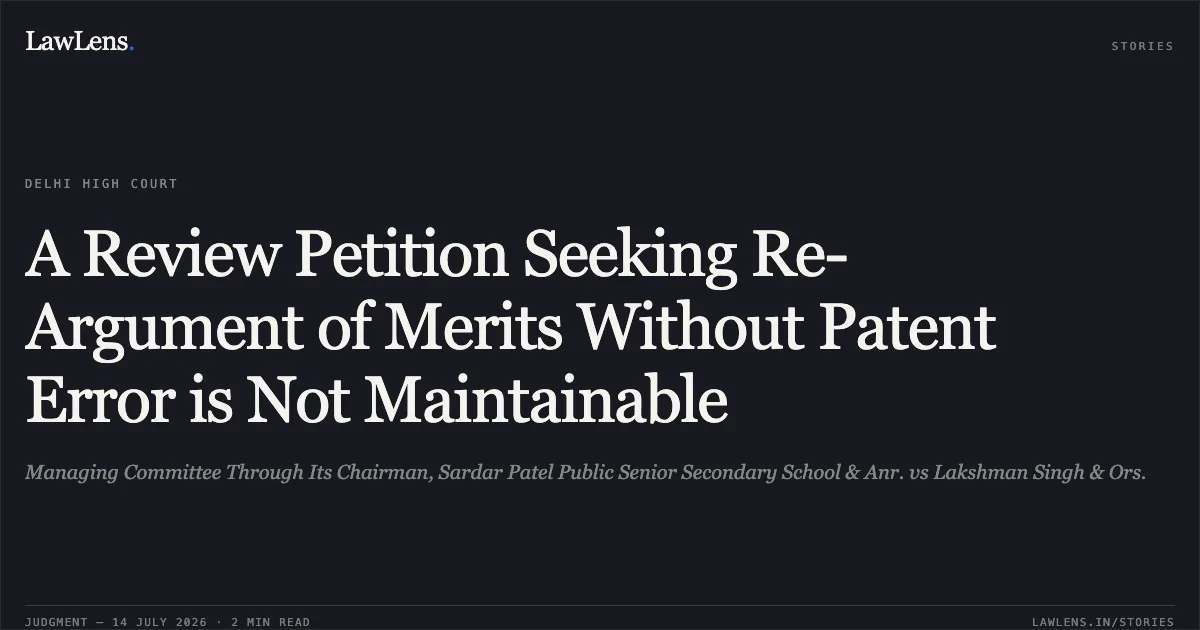
The Court observed that the Petitioner’s arguments in the review petition were an attempt to re-argue the entire case on merits, which is impermissible under Order 47 Rule 1
Source reference: p. 7, para. 8Regarding the resignation, the Court emphasized the categorical stand and affidavit of the DoE confirming that the school's purported letter dated 28.10.2019 was never received
Source reference: p. 7, para. 9The Court reasoned that since the school failed to prove the statutory communication of the resignation, the findings of the Single Judge and the Division Bench were sound. The Petitioner failed to demonstrate any new evidence or manifest legal error that stared the Court in the face without elaborate argument; instead, the Petitioner sought a rehearing of the dispute
Source reference: p. 6-7Holding
The Court condoned the 300-day delay in filing but dismissed the review petition. It held that there was no error apparent on the face of the record
The Court reaffirmed that the Respondent teacher is entitled to dues as per the mandate of the State for aided and unaided schools, noting that a teacher cannot be asked to work without due pay. All pending applications were disposed of accordingly.
Source reference: p. 8, para. 10-11Acts & Sections Cited
2 provisions across 1 statute referred to in this judgment. Each provision opens on LawLens.
Code of Civil Procedure, 19082
Original Court PDF
Managing Committee Through Its Chairman, Sardar Patel Public Senior Secondary School & Anr.vsLakshman Singh & Ors.
Click to open original judgment
Original judgment, available to read, download and summarize on LawLens.in