Facts
The petitioners operated an Indian Oil Corporation petrol pump under the name “D.K. Automobiles” at Khasra/Gata No. 68, Village Govindapur, Tehsil Sadar, District Bahraich, situated on State Highway No. 30.
Source reference: p.2; para. 3They challenged the establishment of a neighbouring petrol outlet by Reliance BP Mobility Limited and respondents nos. 7 and 8, contending that the outlet violated the applicable norms governing the location, layout and access of fuel stations on State roads.
Source reference: p.2–3; para. 4The petitioners sought quashing of the approval granted by the District Magistrate on 9 February 2026 and the No Objection Certificate issued by the City Magistrate on 13 February 2026.
Source reference: p.2; para. 2The respondents raised a preliminary objection that the petitioners were rival businessmen seeking to prevent lawful competition and therefore lacked locus standi.
Source reference: p.3–4; para. 6The Court also noted that a prior public-interest litigation concerning the same proposed outlet had been disposed of after the respondents relied on the amended norms and a seven-metre service road.
Source reference: p.8–10; paras. 12–14Issues
Whether an existing petrol-pump operator has locus standi to maintain a writ petition under Article 226 challenging the approval and NOC granted for a neighbouring petrol outlet merely because the proposed outlet may adversely affect its business.
Source reference: p.4–7; paras. 6–10Whether the approval and NOC granted for the proposed petrol outlet violated the applicable norms relating to minimum distance and access through a seven-metre-wide service road.
Source reference: p.3, 8–10; paras. 5, 12–14Whether the present writ petition constituted an abuse of process because the same objection had already been raised in an earlier public-interest litigation.
Source reference: p.9–10; paras. 12–14Law Applied
The Court applied the principle that a writ of certiorari under Article 226 is ordinarily available only to an “aggrieved person” whose legally protected right has been infringed, and that a business competitor cannot invoke writ jurisdiction merely to eliminate competition.
Source reference: p.4–7; paras. 7–9Relying on Nagar Rice and Flour Mills v. N.T. Gowda, (1970) 1 SCC 575, Jasbhai Motibhai Desai v. Roshan Kumar, (1976) 1 SCC 671, and Mithilesh Garg v. Union of India, (1992) 1 SCC 168, the Court held that commercial loss or apprehension of reduced profits does not create a justiciable right to prevent another person from carrying on a lawful business.
Source reference: p.4–7; paras. 7–9It also relied on State of Orissa v. Madan Gopal Rungta, AIR 1952 SC 12, for the rule that infringement of a legal or fundamental right is foundational to the exercise of Article 226 jurisdiction.
Source reference: p.10–11; para. 16The Court further considered Clauses 3.1 and 3.2 of the 2022 State Guidelines and the amended norms, under which the distance restriction may not apply where access and egress are provided through a common service road at least seven metres wide, subject to the prescribed conditions.
Source reference: p.3, 8–9; paras. 5, 12Reasoning
The Court found that the petitioners’ challenge was motivated principally by their status as a competing petrol-pump operator and by apprehension of financial loss, rather than by infringement of any legally protected right.
Source reference: p.4–7; paras. 7–11Under the cited Supreme Court authorities, the right to carry on business does not include a right to exclude competitors or preserve a monopoly.
Source reference: p.6–7; paras. 8–11Consequently, the petitioners lacked locus standi to challenge the respondents’ approval and NOC solely because the new outlet was proposed nearby.
Source reference: p.6–7; paras. 8–11On the regulatory issue, the Court noted the respondents’ reliance on the amended norms and the existence of a seven-metre-wide service road.
Source reference: p.8–10; paras. 12–13The State authorities further represented that the service road had already been constructed and that operation of the outlet would not be permitted without compliance with the applicable access requirements.
Source reference: p.8–10; paras. 12–13The Court also held that the earlier PIL had raised substantially the same objection and had been disposed of after consideration of the amended guidelines and service-road arrangement; the present petition merely recast the same challenge as one against the approval and NOC, rendering it an abuse of process.
Source reference: p.9–10; para. 14The alleged adverse effect on the petitioners’ business could not justify judicial intervention, as the Court was not required to insure the commercial viability of an existing operator.
Source reference: p.10; para. 15Holding
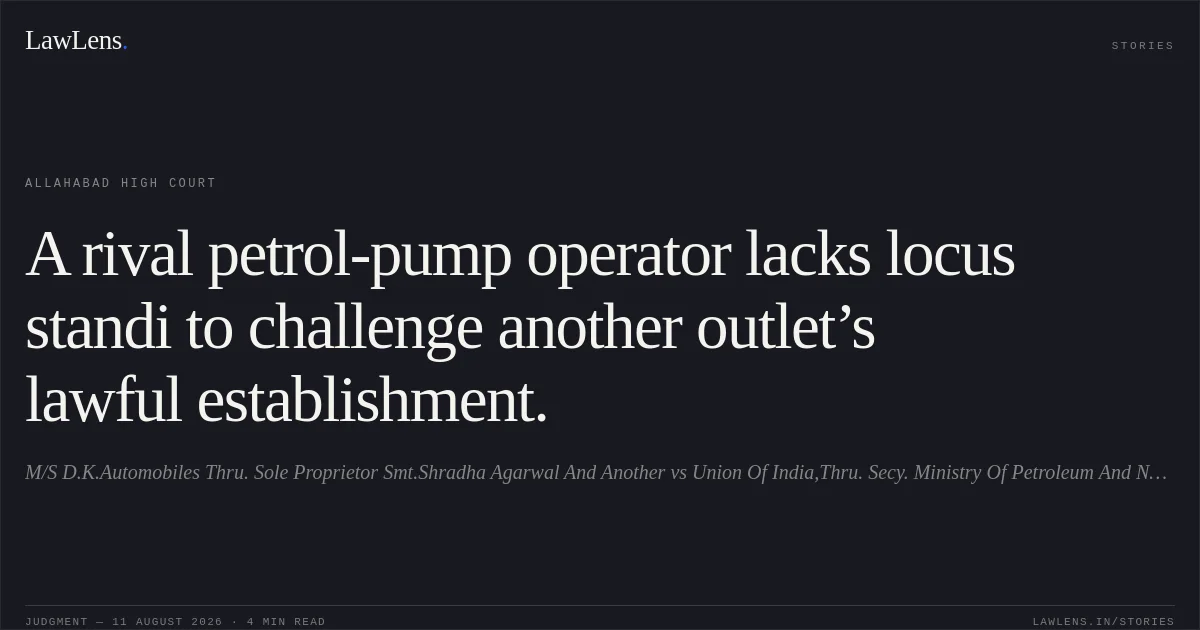
The Court held that the petitioners, being rival businessmen, had no locus standi to maintain the writ petition merely to prevent the establishment of a competing petrol outlet.
No fundamental or statutory right of the petitioners was shown to have been infringed, and the proposed outlet was not demonstrated to violate the applicable access norms.
Source reference: p.7, 9–11; paras. 10–16The Court further found the petition substantially repetitive of the earlier PIL and abusive of the judicial process.
Source reference: p.7, 9–11; paras. 10–16The writ petition was accordingly dismissed for want of maintainability and on merits, with no relief granted to the petitioners.
Source reference: p.11; para. 17Original Court PDF
M/S D.K.Automobiles Thru. Sole Proprietor Smt.Shradha Agarwal And AnothervsUnion Of India,Thru. Secy. Ministry Of Petroleum And Natural Gas New Delhi And 7 Others
Click to open original judgment
Original judgment, available to read, download and summarize on LawLens.in