Facts
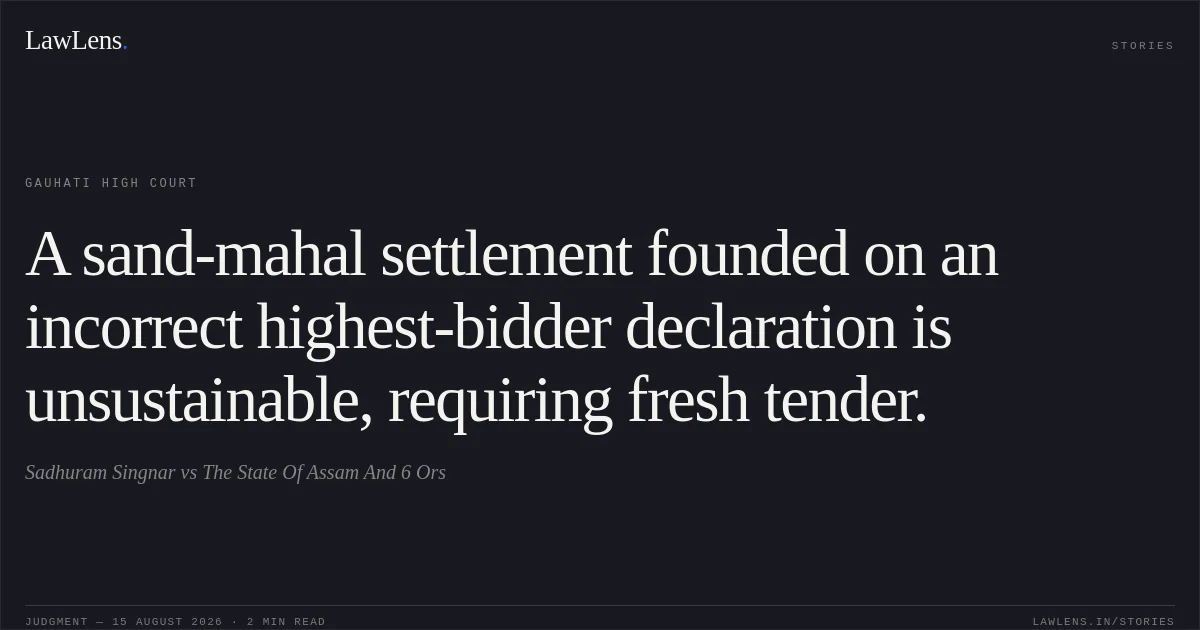
The petitioner participated in a short tender process issued by the Divisional Forest Officer, Karbi Anglong Forest, Hamren Division, for settlement of the Jamuna River Sand Mahal at Upper Hatipura under the Karbi Anglong West Division.
Source reference: pp. 3–5His bid was found technically competent and was recorded as the highest bid in the comparative statement.
Source reference: pp. 3–5However, Respondent No. 3 addressed a communication dated 13 March 2023 to Respondent No. 4 stating that Respondent No. 7 had offered the highest bid of ₹15,50,000 against the government value of ₹8,40,000 for 6,000 m³ of sand for a two-year period, and proposed settlement in his favour.
Source reference: pp. 3–5The petitioner challenged that communication.
Source reference: p. 4On 24 March 2023, the Court directed maintenance of status quo regarding allotment of the sand mahal.
Source reference: p. 4The respondent authorities did not file affidavits, and the tender period subsequently expired.
Source reference: pp. 4–5Issues
1. Whether the communication dated 13 March 2023 proposing settlement of the Jamuna River Sand Mahal in favour of Respondent No. 7 was legally sustainable when the petitioner was the technically competent highest bidder.
Source reference: pp. 3–52. Whether any effective relief could be granted under the expired tender process, and whether the authorities could undertake a fresh settlement process.
Source reference: p. 5Law Applied
The Court applied the doctrine of non-traverse, holding that material factual assertions made in the writ petition stood admitted where the respondent authorities failed to file affidavits.
Source reference: p. 4It further applied the basic principle of fair and rational tender administration that a settlement decision must accord with the comparative bid record and cannot be founded on an incorrect representation of the identity of the highest bidder.
Source reference: pp. 4–5Since the tender period had expired, the Court recognised that the authorities could not proceed under the lapsed tender and were required to adopt a permissible mode of fresh settlement.
Source reference: p. 5Reasoning
The comparative statement showed that the petitioner was both technically competent and the highest bidder, whereas the impugned communication incorrectly represented Respondent No. 7 as the highest bidder.
Source reference: p. 4The authorities’ failure to file affidavits meant that the petitioner’s factual case was treated as admitted under the doctrine of non-traverse.
Source reference: p. 4Further, because the interim status quo order had prevented settlement in favour of Respondent No. 7, the proposed two-year settlement had not crystallised into a completed allotment.
Source reference: p. 5The communication was therefore legally unsustainable.
Source reference: p. 5However, as the period covered by the short tender notice had expired, the Court considered it inappropriate to direct settlement under that process and instead permitted the authorities to initiate a fresh lawful settlement process.
Source reference: p. 5Holding
The Court allowed the writ petition to the extent of setting aside and quashing the communication dated 13 March 2023 issued by Respondent No. 3 to Respondent No. 4.
Since the original tender period had expired, Respondent Nos. 2 to 6 were given liberty to take effective steps for settlement of the sand mahal through permissible modes of settlement, including a fresh tender process.
Source reference: p. 6Original Court PDF
Sadhuram SingnarvsThe State Of Assam And 6 Ors
Click to open original judgment
Original judgment, available to read, download and summarize on LawLens.in