Facts
A search under Section 132 of the Income-tax Act, 1961 was conducted at the premises of Suresh R. Thakkar, a third party, on 15 October 2019.
Source reference: paras. 1–5; pp. 2–3The petitioner was a co-owner of land forming part of the transactions examined pursuant to the search.
Source reference: paras. 1–5; pp. 2–3The assessment of the searched person was completed in August 2021.
Source reference: paras. 1–5; pp. 2–3Thereafter, the Assessing Officer of the searched person recorded satisfaction under Section 153C only on 27 January 2025, and the petitioner’s Assessing Officer recorded satisfaction on 26 March 2025.
Source reference: paras. 1–5; pp. 2–3A notice under Section 153C for Assessment Year 2017–18 was issued to the petitioner on 31 March 2025.
Source reference: paras. 1–5; pp. 2–3The assessment order under Section 153C and demand notice were subsequently issued on 26 March 2026.
Source reference: paras. 1–5; pp. 2–3The petitioner relied on the Gujarat High Court’s decision in Parag Rameshbhai Gathani v. Income Tax Officer, International Taxation, decided on 18 November 2025, concerning a co-owner of the same land and the same search proceedings.
Source reference: paras. 1–2, 6; pp. 2, 4–7In that case, a 22-month delay in recording satisfaction after completion of the searched person’s assessment was held inconsistent with the requirement that satisfaction be recorded “immediately” after completion of assessment.
Source reference: paras. 1–2, 6; pp. 2, 4–7The Supreme Court dismissed the Department’s challenge to that decision on 2 April 2026.
Source reference: para. 7; p. 8Issues
1. Whether the satisfaction required for initiating proceedings under Section 153C of the Income-tax Act could validly be recorded more than four years after completion of the assessment of the searched person.
Source reference: paras. 2–5, 8; pp. 2–3, 82. Whether the notice under Section 153C, the consequential assessment order, and the demand notice were liable to be quashed on account of the delayed recording of satisfaction.
Source reference: paras. 2–3, 8; pp. 2, 8Law Applied
Section 153C of the Income-tax Act, read with Section 158BD, requires the Assessing Officer to record a valid satisfaction that seized material belongs to or relates to a person other than the searched person before initiating proceedings against that other person.
Source reference: para. 6; pp. 4–5Relying on Calcutta Knitwears, the Court held that satisfaction may be recorded at one of three stages: at initiation of proceedings against the searched person, during those assessment proceedings, or immediately after their completion.
Source reference: para. 6; pp. 4–5CBDT Circular No. 24/2015 extended these principles to Section 153C proceedings and directed strict compliance.
Source reference: para. 6; pp. 5–6The Court also relied on Jitendra H. Modi, which held that a substantial delay in recording satisfaction was not “immediate”.
Source reference: para. 6; p. 7The Court also followed Parag Rameshbhai Gathani, where a 22-month delay was held impermissible.
Source reference: paras. 6–8; pp. 4–8The dismissal of the Department’s SLP against that decision reinforced its application.
Source reference: paras. 6–8; pp. 4–8Reasoning
The Court found that the petitioner’s case was materially identical to Parag Rameshbhai Gathani because it arose from the same search of Suresh R. Thakkar and concerned co-ownership of the same land.
Source reference: paras. 4–5; p. 3Although the searched person’s assessment had concluded in August 2021, satisfaction was recorded only on 27 January 2025—more than four years later—and the petitioner’s Assessing Officer recorded satisfaction on 26 March 2025.
Source reference: para. 5; p. 3This delay could not qualify as recording satisfaction “immediately after” completion of the searched person’s assessment under Calcutta Knitwears and CBDT Circular No. 24/2015.
Source reference: paras. 3–8; pp. 3, 8Since the same defect had invalidated the proceedings in the co-owner’s case, the Court adopted that reasoning and rejected the Department’s objection that the reassessment was based on incriminating search material.
Source reference: paras. 3–8; pp. 3, 8Holding
The Court answered the issues in favour of the petitioner.
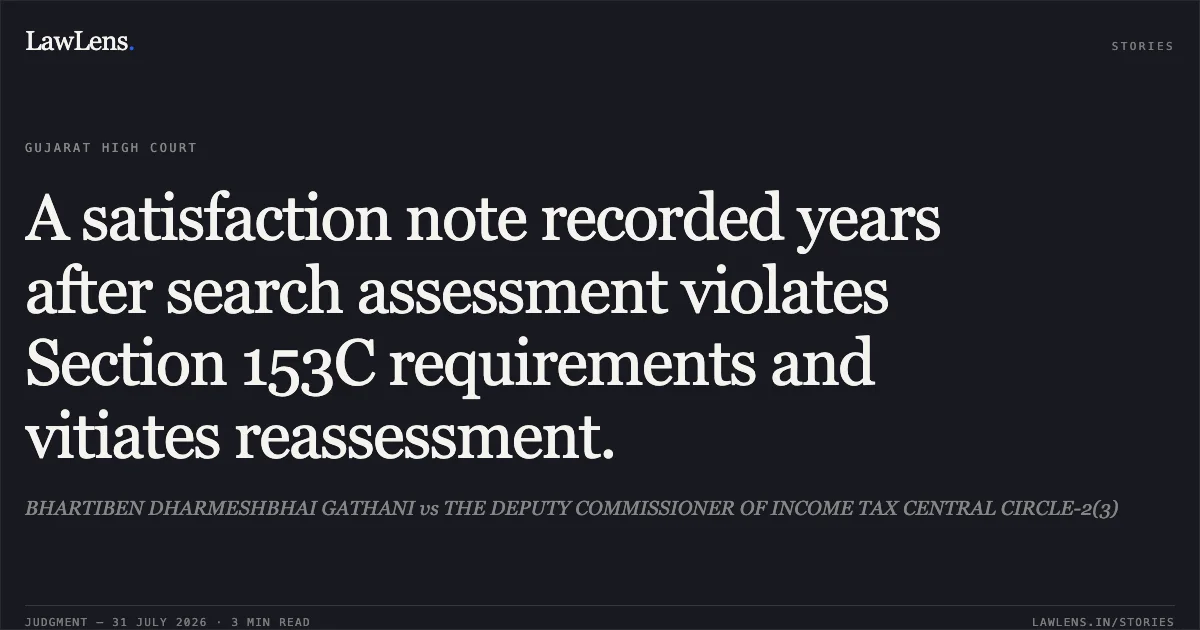
It held that the satisfaction recorded after an interval exceeding four years was invalid for the purposes of Section 153C.
Source reference: para. 8; p. 8Accordingly, the notice dated 31 March 2025, the assessment order dated 26 March 2026 passed under Section 153C, and the consequential demand notice dated 26 March 2026 were quashed and set aside.
Source reference: para. 8; p. 8The writ petition was allowed, and the connected civil application for interim relief was rendered infructuous.
Source reference: para. 9; p. 8Acts & Sections Cited
5 provisions across 1 statute referred to in this judgment. Linked provisions open on LawLens.
Income Tax Act, 19615
Original Court PDF
BHARTIBEN DHARMESHBHAI GATHANIvsTHE DEPUTY COMMISSIONER OF INCOME TAX CENTRAL CIRCLE-2(3)
Click to open original judgment
Original judgment, available to read, download and summarize on LawLens.in