Facts
The State appealed under Section 419 of the Bharatiya Nagarik Suraksha Sanhita, 2023, against the acquittal of the accused of offences under Sections 363, 366 and 376(2)(n) of the Indian Penal Code and Sections 4 and 6 of the POCSO Act.
Source reference: para. 1–2The complainant alleged that his 15-year-old daughter disappeared from home on the night of 26 September 2022 and that the accused had taken her away.
Source reference: para. 4–8The prosecution relied on her testimony, school records, medical evidence and parental evidence; the trial court acquitted the accused, finding the victim’s age and the allegations of forcible abduction and sexual assault unproved.
Source reference: para. 4–8The State contended that the acquittal was perverse and that the trial court had failed to apply the POCSO presumptions.
Source reference: para. 10–11Issues
Whether the prosecution proved that the victim was a minor on the date of the alleged incident.
Source reference: para. 15–19Whether the prosecution proved that the victim was taken away by force, threat or deceit and subjected to sexual relations against her will or without her consent.
Source reference: para. 15, 19–22Whether the trial court’s acquittal was perverse or otherwise warranted appellate interference.
Source reference: para. 12–15, 24, 27Law Applied
The Court considered Sections 363, 366 and 376(2)(n) of the IPC and Sections 4, 6, 29 and 30 of the POCSO Act; it held that the POCSO presumptions did not arise unless the victim’s minority was first established.
Source reference: para. 22It applied Section 35 of the Indian Evidence Act, 1872, recognising that an official or school-register entry may be admissible but that admissibility is distinct from probative value: the entry’s evidentiary weight depends on proof of its authenticity and the source of the underlying information.
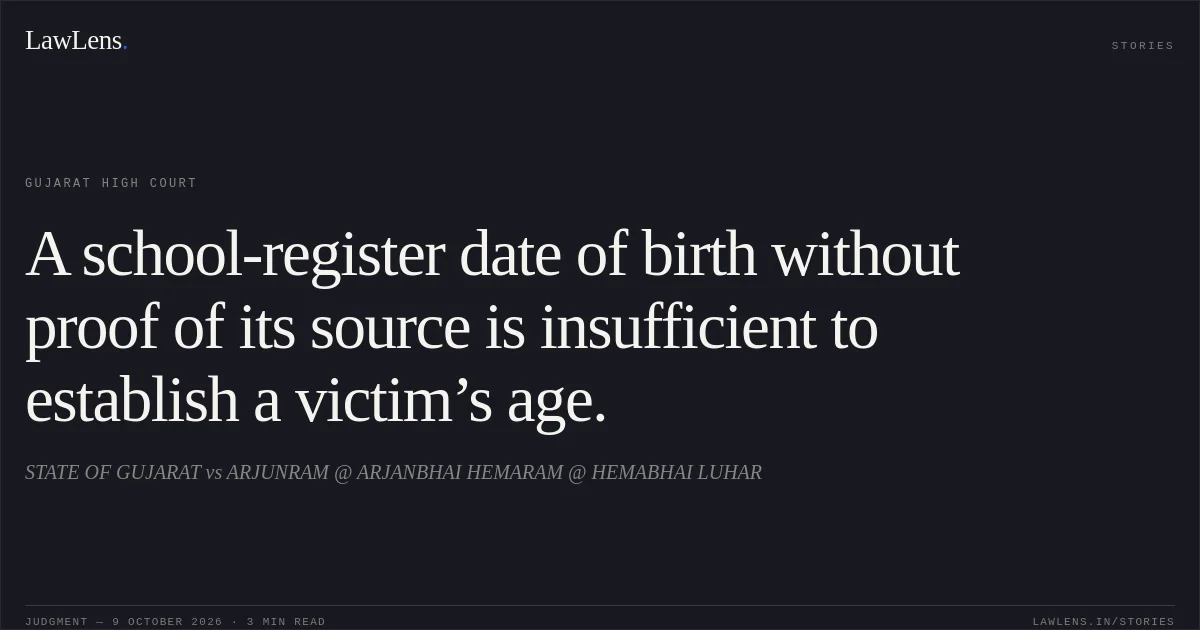
Source reference: para. 23, 26Relying on Alamelu v. State and Birka Shiva v. State of Telangana, the Court stated that a school certificate or register entry, without evidence establishing the basis of the recorded date of birth, may be insufficient to prove age.
Source reference: para. 23, 25–26On an appeal against acquittal, the appellate court should respect the reinforced presumption of innocence and avoid interference where the acquittal reflects a reasonable possible view; interference is justified where the judgment is perverse or compelling circumstances exist.
Source reference: para. 14, 24Reasoning
The school register recorded the victim’s date of birth as 20 May 2007, but the principal could not identify the source of that entry, and the medical evidence provided only age estimates; the Court therefore found her minority unproved.
Source reference: para. 16–19The victim’s trial testimony—that she was threatened and abducted—was materially inconsistent with her police statement that she liked the accused and left voluntarily, and her Section 164 statement did not mention the alleged threat.
Source reference: para. 19The Court also noted the absence of call-detail records, the lack of injuries or signs of binding, and medical evidence that established pregnancy and sexual relations but not force.
Source reference: para. 20–21In these circumstances, the evidence did not establish the essential allegations beyond reasonable doubt, and the POCSO presumptions could not be invoked without proof of minority.
Source reference: para. 22The trial court’s assessment was a reasonable view of the evidence, not a perverse one.
Source reference: para. 27Holding
The Court held that the prosecution had not reliably proved the victim’s minority or established forcible abduction or non-consensual sexual relations.
Finding no perversity or compelling basis to interfere with the acquittal, it dismissed the State’s appeal at the admission stage.
Source reference: para. 22, 27–28Acts & Sections Cited
15 provisions across 5 statutes referred to in this judgment. Each provision opens on LawLens.
Bharatiya Nagarik Suraksha Sanhita, 20231
Code of Criminal Procedure, 19734
Indian Penal Code, 18603
Protection of Children from Sexual Offences Act, 20126
Juvenile Justice (Care and Protection of Children) Act, 2015.1
Original Court PDF
STATE OF GUJARATvsARJUNRAM @ ARJANBHAI HEMARAM @ HEMABHAI LUHAR
Click to open original judgment
Original judgment, available to read, download and summarize on LawLens.in