01Facts
Late Adiram Patia owned 7 Bighas 14 Lechas of land covered by P.P. No. 6, Dag No. 32/353/334.
p. 3 · ¶ 3In 1969, he executed a registered Gift Deed No. 1987 in favour of his minor grandson, Bimal Chandra Bora, gifting 3 Bighas 2 Kathas 17 Lechas.
p. 3 · ¶ 3Bimal’s father, Ranjit Bora, managed the property during Bimal’s minority and died on 5 May 1989.
p. 3 · ¶ 4Thereafter, certain defendants allegedly occupied 3 Kathas and constructed a Namghar, while Mahendra Bordoloi allegedly dispossessed Bimal from 2 Bighas 4 Kathas 17 Lechas and cultivated the land.
p. 3 · ¶ 5–7Mahendra Bordoloi and other defendants contended that Adiram Patia had exchanged the disputed land with land belonging to Purnakanta Lalung, predecessor of Mahendra, and that the revenue records had not been corrected due to departmental error.
p. 3 · ¶ 8The trial court declared Bimal’s right, title and interest over the gifted land and directed eviction of Mahendra Bordoloi.
p. 3 · ¶ 2, 12–14The first appellate court affirmed the decree by judgment dated 31 March 2012.
p. 3 · ¶ 2, 12–14Mahendra thereafter preferred the present Regular Second Appeal under Section 100 CPC.
p. 3 · ¶ 2, 12–1402Issues
i.Whether the courts below were justified in declaring Bimal Chandra Bora’s right, title and interest on the basis of Ext. 3, the registered Gift Deed, and whether the Gift Deed was correctly interpreted?
p. 4 · ¶ 14ii.Whether the appeal raised any substantial question of law warranting interference under Section 100 CPC?
p. 4 · ¶ 16–1803Law Applied
The Court applied Section 100 of the Code of Civil Procedure, under which a Regular Second Appeal lies only where a substantial question of law is involved.
p. 4 · ¶ 16Relying on Santosh Hazari v. Purushottam Tiwari, (2001) 3 SCC 179, the Court held that a substantial question of law must be debatable, must not be settled by binding law, must materially affect the parties’ rights, and must arise from the pleadings and sustainable findings of the courts below.
p. 4 · ¶ 16The Court further reiterated that the first appellate court is ordinarily the final court on questions of fact and that pure findings of fact cannot be reappreciated in second appeal unless a genuine substantial question of law arises.
p. 4 · ¶ 17Provisions in the judgment · 1 · Linked ones open on LawLens
Code of Civil Procedure, 1908 Section 100
04Reasoning
The registered Gift Deed relied upon by Bimal was proved before the trial court.
p. 5 · ¶ 18The appellant’s challenge essentially required reconsideration of the factual circumstances surrounding the gift, the alleged exchange, possession, and the competing claims to title.
p. 5 · ¶ 18The High Court held that these matters had already been considered by the courts below and did not disclose a substantial question of law.
p. 5 · ¶ 18The framed question concerning the interpretation and effect of Ext. 3 was, in substance, directed at reappreciating evidence and factual findings, which was impermissible in a second appeal under Section 100 CPC.
p. 5 · ¶ 18Consequently, the concurrent findings recognising Bimal’s title and directing eviction were not open to interference.
p. 5 · ¶ 1805Holding
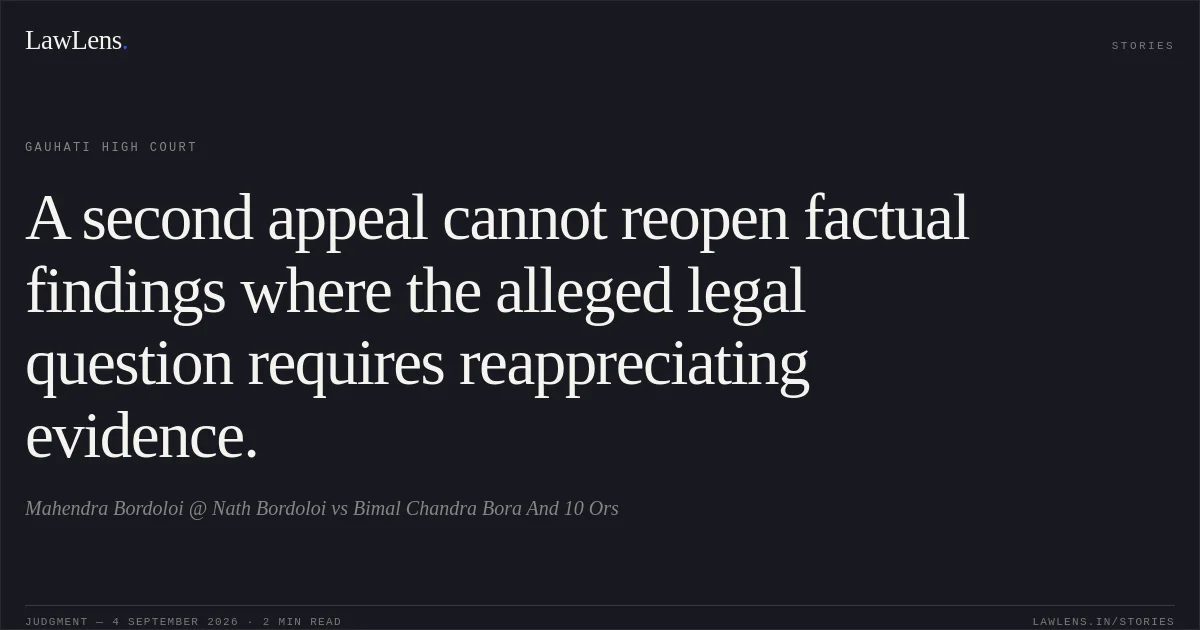
The High Court answered the substantial-question inquiry against the appellant, holding that the appeal did not involve any substantial question of law.
p. 5 · ¶ 19The challenge to the registered Gift Deed and the concurrent factual findings of the courts below was rejected.
p. 5 · ¶ 19The Regular Second Appeal was accordingly dismissed, and the Trial Court Record was directed to be sent back.
p. 5 · ¶ 19Original Court PDF
Mahendra Bordoloi @ Nath BordoloivsBimal Chandra Bora And 10 Ors
Click to open original judgment
Original judgment, available to read, download and summarize on LawLens.in