Facts
Opposite Party No. 2 alleged that her daughter, Anuradha Devi, married petitioner No. 1 on 11 May 2013 and was thereafter subjected to dowry-related cruelty and demands for a motorcycle and ₹25,000. It was further alleged that Anuradha was killed on 10 November 2013 and that her body was concealed or disposed of by her husband and in-laws.
Source reference: para. 4Prior to the impugned proceeding, Bhagwanpur P.S. Case No. 219 of 2013 had been registered on 11 November 2013 under Sections 304-B and 34 IPC against the same petitioners concerning Anuradha’s death. The case was investigated, charge-sheeted, tried as Sessions Trial No. 118 of 2015, and culminated in the petitioners’ acquittal on 6 November 2015.
Source reference: paras. 6–7, 21–22Despite the earlier prosecution, Opposite Party No. 2 filed Complaint Case No. 448 of 2014 concerning the same death and substantially the same allegations. The complaint was forwarded for investigation, resulting in registration of Mahila (Saran) P.S. Case No. 7 of 2017. The police submitted a closure report describing the case as a “mistake of law,” but the Magistrate took cognizance on 23 April 2018 under Sections 304-B, 201 and 34 IPC and Section 4 of the Dowry Prohibition Act.
Source reference: paras. 2, 8–9The petitioners consequently invoked Section 482 CrPC to quash the subsequent proceeding.
Source reference: no citationIssues
Whether the subsequent complaint and FIR concerning Anuradha Devi’s death constituted an impermissible second FIR and prosecution relating to the same occurrence or transaction as Bhagwanpur P.S. Case No. 219 of 2013?
Source reference: paras. 15–20, 23–25Whether continuation of the subsequent criminal proceeding, despite the earlier investigation, trial and acquittal, amounted to an abuse of the process of court warranting exercise of the High Court’s inherent jurisdiction under Section 482 CrPC?
Source reference: paras. 27–35Whether the addition of Sections 201 IPC and Section 4 of the Dowry Prohibition Act made the subsequent proceeding legally distinct from the earlier prosecution?
Source reference: para. 20Law Applied
The Court applied Section 482 CrPC, which empowers the High Court to prevent abuse of the process of court and secure the ends of justice.
Source reference: no citationRelying on T.T. Antony v. State of Kerala, (2001) 6 SCC 181, it held that a second FIR cannot ordinarily be registered in respect of the same cognizable offence, occurrence or transaction; subsequent information must be dealt with in the course of the original investigation.
Source reference: paras. 16, 19Under Babubhai v. State of Gujarat, (2010) 12 SCC 254, the “test of sameness” determines whether two FIRs concern the same incident or transaction.
Source reference: para. 17Anju Chaudhary v. State of U.P., (2013) 6 SCC 384, recognises exceptions where the subsequent FIR concerns a distinct occurrence, a counter-case, or a materially different offence or transaction.
Source reference: para. 18The Court also relied on Rutvij Bhagat Singh Wakhare v. State of Maharashtra, 2026 SCC OnLine SC 1384, and the principles concerning unity of purpose and design, proximity of time and place, and continuity of action in determining whether acts form part of the same transaction.
Source reference: para. 19The bar against successive FIRs was distinguished from the statutory protection against double jeopardy under Section 300 CrPC.
Source reference: para. 29Reasoning
The Court compared the factual foundation of both proceedings rather than merely the statutory provisions invoked. It found that both cases related to the death of the same deceased, involved substantially the same accused persons, arose from the same matrimonial and dowry-related allegations, and concerned the same occurrence.
Source reference: paras. 21–24Applying the test of sameness, the Court held that the subsequent case did not disclose a separate or distinct incident. It was not a counter-case or rival version but a later prosecution initiated by the complainant side in respect of an occurrence already investigated and tried.
Source reference: para. 25The addition of Section 201 IPC and Section 4 of the Dowry Prohibition Act did not alter the factual substratum or create a distinct transaction.
Source reference: para. 20Since the earlier case had already proceeded to trial and ended in acquittal, continuation of the later proceeding would subject the petitioners to a second investigation and prosecution concerning the same occurrence, thereby constituting an abuse of process.
Source reference: paras. 26–31Holding
The High Court answered the issues in favour of the petitioners.
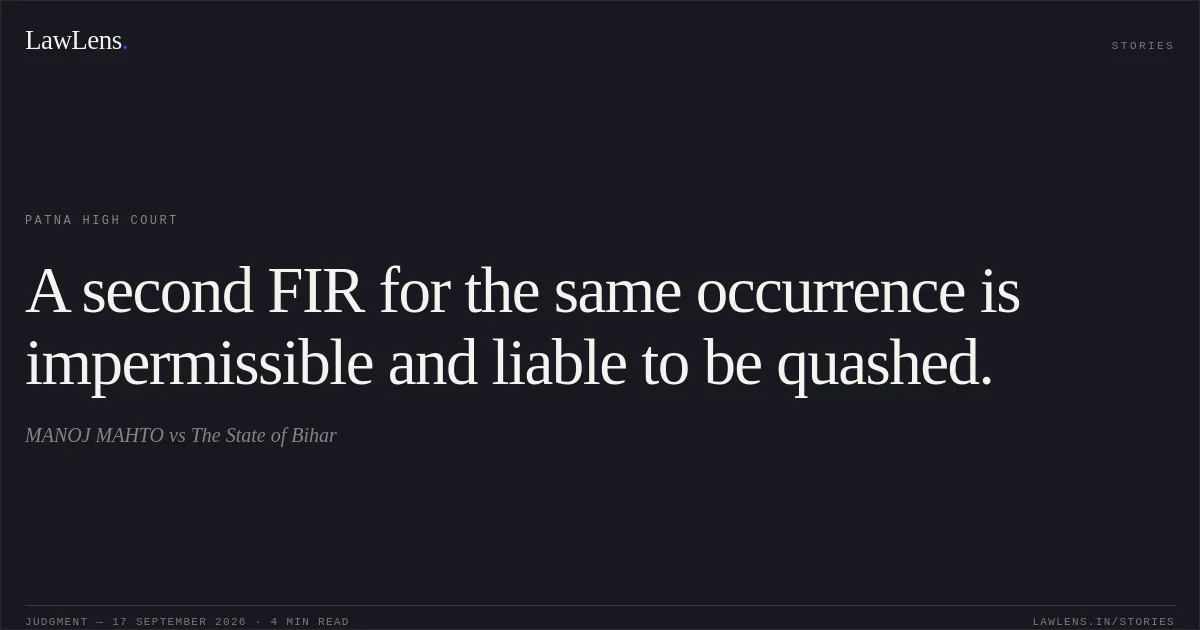
It held that Mahila (Saran) P.S. Case No. 7 of 2017, arising from Complaint Case No. 448 of 2014, was substantially founded on the same occurrence as Bhagwanpur P.S. Case No. 219 of 2013 and therefore amounted to an impermissible second FIR and prosecution.
Source reference: paras. 32–34Exercising jurisdiction under Section 482 CrPC, the Court quashed the entire subsequent criminal proceeding, including the order dated 23 April 2018 taking cognizance and all consequential proceedings, insofar as they related to the five petitioners.
Source reference: para. 35The application was accordingly allowed.
Source reference: para. 36Acts & Sections Cited
19 provisions across 4 statutes referred to in this judgment. Each provision opens on LawLens.
Indian Penal Code, 18605
Dowry Prohibition Act, 19611
Code of Criminal Procedure, 1973
Bharatiya Nagarik Suraksha Sanhita, 20231
Original Court PDF
MANOJ MAHTOvsThe State of Bihar
Click to open original judgment
Original judgment, available to read, download and summarize on LawLens.in