Facts
National Highways Logistics Management Ltd. and Jawaharlal Nehru Port Trust undertook development of a Multi Modal Logistics Park at Sindhi, Nagpur through the respondent no.1 Special Purpose Vehicle. Following a tender process, the petitioner was incorporated as concessionaire and entered into a Concession Agreement dated 12 December 2023, granting it the right to design, finance, operate and maintain the project for 45 years.
Source reference: paras. 2(a)–(c), pp. 2–3Phase I was to be completed by 10 July 2026, subject to contractual milestone provisions and termination rights. After the petitioner deposited performance security, achieved financial closure and received possession of land, 11 July 2024 was declared the appointed date.
Source reference: paras. 2(c)–(f), pp. 2–4; para. 2(d), p. 3The respondent no.1 terminated the Concession Agreement on 18 September 2025. The petitioner filed an earlier Section 9 petition, O.M.P.(I)(COMM) 417/2025, seeking reliefs including stay of termination and restraint against further action. By order dated 2 December 2025, the Court declined interim relief and directed the parties to constitute an arbitral tribunal, with the First Petition to be treated as an application under Section 17 of the Arbitration and Conciliation Act, 1996.
Source reference: paras. 2(g)–(h), pp. 4–5; para. 25, p. 12Meanwhile, respondent no.1 issued a fresh NIT on 9 October 2025 for the balance works. Respondent no.2 qualified in the re-tendering process, its financial bid was accepted, and a Letter of Award was issued in its favour on 18 March 2026.
Source reference: paras. 2(i)–(j), pp. 4–5; para. 26, p. 12The petitioner thereafter filed the present second Section 9 petition seeking, inter alia, restraint against execution of the fresh contract, maintenance of status quo, stay of termination, and permission to continue and complete the project.
Source reference: paras. 3–7, pp. 5–6; paras. 27–29, pp. 12–15Issues
Whether the present Section 9 petition was maintainable when substantially identical interim reliefs had already been sought and declined in the petitioner’s earlier Section 9 petition?
Source reference: paras. 24–29, pp. 11–15; para. 35, p. 21Whether the interim status quo order dated 19 May 2026 should continue, and whether the petitioner could be permitted to restrain respondent no.1 from proceeding with the re-tendering or from entering into a contract with respondent no.2?
Source reference: paras. 21–23, pp. 10–11; paras. 30–33, pp. 15–18Whether an injunction should be granted in relation to a project potentially falling within the statutory protection accorded to infrastructure projects under Sections 20A and 41(ha) of the Specific Relief Act, 1963?
Source reference: paras. 32–35, pp. 17–21Whether Clause 36.9 of the Concession Agreement entitled the petitioner to continue executing the project during the pendency of proceedings challenging termination?
Source reference: para. 31, pp. 15–17Law Applied
The Court applied Section 9 of the Arbitration and Conciliation Act, 1996, which permits interim measures before, during or after arbitral proceedings, while recognising that such relief is discretionary and cannot ordinarily be used to keep a terminated commercial contract alive. Section 17 of the Act was relevant because the earlier Section 9 proceedings had been directed to be treated as an application before the arbitral tribunal.
Source reference: no citationSections 20A and 41(ha) of the Specific Relief Act, 1963 embody the principle that injunctions should not be granted where they would impede or delay the progress or completion of an infrastructure project.
Source reference: no citationClause 36.9 of the Concession Agreement permitted the authority to engage another entity to complete the project during pending judicial or arbitral proceedings, while requiring restoration of the concessionaire’s position if termination was subsequently set aside.
Source reference: no citationThe Court relied on Time Cinemas and Entertainment Pvt. Ltd. v. Venus Infrastructure and Developers Pvt. Ltd., RFA No. 3416/2021, decided on 21 April 2022, for the proposition that a subsequent Section 9 application seeking substantially identical reliefs is not maintainable after such reliefs were dealt with in an earlier proceeding, and on National Highways Authority of India v. Roadways Solutions India Infra Ltd., FAO(OS)(COMM) 4/2026, decided on 13 January 2026, for the principle that courts should ordinarily refrain from restraining continuation of infrastructure works, leaving monetary compensation for arbitral determination.
Source reference: paras. 34–35, pp. 18–21Reasoning
The Court found that the petitioner had already sought substantially the same reliefs in the First Petition, including stay of termination, restraint against consequential action, permission to continue the project, and restraint against engaging a third party. Those reliefs had not been granted; instead, the petitioner was relegated to the arbitral tribunal under Section 17.
Source reference: paras. 25, 27–29, pp. 12–15Recasting the same reliefs in a second Section 9 petition was held to be an impermissible attempt to obtain indirectly what had earlier been refused.
Source reference: para. 29, p. 15The petitioner had also known of the fresh NIT and its progression but did not challenge the process promptly; it approached the Court only after respondent no.2 had been selected and the Letter of Award issued, which adversely affected its plea for discretionary relief.
Source reference: para. 26, p. 12; para. 36, p. 22On the merits, Clause 36.9 expressly allowed respondent no.1 to appoint another contractor and complete the balance works notwithstanding pending proceedings. The Court interpreted the clause harmoniously: the authority could proceed with the infrastructure project, while the petitioner’s position could be restored if the termination were ultimately set aside; any intervening loss could be compensated through damages.
Source reference: para. 31, pp. 15–17Restraining the fresh tender or subsequent contract would risk delaying the project, contrary to the principles reflected in Sections 20A and 41(ha) of the Specific Relief Act and the authorities cited by the Court.
Source reference: paras. 32–35, pp. 17–21The Court also noted that respondent no.2 had not been served in advance despite its details being available, and that the status quo order had initially been passed without respondent no.2 having an effective opportunity of hearing.
Source reference: paras. 37–38, p. 22Holding
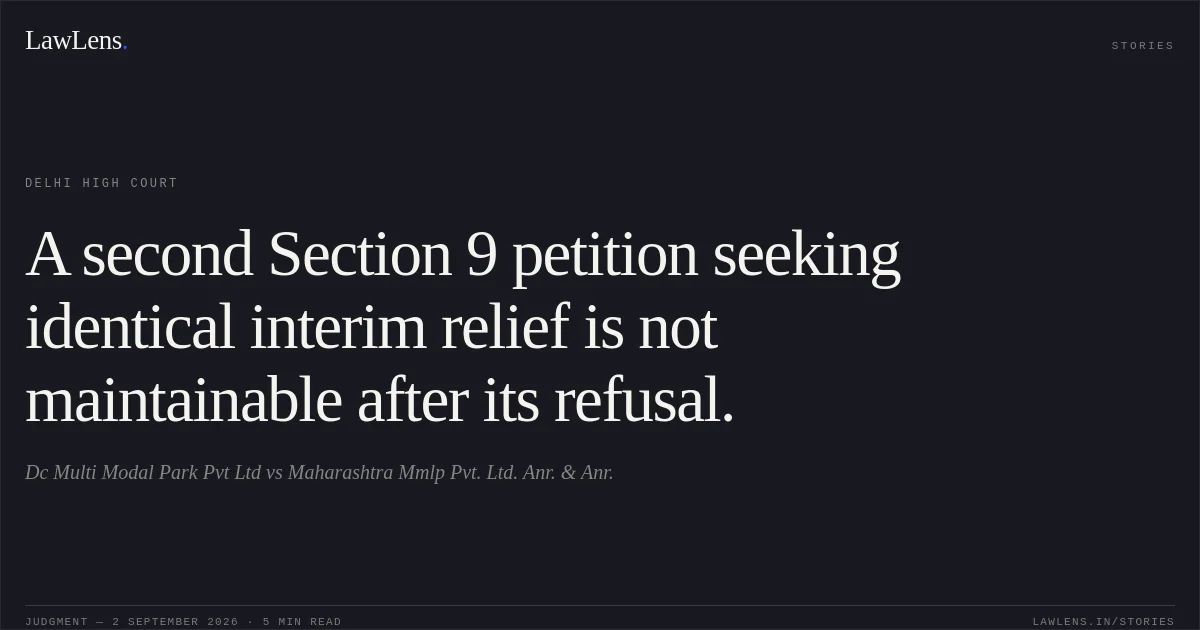
The Court held that the present petition was not maintainable, being a second Section 9 petition seeking substantially identical reliefs that had already been declined in the First Petition.
Independently, the Court found no merit in granting interim relief because the petitioner had delayed approaching the Court, Clause 36.9 permitted respondent no.1 to proceed through another entity, and restraint could impede an infrastructure project.
Source reference: paras. 31–35, pp. 15–21The status quo order dated 19 May 2026 was consequently not continued, and the petition was dismissed with costs of Rs. 1 lakh, payable by the petitioner to the Delhi High Court Staff Welfare Fund within two weeks, with proof of payment to be filed thereafter.
Source reference: paras. 39–40, p. 23Acts & Sections Cited
4 provisions across 2 statutes referred to in this judgment. Each provision opens on LawLens.
Arbitration and Conciliation Act, 19962
Specific Relief Act, 19632
Original Court PDF
Dc Multi Modal Park Pvt LtdvsMaharashtra Mmlp Pvt. Ltd. Anr. & Anr.
Click to open original judgment
Original judgment, available to read, download and summarize on LawLens.in