01Facts
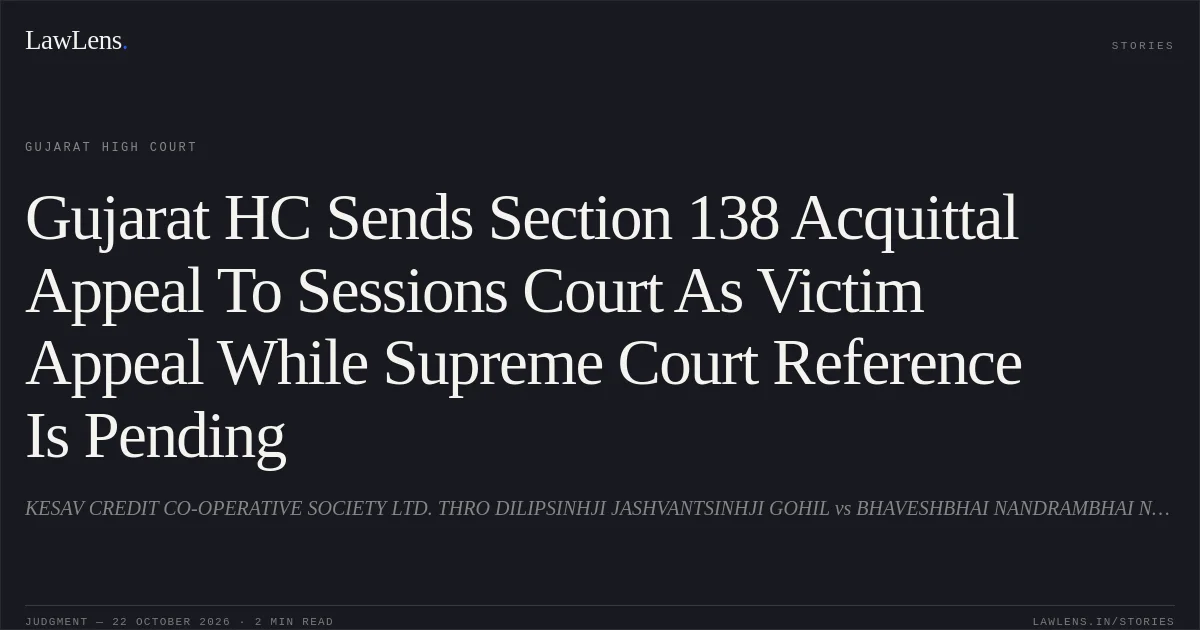
The appellant, the original complainant, filed an appeal under Section 378 of the Code of Criminal Procedure, 1973 (“CrPC”) and Section 419 of the Bharatiya Nagarik Suraksha Sanhita, 2023 (“BNSS”), challenging the judgment dated 26 November 2018 of the learned 2nd Additional Chief Judicial Magistrate, Mehsana, acquitting the accused of an offence under Section 138 of the Negotiable Instruments Act, 1881 (“NI Act”).
¶ 1 · p. 1During the hearing, the parties relied on Celestium Financial v. A. Gnanasekaran, which held that a complainant in a Section 138 prosecution is a “victim” entitled to appeal against acquittal under the proviso to Section 372 CrPC before the immediately superior court, namely, the Sessions Court.
¶ 3–4 · pp. 2–3The Court was also informed that the correctness of that decision was pending consideration before a larger Bench of the Supreme Court in Special Leave to Appeal (Crl.) No. 12350 of 2024.
¶ 6 · p. 302Issues
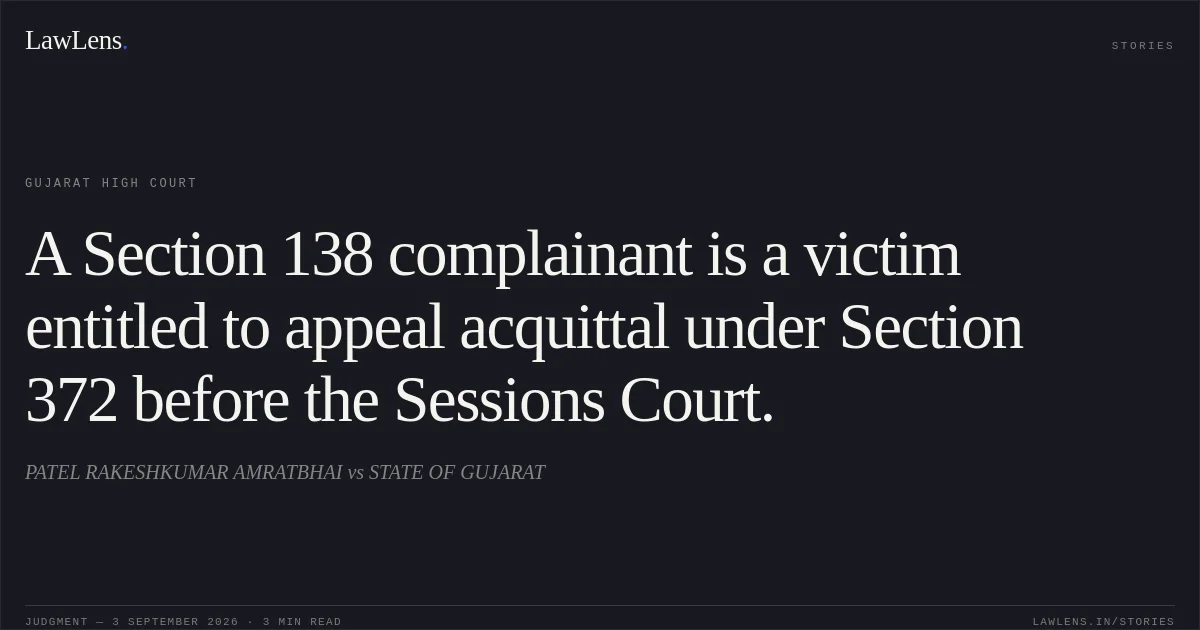
i.1. Whether the original complainant in a prosecution under Section 138 of the NI Act is a “victim” entitled to prefer an appeal against acquittal under the proviso to Section 372 CrPC / corresponding provision of the BNSS before the Sessions Court.
¶ 3–4, 7 · pp. 2–5ii.2. Whether the present appeal, filed before the High Court under Section 378 CrPC / Section 419 BNSS, should be transferred and treated as an appeal under the proviso to Section 372 CrPC / Section 413 BNSS before the concerned Sessions Court.
¶ 5–8 · pp. 2–6iii.3. Whether the appeal should be transferred subject to the final outcome of the Supreme Court’s reference concerning the complainant’s appellate remedy in Section 138 proceedings.
¶ 6 · p. 303Law Applied
The Court applied Section 138 of the NI Act, which creates the offence of dishonour of cheque, together with the appellate framework under Sections 372 and 378 CrPC and the corresponding provisions of the BNSS, namely Sections 413, 419 and related provisions.
Relying on Celestium Financial v. A. Gnanasekaran, the Court held that the payee or holder of a dishonoured cheque is the victim of the deemed offence under Section 138 and may appeal against acquittal under the proviso to Section 372 CrPC without seeking special leave under Section 378(4) CrPC; such appeal lies before the court immediately superior to the trial court, ordinarily the Sessions Court.
¶ 7 · pp. 3–5The Court also relied on Shivsinh Ganpatsinh Solanki v. State of Gujarat and Thakar Hariprasad Dalsukhram v. State of Gujarat, 2026 SCC OnLine Guj 569, concerning transfer of such appeals to the competent Sessions Court.
¶ 4, 8 · pp. 2, 5–6Provisions in the judgment · 9 · Linked ones open on LawLens
Code of Criminal Procedure, 1973 Section 378Section 372Section 374Section 200Section 2
Bharatiya Nagarik Suraksha Sanhita, 2023 Section 419Section 413
Negotiable Instruments Act, 1881 Section 138Section 143
04Reasoning
The High Court did not examine the merits of the acquittal.
In light of the decisions treating a Section 138 complainant as a victim, it concluded that the appropriate appellate forum was the concerned Sessions Court rather than the High Court exercising jurisdiction under Section 378 CrPC / Section 419 BNSS.
¶ 3–5, 8 · pp. 2–6Although the Supreme Court’s larger-Bench consideration of the issue was pending, the Court directed transfer in accordance with the prevailing legal position, with the matter remaining subject to the final outcome of that reference.
¶ 6 · p. 3The appeal was therefore required to be recharacterised and numbered as a victim’s appeal under the proviso to Section 372 CrPC / Section 413 BNSS.
¶ 8 · p. 505Holding
The High Court disposed of the appeal without adjudicating its merits and directed the Registry to transfer the entire record, including the impugned order and record and proceedings, to the concerned Sessions Court.
¶ 8 · p. 5The Sessions Court was directed to treat and number the matter as an appeal under the proviso to Section 372 CrPC / Section 413 BNSS and to issue notice to the parties.
¶ 8 · p. 5It was further directed to endeavour to dispose of the matter expeditiously, and the transfer was expressly made subject to the final decision of the Supreme Court on the pending reference.
¶ 6, 8–9 · pp. 3, 5–6Original Court PDF
PATEL RAKESHKUMAR AMRATBHAIvsSTATE OF GUJARAT
Click to open original judgment
Original judgment, available to read, download and summarize on LawLens.in