Facts
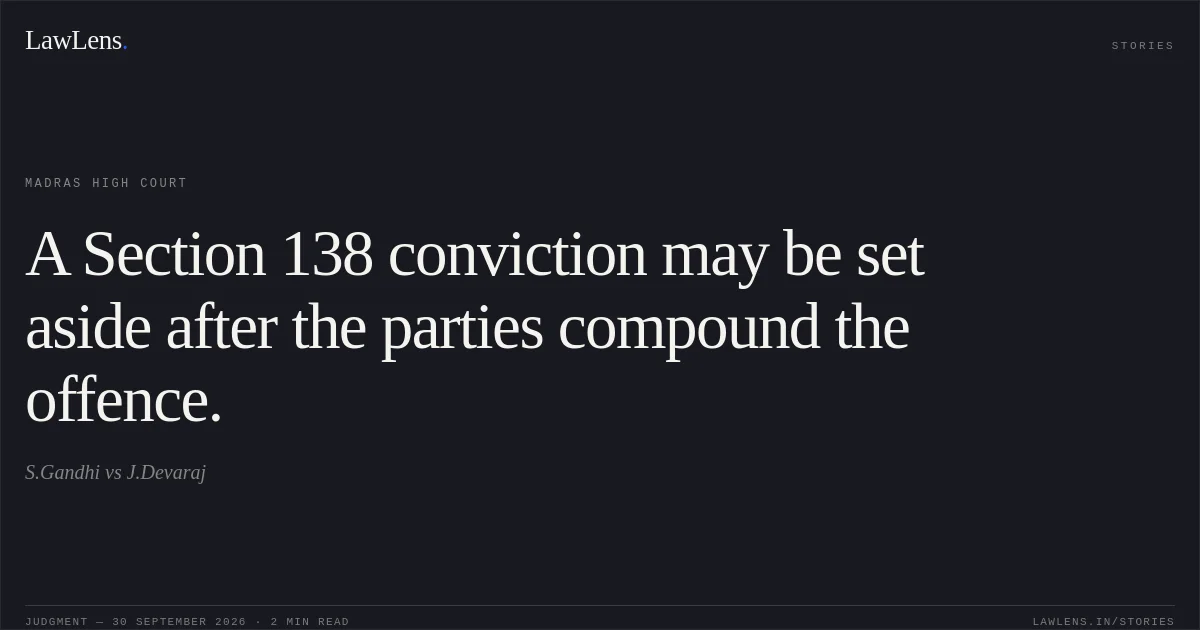
The petitioner was convicted under Section 138 of the Negotiable Instruments Act, 1881, and sentenced by the Principal District Munsif-cum-Judicial Magistrate, Gudalur, to one year’s simple imprisonment, with compensation of ₹3,00,000.
Source reference: pp. 1–2The appellate court upheld the conviction, substantive sentence and compensation, but set aside the fine.
Source reference: pp. 1–2While the petitioner was in prison, the parties entered into a joint compromise: the respondent accepted ₹1,80,000 in full and final settlement, comprising ₹1,50,000 already received and ₹30,000 deposited to the trial court’s credit, which he agreed to withdraw.
Source reference: pp. 2–3Issues
Whether the parties’ compromise permitted the offence under Section 138 of the Negotiable Instruments Act to be compounded and the conviction and sentence set aside
Source reference: p. 5Whether, following compounding and acquittal, the petitioner was entitled to release and the respondent to withdraw the deposited amount
Source reference: p. 6Law Applied
Section 138 of the Negotiable Instruments Act, 1881, criminalises the dishonour of a cheque in the circumstances prescribed by that provision.
Source reference: p. 5Section 147 of the Act makes offences under the Act compoundable.
Source reference: p. 5The revision petition was presented under Sections 438 and 442 of the Bharatiya Nagarik Suraksha Sanhita, 2023, as stated in the prayer.
Source reference: p. 1Reasoning
The Court took the signed joint compromise memo on record, noted the respondent’s personal appearance and identification, and recorded that he had accepted ₹1,50,000 and agreed to withdraw the remaining ₹30,000 deposited in the trial court.
Source reference: pp. 2–5In view of the compromise and the nature of the offence, the Court permitted compounding, set aside the conviction and sentence, and acquitted the petitioner.
Source reference: pp. 5–6Holding
The revision petition was allowed on the terms of the compromise, and the petitioner was acquitted of the offence under Section 138 of the Negotiable Instruments Act.
The Superintendent of the Central Prison, Coimbatore, was directed to release him forthwith; any fine paid was to be refunded, any bail bond discharged, and the respondent was permitted to withdraw ₹30,000 deposited to the credit of the trial case.
Source reference: p. 6Acts & Sections Cited
3 provisions across 2 statutes referred to in this judgment. Each provision opens on LawLens.
Bharatiya Nagarik Suraksha Sanhita, 20232
Negotiable Instruments Act, 18811
Original Court PDF
S.GandhivsJ.Devaraj
Click to open original judgment
Original judgment, available to read, download and summarize on LawLens.in