Facts
The complainant alleged that the accused borrowed ₹45,000, agreed to repay it by 11 August 2013, and issued a cheque that was dishonoured for insufficient funds.
Source reference: p. 2–3The complainant sent a demand notice, but the accused did not pay; he admitted issuing the cheque, its dishonour, and service of notice, while asserting that the cheque had been issued in 2003
Source reference: p. 2–3The trial court acquitted the accused, finding a material alteration to the cheque’s date.
Source reference: p. 3The complainant appealed, contending that the alteration was initialled by the accused
Source reference: p. 4Issues
Whether the trial court’s acquittal based on the alleged material alteration to the cheque warranted appellate interference
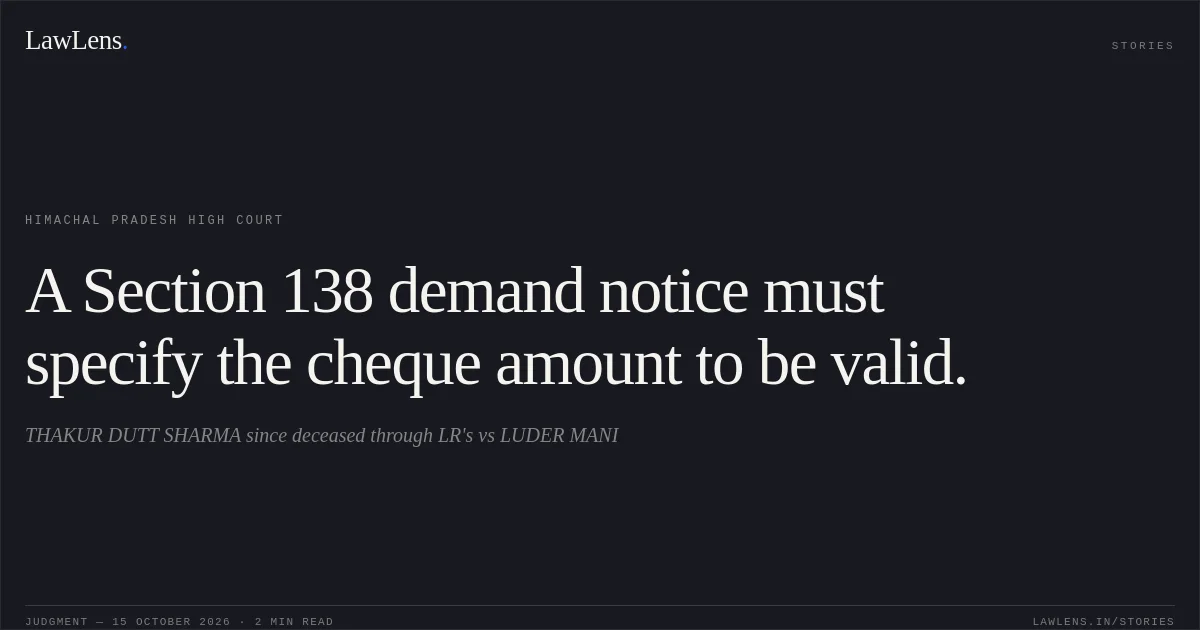
Source reference: p. 12–13Whether the demand notice was valid under Section 138 of the Negotiable Instruments Act when it did not specify the cheque amount
Source reference: p. 13–15Law Applied
Section 138 of the Negotiable Instruments Act requires, among other things, a cheque issued towards a legally enforceable debt or liability, its timely presentation and dishonour, a written demand for payment, and the drawer’s failure to pay within the prescribed period
Source reference: p. 10–12Sections 118 and 139 provide presumptions in favour of the cheque holder, which the accused may rebut on a preponderance of probabilities; the appellate court may assess whether the defence has displaced those presumptions
Source reference: p. 9–10An acquittal is not ordinarily disturbed where the trial court’s view is a reasonable one, though the appellate court may intervene where it is perverse or wholly unsustainable; the presumption of innocence is strengthened by acquittal
Source reference: p. 5–9; p. 9–10Under Kaveri Plastics v. Mahdoom Bawa Bahrudeen Noorul, (2025) 259 Comp Cas 658, a statutory demand notice under Section 138 must specify the cheque amount; omission of that amount renders the notice invalid
Source reference: p. 13–15Reasoning
The High Court held that the trial court was wrong to treat the alteration of the cheque date as unauthorised because the alteration was initialled by the accused
Source reference: p. 12However, the demand notice merely required the accused to pay “his money” and did not state the amount payable
Source reference: p. 13–14Applying Kaveri Plastics, the Court found that this omission failed to satisfy an essential requirement of Section 138, independently supporting the acquittal.
Source reference: p. 15Accordingly, the acquittal did not warrant appellate interference
Source reference: p. 15Holding
The appeal was dismissed, and the acquittal was left undisturbed because the demand notice did not specify the cheque amount
The respondent was directed to furnish a bail bond of ₹50,000 with one surety for six months in accordance with Section 437A of the Code of Criminal Procedure
Source reference: p. 15–16Acts & Sections Cited
6 provisions across 3 statutes referred to in this judgment. Each provision opens on LawLens.
Negotiable Instruments Act, 18813
Code of Criminal Procedure, 19732
Bharatiya Nagarik Suraksha Sanhita, 20231
Original Court PDF
THAKUR DUTT SHARMA since deceased through LR'svsLUDER MANI
Click to open original judgment
Original judgment, available to read, download and summarize on LawLens.in