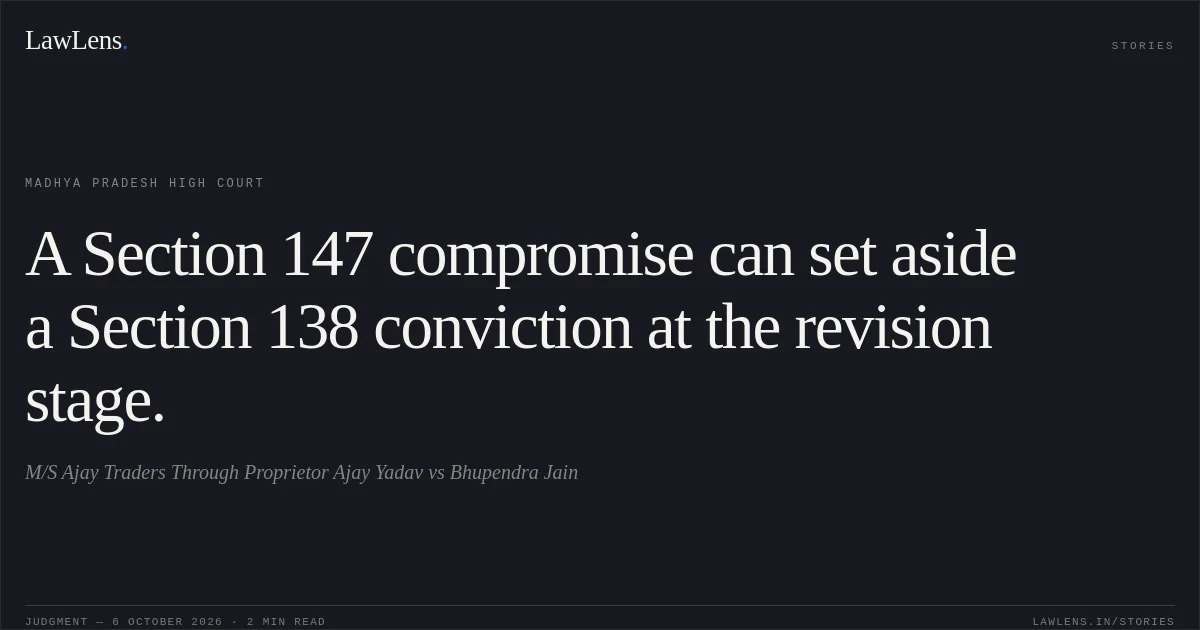
Facts
The applicant was convicted under Section 138 of the Negotiable Instruments Act, 1881, and sentenced to six months’ rigorous imprisonment with a fine of ₹2,19,200.
Source reference: no citationThe Sessions Court partly allowed the applicant’s appeal and modified the trial court’s judgment.
Source reference: no citationIn revision, the parties reported that they had amicably settled the dispute, the respondent had received the entire amount, and they filed an application for compromise under Section 147 of the NI Act.
Source reference: para. 1, 3The applicant relied on Gian Chand Garg v. Harpal Singh & Anr., which addressed the effect of a full-and-final settlement on Section 138 proceedings.
Source reference: para. 2Issues
1. Whether the parties’ settlement and the respondent’s receipt of the full amount justified compounding the Section 138 offence and setting aside the concurrent judgments.
Source reference: para. 3, 62. Whether, given that the compromise was reached at the revision stage, costs should be imposed under the principles in Damodar S. Prabhu v. Sayed Babalal H.
Source reference: para. 4–5, 7Law Applied
Section 147 of the NI Act permits compounding of offences under the Act.
Source reference: no citationIn Gian Chand Garg v. Harpal Singh & Anr., the Court relied on the principle that proceedings under Section 138 cannot continue where the complainant has accepted the amount in full and final settlement.
Source reference: para. 2Under Damodar S. Prabhu v. Sayed Babalal H., (2010) 5 SCC 663, costs may be imposed on a graded basis for delayed compounding; the suggested rate for compounding before a Sessions Court or High Court in appeal or revision is 15% of the cheque amount.
Source reference: para. 4–5The competent court may, however, vary the suggested costs in its discretion, recording reasons for doing so.
Source reference: para. 4–5Reasoning
The Court found that the dispute was private in nature, the parties had voluntarily settled it, and the respondent had received the entire amount. Applying Section 147 and the settlement principle stated in Gian Chand Garg, it accepted the compromise and set aside the lower courts’ judgments.
Source reference: para. 6Because settlement occurred at the revision stage, the Court also considered Damodar S. Prabhu and imposed costs. Although that decision suggests 15% for compounding at the High Court revision or appeal stage, the Court directed payment of 1% of the cheque amount—₹1,500—without expressly explaining the departure from the suggested rate.
Source reference: para. 5, 7Holding
The revision was allowed on the basis of the compromise; the judgments below were set aside and the applicant was acquitted of the Section 138 offence, subject to payment of ₹1,500 to the High Court Legal Services Authority, Indore within ten days.
The applicant’s bail bonds were to be discharged upon compliance. If the amount was not deposited within the prescribed period, the acquittal would not enure to the applicant’s benefit, and he would remain liable to undergo the sentence in accordance with law.
Source reference: para. 8–9The respondent was permitted to withdraw any fine amount deposited by the applicant.
Source reference: para. 12Acts & Sections Cited
5 provisions across 3 statutes referred to in this judgment. Each provision opens on LawLens.
Bharatiya Nagarik Suraksha Sanhita, 20232
Negotiable Instruments Act, 18812
Code of Criminal Procedure, 19731
Original Court PDF
M/S Ajay Traders Through Proprietor Ajay YadavvsBhupendra Jain
Click to open original judgment
Original judgment, available to read, download and summarize on LawLens.in
![HRA parity claims must be assessed against similarly situated employees, with reasoned orders where parity is denied.. Shaphaba Thokchom vs DY. COMPTROLLER AND AUDITOR GENERAL OF INDIA. CAT - ['Guwahati']. LawLens](/stories/thumbnails/hra-parity-claims-must-be-assessed-against-similarly-situated-employees-with-reasoned-orde-a9c45995b0704be18e4bcf7b91c8e507.webp)
![Article 311(2)(c) dismissal is valid where relevant material shows an inquiry would endanger security sources.. Mohd Rafi vs GENERAL ADMINITRATIVE DEPARTMENT. CAT - ['Jammu']. LawLens](/stories/thumbnails/article-311-2-c-dismissal-is-valid-where-relevant-material-shows-an-inquiry-would-endanger-58dabaa9372a4b41bd304e91e9ebe890.webp)