Facts
On 7 January 2006, officers of the electricity authority inspected premises at Santkutir, Nageswar, Jamnagar, where the residential electricity meter standing in the name of Bhagirathiben Kalyansinh Bhandari was allegedly not recording consumption.
Source reference: paras. 2, 10The prosecution alleged that a plastic factory operated behind the residence by the respondent, her son, was drawing electricity directly from the residential connection through a cable and other apparatus, resulting in alleged theft of 5.285 kW of electricity valued at Rs. 2,70,017.82 under Section 135 of the Electricity Act, 2003.
Source reference: paras. 2, 10A written complaint was forwarded to the GEB Police Station, and the FIR was registered on 28 February 2006 as II-C.R. No. 137 of 2006, nearly two months after the inspection.
Source reference: para. 11The respondent was charged under Section 135 of the Act; after the prosecution examined five witnesses and produced eight documents, and the respondent denied the allegations in his Section 313 CrPC statement, the Special Court, Jamnagar acquitted him on 12 September 2012 in Special (GEB) Case No. 59 of 2009.
Source reference: paras. 2.3–5The State challenged the acquittal under Section 378(1)(3) CrPC.
Source reference: para. 1Issues
1. Whether the trial Court was justified in acquitting the respondent of the offence under Section 135 of the Electricity Act, 2003
Source reference: para. 9(1)2. Whether the trial Court properly appreciated the oral and documentary evidence led by the prosecution
Source reference: para. 9(2)3. Whether the impugned judgment suffered from illegality, irregularity, perversity, or any other infirmity warranting appellate interference
Source reference: para. 9(3)Law Applied
The Court applied Section 135 of the Electricity Act, 2003, which criminalises dishonest abstraction, consumption, or use of electricity, including through unauthorised connections or tampering with meters.
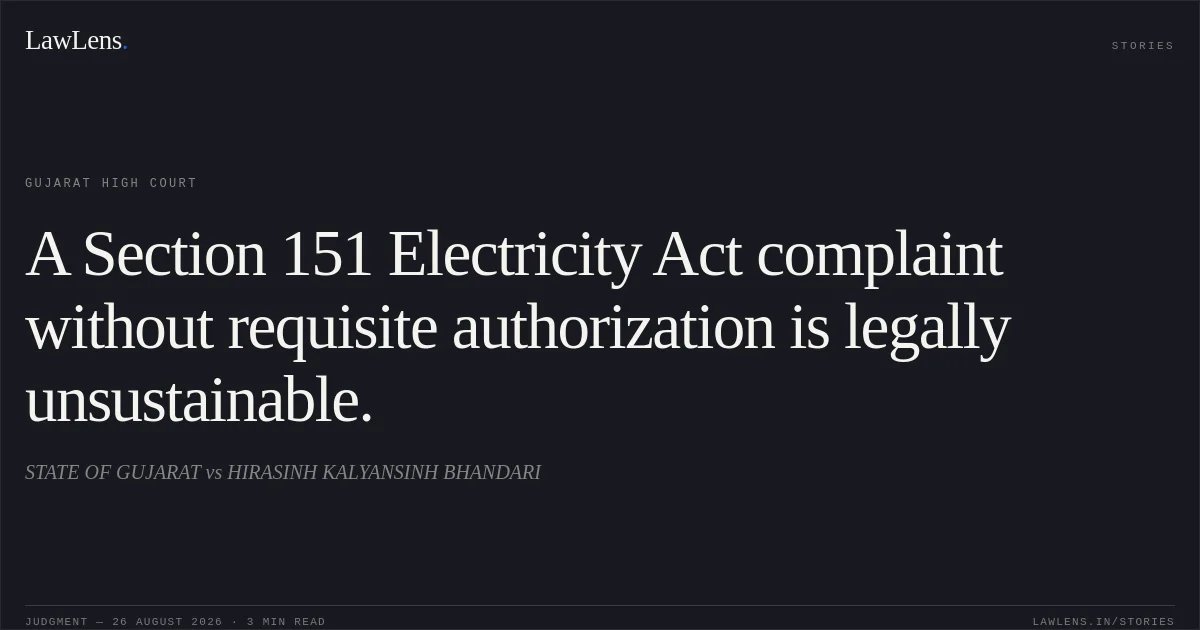
Source reference: para. 8It also considered Section 151 of the Electricity Act, under which cognizance of offences under the Act requires a complaint by an authorised person or an authorised governmental/electricity authority; a complaint unsupported by the requisite authorisation is not legally sustainable.
Source reference: paras. 11, 13The Court further applied the principles governing appeals against acquittal under Section 378 CrPC: an appellate court may review and reappreciate the evidence, but an acquitted accused enjoys a reinforced or “double presumption” of innocence, and where two reasonable views are possible, the acquittal should not be disturbed.
Source reference: paras. 14–17These principles were drawn principally from Chandrappa v. State of Karnataka, (2007) 4 SCC 415; Rajesh Prasad v. State of Bihar, (2022) 3 SCC 471; Babu Sahebagouda Rudragoudar v. State of Karnataka, (2024) 8 SCC 149; and Ramesh v. State of Karnataka, (2024) 9 SCC 169.
Source reference: paras. 16–17Reasoning
The High Court found that the prosecution evidence did not establish the respondent’s guilt beyond reasonable doubt.
Source reference: paras. 11–19The prosecution witnesses admitted that the FIR was registered after an unexplained delay of almost two months, no panchnama was prepared at the inspection site, and neither the alleged electric cable nor other apparatus was recovered or produced before the Investigating Officer or trial Court.
Source reference: paras. 11–12The evidence also failed to establish the respondent’s ownership or occupation of the premises where the alleged factory was operating.
Source reference: para. 12Additionally, the complainant had not obtained or demonstrated the authorisation required under Section 151 of the Electricity Act, rendering the prosecution legally unsustainable according to the authorities relied upon by the Court.
Source reference: paras. 11, 13In light of these evidentiary deficiencies and the reinforced presumption arising from the acquittal, the trial Court’s view was held to be reasonable and neither perverse nor manifestly illegal.
Source reference: paras. 13–19Holding
The High Court answered the issues in favour of the respondent and held that the trial Court had correctly appreciated the evidence and law.
Finding no illegality, perversity, or infirmity warranting interference with the acquittal, it dismissed the State’s appeal and confirmed the judgment and order dated 12 September 2012 acquitting the respondent under Section 135 of the Electricity Act, 2003.
Source reference: paras. 18–20The bail bond was cancelled, and the record and proceedings were directed to be returned to the trial Court.
Source reference: para. 20Acts & Sections Cited
4 provisions across 2 statutes referred to in this judgment. Each provision opens on LawLens.
Code of Criminal Procedure, 19732
Electricity Act, 20032
Original Court PDF
STATE OF GUJARATvsHIRASINH KALYANSINH BHANDARI
Click to open original judgment
Original judgment, available to read, download and summarize on LawLens.in
![Courts will not interfere with transfers absent mala fides or violation of statutory rules.. M Ramya vs EMPLOYEES STATE INSURANCE CORPORATION (ESIC). CAT - ['Chennai']. LawLens](/stories/thumbnails/courts-will-not-interfere-with-transfers-absent-mala-fides-or-violation-of-statutory-rules-a6845e9ca6f548fca284c51c8351957f.webp)
![Courts cannot direct one-time recruitment age relaxation absent authority in the governing rules or advertisement.. UT OF PUDUCHERRY vs M ANDAL. CAT - ['Chennai']. LawLens](/stories/thumbnails/courts-cannot-direct-one-time-recruitment-age-relaxation-absent-authority-in-the-governing-895d78fde47143e2a8ed0207c4b6a44f.webp)
![A review cannot correct an allegedly erroneous decision absent an error apparent on the record.. Ajit Kumar Jha vs RAILWAY BOARD. CAT - ['Delhi']. LawLens](/stories/thumbnails/a-review-cannot-correct-an-allegedly-erroneous-decision-absent-an-error-apparent-on-the-re-8ac952fd4eba470c92f7da20af72a220.webp)