Facts
The petitioner alleged that respondent No.1, originally recorded as Alok Kumar, son of Babu Ram, had, in collusion with Panchayat and revenue officials, represented himself as the son of Swaroop Singh. The petitioner challenged various documents, including a Will dated 27.01.1999, Family Settlement Deed No. 709/2013 dated 31.08.2013, an agriculturist certificate dated 30.08.2013, and a Will dated 05.07.2016, alleging that they were fabricated and procured by fraud for wrongful gain.
Source reference: pp. 2–3, paras. 2–6He sought registration of an FIR for offences under Sections 465, 467 and 420-B IPC through an application under Section 156(3) CrPC. The Judicial Magistrate dismissed the application after considering the petitioner’s affidavit and documents on record.
Source reference: p. 4, para. 7The petitioner challenged that dismissal in revision, contending that the Magistrate had passed a non-speaking order without conducting an inquiry and had failed to appreciate that civil and criminal proceedings could proceed simultaneously.
Source reference: p. 4, para. 8The respondent opposed the revision, asserting that the complaint was a counterblast to pending civil litigation and that the petitioner had not disclosed compliance with Sections 154(1) and 154(3) CrPC.
Source reference: pp. 4–5, para. 9Issues
Whether the Magistrate correctly dismissed the application under Section 156(3) CrPC after examining the documents and concluding that no cognizable offence was disclosed?
Source reference: pp. 5–7, paras. 10–13Whether the petitioner’s failure to plead and establish prior recourse under Sections 154(1) and 154(3) CrPC justified rejection of the Section 156(3) application?
Source reference: pp. 7–9, paras. 14–15Whether the allegations prima facie constituted forgery or the making of a “false document” under Sections 464, 467 and 471 IPC?
Source reference: pp. 10–13, paras. 16–17Whether the criminal proceedings were an abuse of process arising from a pending civil/property dispute?
Source reference: p. 10, paras. 14–15Law Applied
The Court applied Section 156(3) CrPC, under which a Magistrate may direct investigation only where the complaint and supporting material disclose a cognizable offence.
Source reference: no citationSections 154(1) and 154(3) CrPC require an aggrieved person ordinarily to first approach the officer-in-charge of the police station and thereafter the Superintendent of Police before invoking Section 156(3), as affirmed in Priyanka Srivastava v. State of Uttar Pradesh, (2015) 6 SCC 287.
Source reference: pp. 7–9, paras. 14–15The Court relied on Y.N. Ramachandra Rao v. M/s CCI Ltd., 2011 Cri LJ 1073, for the proposition that an order recording that the Magistrate heard the parties and perused the record may demonstrate application of mind.
Source reference: pp. 5–6, paras. 10–11Under Section 464 IPC, forgery requires the dishonest or fraudulent making, alteration or execution of a false document in one of the statutorily specified manners; Sections 467 and 471 IPC consequently require the existence of a forged or false document.
Source reference: pp. 10–12, para. 16The Court relied on Mohammed Ibrahim v. State of Bihar, (2009) 8 SCC 751, for the principle that merely executing or asserting a document containing an allegedly incorrect claim does not, without more, amount to making a false document or forgery.
Source reference: pp. 12–13, para. 17Reasoning
The Court found that the Magistrate had applied his mind by considering the affidavit, pleadings and documents, and that the mere absence of a detailed discussion did not establish mechanical exercise of jurisdiction.
Source reference: pp. 5–6, paras. 10–13The petitioner’s own documents—including the 2016 Will, agriculturist certificate, settlement deed and Parivar Register entries—consistently reflected respondent No.1 as the son or adopted son of Swaroop Singh; the Parivar Register also showed his removal from Babu Ram’s household and inclusion in Swaroop Singh’s household.
Source reference: pp. 6–7, para. 12The Court further noted that the petitioner had not disclosed any prior complaint to the police under Section 154(1) CrPC, and the alleged complaint to the Superintendent of Police appeared to have been made after the Section 156(3) application.
Source reference: pp. 7–9, para. 14On the substance of the allegations, the Court held that there was no material showing that respondent No.1 had forged, altered or executed the disputed documents by impersonating another person, or had caused another person to execute them through deception. Thus, the essential ingredients of making a false document and forgery were absent.
Source reference: pp. 10–13, paras. 16–17The existence of pending civil litigation and the timing of the criminal complaint also supported the inference that the criminal process was being used to pressurise the respondent in a civil dispute.
Source reference: p. 10, paras. 14–15Holding
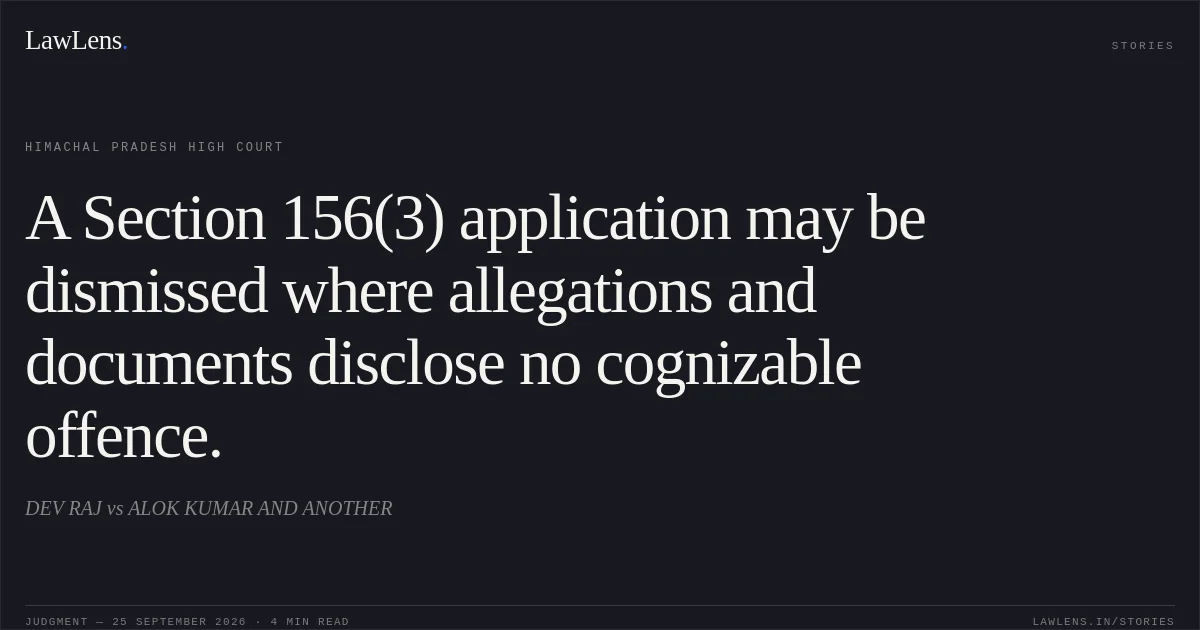
The High Court held that the allegations and documents did not disclose any cognizable offence warranting an investigation under Section 156(3) CrPC.
The petitioner also failed to demonstrate compliance with the mandatory procedural safeguards under Sections 154(1) and 154(3) CrPC.
Source reference: p. 13, para. 18The revision petition was accordingly dismissed, and the Magistrate’s order rejecting the Section 156(3) application was affirmed.
Source reference: p. 13, para. 18The judgment refers to the impugned Magistrate’s order as dated 06.10.2023 in the operative portion, although the opening portion mentions 16.10.2023.
Source reference: pp. 1, 13Acts & Sections Cited
7 provisions across 2 statutes referred to in this judgment. Each provision opens on LawLens.
Code of Criminal Procedure, 19732
Indian Penal Code, 18605
Original Court PDF
DEV RAJvsALOK KUMAR AND ANOTHER
Click to open original judgment
Original judgment, available to read, download and summarize on LawLens.in