Facts
The complainant alleged that the petitioners and others forged her and another heir’s signatures in connection with a compromise petition before the High Court concerning inherited land, and thereby obtained orders and compensation from the Bangalore Development Authority (BDA).
Source reference: para. 3, 12The complainant filed PCR No. 181/2018; the Magistrate referred it to police under Section 156(3) Cr.P.C., leading to registration of Crime No. 81/2018 for offences under Sections 416, 418, 420, 463, 466, 468, 470 and 471 IPC.
Source reference: para. 1, 9The petitioners sought quashing, arguing that the complainant had not demonstrated prior recourse to the police under Section 154 Cr.P.C. or filed the affidavit required by Priyanka Srivastava.
Source reference: para. 4–6The petition was recorded as abated against petitioner No. 1.
Source reference: no citationIssues
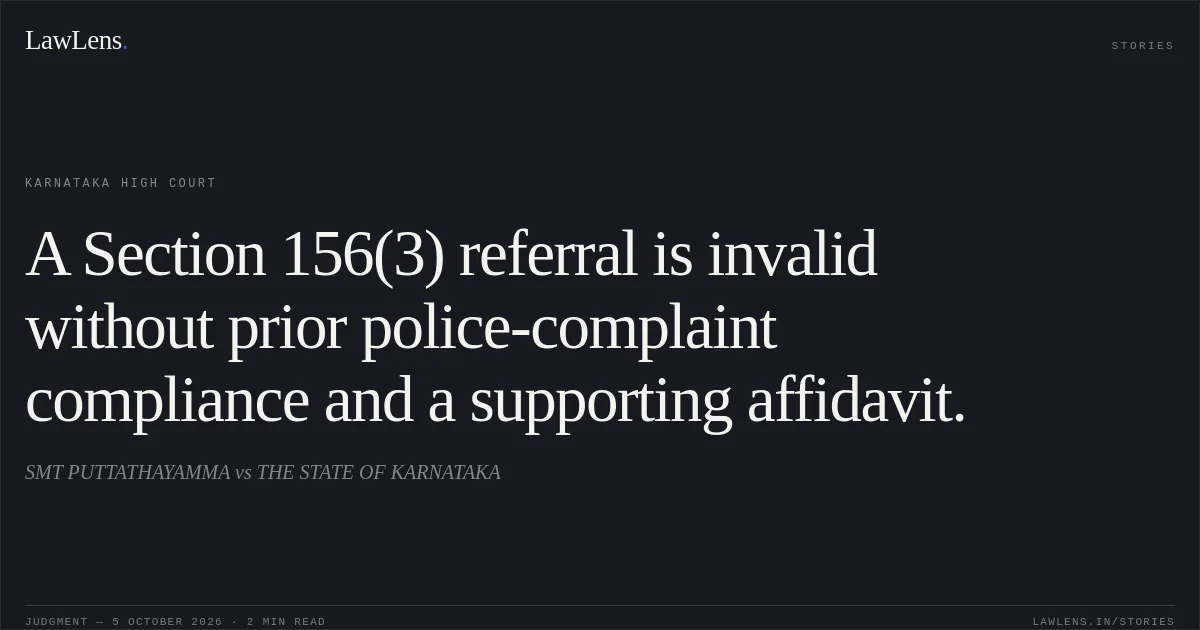
Whether the Magistrate’s referral of the private complaint for investigation under Section 156(3) Cr.P.C. was legally sustainable when the complaint did not establish prior recourse under Section 154(1) and (3) Cr.P.C.
Source reference: para. 11–13Whether the absence of the affidavit contemplated in Priyanka Srivastava rendered the referral order, and consequently the criminal proceedings, liable to be quashed.
Source reference: para. 4, 11–13Law Applied
Under Sections 154(1) and 154(3) Cr.P.C., a complainant seeking police action must first approach the police station and, if necessary, the senior police officer; under Section 156(3), the Magistrate may direct investigation before taking cognizance.
Source reference: para. 4–6, 11Priyanka Srivastava v. State of U.P., (2015) 6 SCC 287, requires an application under Section 156(3) to be supported by an affidavit and to disclose prior recourse under Section 154(1) and (3); the Court also referred to Babu Venkatesh v. State of Karnataka, (2022) 5 SCC 639, and Om Prakash Ambadkar v. State of Maharashtra, Criminal Appeal No. 352/2020, decided 16 January 2025, in considering those safeguards.
Source reference: para. 4–6, 11The Court distinguished a pre-cognizance referral under Section 156(3) from proceedings in which the Magistrate proceeds under Section 200 Cr.P.C.
Source reference: para. 10Reasoning
The Court found that the complaint and accompanying material did not state that the complainant had first approached the police under Section 154(1) and (3), and that no supporting documents or affidavit establishing compliance had been filed.
Source reference: para. 12–13Although the Magistrate had noted the documents produced and referred the complaint for investigation, the Court held that the Magistrate had not applied the required safeguards before making the Section 156(3) referral.
Source reference: para. 9, 13It also held that the Magistrate’s order referred the matter for investigation at the pre-cognizance stage, so the taking of cognizance was not appropriate.
Source reference: para. 10On that basis, it found grounds to quash the proceedings.
Source reference: para. 13Holding
The High Court allowed the petition and quashed the proceedings in Crime No. 81/2018/PCR No. 181/2018 for the offences under Sections 416, 418, 420, 463, 466, 468, 470 and 471 IPC.
It reserved liberty to the complainant to proceed in accordance with law.
Source reference: para. 14The petition had abated as against petitioner No. 1.
Source reference: no citationActs & Sections Cited
12 provisions across 2 statutes referred to in this judgment. Each provision opens on LawLens.
Code of Criminal Procedure, 19734
Indian Penal Code, 18608
Original Court PDF
SMT PUTTATHAYAMMAvsTHE STATE OF KARNATAKA
Click to open original judgment
Original judgment, available to read, download and summarize on LawLens.in