Facts
The informant, Lalan Jha, was employed as a security guard in Mumbai, while his wife, Punita Devi, lived in the village with their two minor children.
Source reference: para. 3; p. 2The prosecution alleged that on 18 May 2013, Punita Devi left home with the appellant, their neighbour, on the pretext of taking their younger son for medical treatment, but neither she nor the child returned.
Source reference: para. 3; p. 2The informant subsequently learnt that the appellant had taken them to Mumbai and lodged the criminal case.
Source reference: para. 3; p. 2After investigation, a charge-sheet was submitted under Sections 363, 366 and 376 of the Indian Penal Code (IPC).
Source reference: para. 3; p. 2The prosecution examined eight witnesses, including the informant, the alleged victim, the Judicial Magistrate who proved the victim’s statement under Section 164 of the Code of Criminal Procedure (Cr.P.C.), and the Investigating Officer.
Source reference: para. 4; p. 2–3Three witnesses were declared hostile, and the victim did not provide sufficient support to the prosecution case.
Source reference: para. 4; p. 2–3The Trial Court convicted the appellant under Sections 366 and 376 IPC and sentenced him to ten years’ rigorous imprisonment and fines for each offence, with the sentences to run concurrently.
Source reference: para. 2; p. 1–2The appellant challenged the conviction and sentence before the High Court.
Source reference: no citationIssues
Whether the prosecution proved beyond reasonable doubt that the appellant abducted or compelled Punita Devi to accompany him, thereby committing an offence under Section 366 IPC.
Source reference: paras. 8–10; pp. 4–5Whether the prosecution proved beyond reasonable doubt that the appellant committed sexual assault or rape upon the victim, thereby attracting Section 376 IPC.
Source reference: paras. 8–10; pp. 4–5Whether the victim’s statement recorded under Section 164 Cr.P.C., merely proved through the Judicial Magistrate, could independently establish the appellant’s guilt in the absence of reliable substantive testimony from the victim.
Source reference: para. 8; p. 4Law Applied
The Court applied Sections 366 and 376 IPC, requiring the prosecution to establish, respectively, the essential elements of kidnapping or abduction of a woman with the requisite intent and the commission of rape.
Source reference: para. 10; p. 5The Court reiterated the fundamental criminal-law principle that the prosecution bears the burden of proving the accused’s guilt beyond reasonable doubt and that strong suspicion cannot substitute proof.
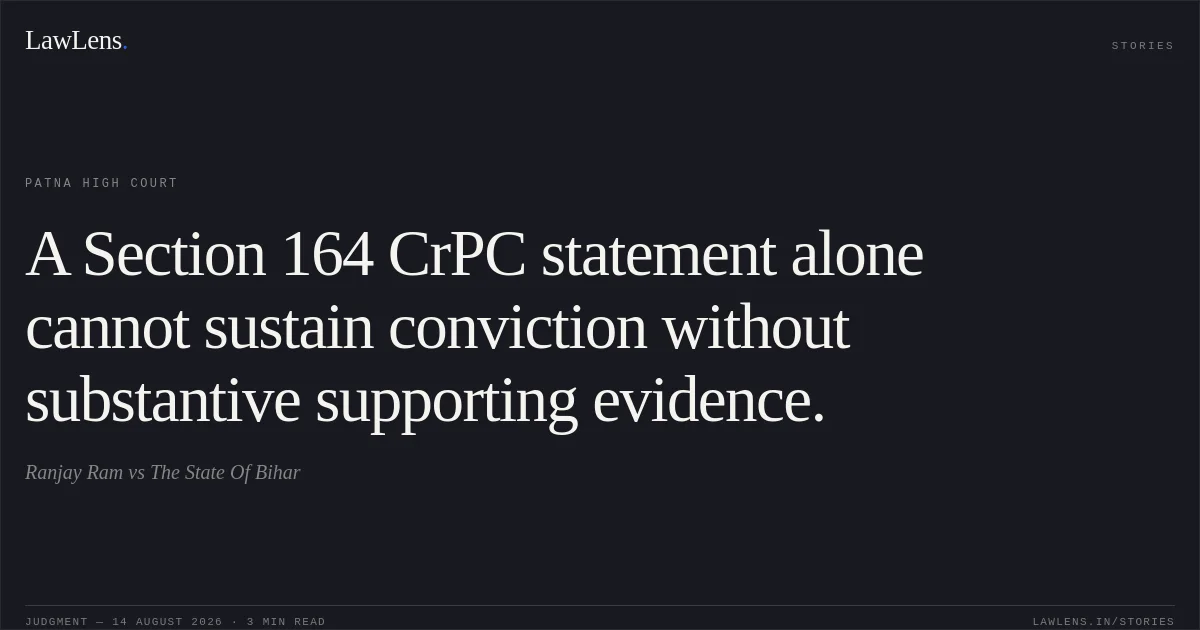
Source reference: para. 10; p. 5It further held that proof of a victim’s statement recorded under Section 164 Cr.P.C. does not, by itself, constitute substantive evidence sufficient to establish guilt; the prosecution must rely on substantive and reliable evidence proving the charge.
Source reference: para. 8; p. 4Reasoning
The Court found that the victim, who was the material witness regarding the alleged abduction and sexual assault, did not sufficiently support the prosecution case.
Source reference: paras. 8–9; pp. 4–5The evidence of the informant was also treated with caution because he was not present at the alleged occurrence and therefore required corroboration from reliable substantive evidence.
Source reference: paras. 8–9; pp. 4–5The hostility of three prosecution witnesses, the absence of consistent support from the victim, and the limited evidentiary value of merely proving the Section 164 Cr.P.C. statement created reasonable doubt.
Source reference: paras. 8–10; pp. 4–5Consequently, the prosecution failed to establish either the alleged abduction or the alleged sexual assault beyond reasonable doubt.
Source reference: paras. 8–10; pp. 4–5Holding
The High Court held that the prosecution had failed to prove the appellant’s guilt under Sections 366 and 376 IPC beyond reasonable doubt.
Extending the benefit of doubt, it set aside the judgment of conviction dated 26 July 2017 and the order of sentence dated 28 July 2017, acquitted the appellant of all charges, discharged him from the liabilities of his bail bond, and allowed the appeal.
Source reference: paras. 11–14; pp. 5–6Acts & Sections Cited
4 provisions across 2 statutes referred to in this judgment. Each provision opens on LawLens.
Indian Penal Code, 18603
Code of Criminal Procedure, 19731
Original Court PDF
Ranjay RamvsThe State Of Bihar
Click to open original judgment
Original judgment, available to read, download and summarize on LawLens.in