Facts
The appellants claimed title to Plot No. 20D, Sector 10A, Airoli, Navi Mumbai, through their predecessors, whose names had been recorded as protected tenants in the 7/12 extracts pursuant to Mutation Entry No. 681 dated 30 August 1950.
Source reference: para. 3(i)Their names were deleted by Mutation Entry No. 1201 dated 24 April 1962.
Source reference: para. 3(ii)The land was subsequently acquired under the Land Acquisition Act, 1894, and an award was passed on 1 September 1986; CIDCO’s name was thereafter recorded by Mutation Entry No. 1282.
Source reference: para. 3(iii)–(v)The appellants successfully initiated proceedings under Sections 32G and 32M of the Maharashtra Tenancy and Agricultural Lands Act, 1948 (“MTAL Act”), resulting in an order dated 2 August 2002 and purchase certificates dated 6 September 2002.
Source reference: para. 3(vii)–(ix)However, the respondents challenged those proceedings. By judgment dated 14 July 2025, the High Court upheld the respondents’ challenge, held that the Section 32G proceedings in favour of the appellants were vitiated and non-est, directed deletion of Mutation Entry Nos. 2473, 2474 and 2475, and directed CIDCO to hand over the earmarked plot and acquisition benefits to the respondents.
Source reference: para. 3(xv)–(xvii); para. 23The appellants’ Special Leave Petition was dismissed by the Supreme Court on 8 September 2025.
Source reference: para. 3(xviii)They thereafter instituted Special Civil Suit No. 237 of 2025, claiming ownership on the basis of the Section 32M certificates and seeking declarations concerning title, mutation entries, acquisition compensation and entitlement under CIDCO’s 12.5% scheme.
Source reference: para. 3(xix); para. 16After CIDCO executed an agreement granting the respondents a licence over the property on 26 December 2025, the appellants sought temporary injunction restraining the respondents from creating third-party interests, developing the property, obtaining approvals or accepting bookings.
Source reference: para. 3(xx)–(xxi)The Trial Court rejected the injunction application below Exhibit 5 on 26 February 2026. The present Appeal from Order challenged that refusal.
Source reference: paras. 1–2Issues
Whether the appellants established a prima facie case, balance of convenience and likelihood of irreparable injury warranting temporary injunction under Order XXXIX Rules 1 and 2 of the Code of Civil Procedure, 1908.
Source reference: paras. 6–12, 32–36Whether the Section 32M purchase certificates, issued pursuant to the Section 32G proceedings subsequently held invalid and non-est, could independently confer title or ownership upon the appellants.
Source reference: paras. 23–26, 32Whether the appellants’ delayed challenge to the mutation entries and acquisition-related changes, raised after approximately 33 years without a satisfactory explanation or an application for condonation of delay, could support interim relief.
Source reference: paras. 27–31, 37–38Whether the civil suit was maintainable insofar as it sought alteration or cancellation of mutation entries, in view of Section 158 of the Maharashtra Land Revenue Code, 1966.
Source reference: para. 29Law Applied
The Court applied Order XXXIX Rules 1 and 2 CPC, under which interim injunction depends principally on a prima facie case, balance of convenience and irreparable injury.
Source reference: paras. 18, 35It relied on Wander Ltd. v. Antox India (P) Ltd., 1990 Supp SCC 727, holding that an appellate court should not interfere with the trial court’s discretionary order unless the discretion is arbitrary, capricious, perverse or based on disregard of settled principles.
Source reference: paras. 18, 35Under Sections 32G and 32M of the MTAL Act, determination of purchase price and its payment under Section 32G precede issuance of the purchase certificate under Section 32M; therefore, a Section 32M certificate cannot independently survive when the underlying Section 32G proceedings have been invalidated.
Source reference: paras. 24–26Section 158 of the Maharashtra Land Revenue Code bars a suit against the State or its officers seeking insertion, deletion or amendment of an entry in revenue records.
Source reference: para. 29The Court further applied the principle that an inordinate and unexplained delay, particularly in challenging mutation entries, disentitles a claimant to relief; mere assertion of lack of knowledge is insufficient without a cogent explanation covering the entire period of delay, as reflected in Amol Govind Mhatre v. Sharda Ganpat Sawant, B.M.E.’s Bhagyawan Cooperative Housing Society Ltd. v. District Superintendent of Land Records, 2025 SCC OnLine Bom 1208, and Balkrishna Sadashiv Thakur v. Prabhakar Sadashiv Thakur, 2021 (5) Mh LJ 669.
Source reference: paras. 27, 32–37Reasoning
The Court held that the earlier High Court judgment dated 14 July 2025 had conclusively treated the appellants’ Section 32G proceedings as vitiated and non-est, and that decision had been affirmed by dismissal of the SLP.
Source reference: paras. 23–24, 34Since Section 32G proceedings are the statutory foundation for a Section 32M certificate, the certificates could not, by themselves, establish the appellants’ ownership after the underlying proceedings had failed.
Source reference: paras. 24–26The appellants had also challenged the relevant mutation entries after an inordinate delay of approximately 33 years and provided no satisfactory explanation demonstrating due diligence or absence of constructive knowledge, particularly in view of the land acquisition and public notices under Sections 4 and 6 of the Land Acquisition Act, 1894.
Source reference: paras. 27–31, 37The Court further found the maintainability of the suit doubtful to the extent it directly sought alteration of mutation entries because of Section 158 of the Maharashtra Land Revenue Code.
Source reference: para. 29In these circumstances, the appellants failed to establish a prima facie case or a favourable balance of convenience. Conversely, restraining the respondents, who had received CIDCO’s licence pursuant to the earlier High Court directions, would cause them prejudice.
Source reference: para. 34Applying Wander, the Court found no perversity or arbitrariness in the Trial Court’s exercise of discretion warranting appellate interference.
Source reference: paras. 35–38Holding
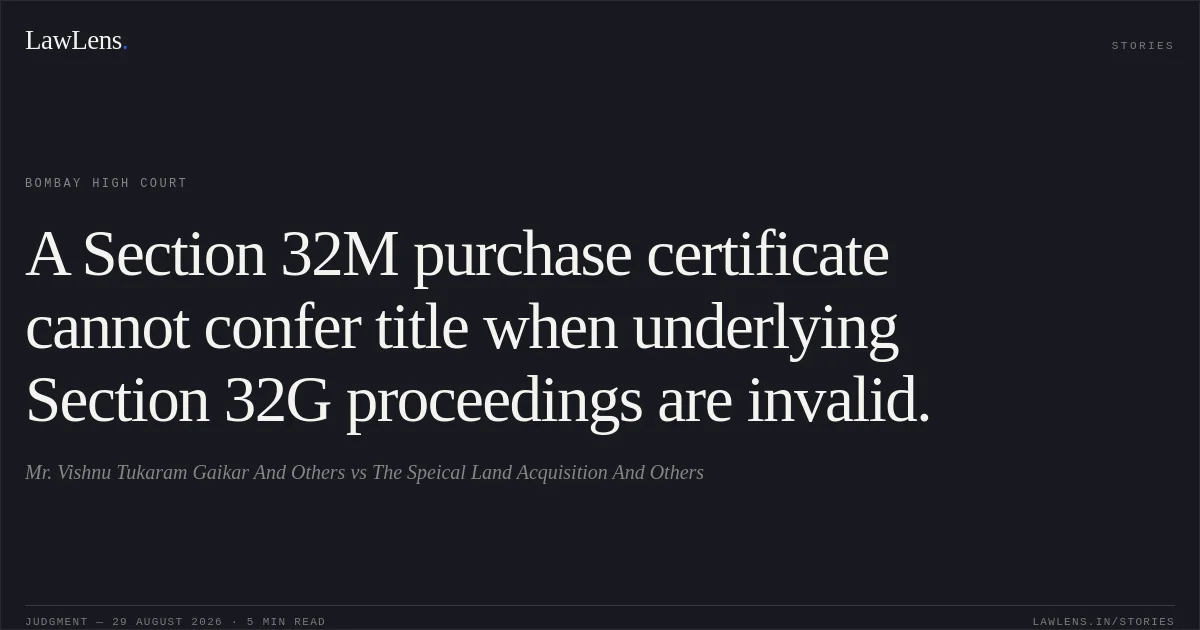
The Bombay High Court dismissed the Appeal from Order and upheld the Trial Court’s refusal to grant temporary injunction.
It held that the appellants’ Section 32M certificates did not independently confer title after the underlying Section 32G proceedings had been declared invalid, that their delayed challenge and the statutory bar under Section 158 undermined their claim for interim relief, and that the Trial Court had properly applied the principles governing injunctions.
Source reference: paras. 24–35The Trial Court was directed to dispose of the suit expeditiously.
Source reference: para. 39There was no order as to costs, and the pending Interim Application was disposed of as infructuous.
Source reference: paras. 39–41Acts & Sections Cited
7 provisions across 4 statutes referred to in this judgment. Each provision opens on LawLens.
Code of Civil Procedure, 19081
Maharashtra Tenancy and Agricultural Lands Act.1
Maharashtra Land Revenue Code, 19662
Transfer of Property Act, 18823
Original Court PDF
Mr. Vishnu Tukaram Gaikar And OthersvsThe Speical Land Acquisition And Others
Click to open original judgment
Original judgment, available to read, download and summarize on LawLens.in
![A police constable cannot be removed for unauthorized absence without a Rule 359-compliant inquiry.. Mohammad Sidiq Khan vs D/o Home Ut Of Jammu & Kashmir. CAT - ['Srinagar']. LawLens](/stories/thumbnails/a-police-constable-cannot-be-removed-for-unauthorized-absence-without-a-rule-359-compliant-7b43fc316bd94f22a62676153bbc9d54.webp)
![A Review DPC lacks authority to determine or alter inter se seniority.. SAURABH KUMAR vs REVENUE. CAT - ['Patna']. LawLens](/stories/thumbnails/a-review-dpc-lacks-authority-to-determine-or-alter-inter-se-seniority-4b21640f20af46fcabdfc8273d2ce959.webp)