Facts
The petitioners—liquor manufacturers and suppliers—challenged Collector’s orders imposing recoveries or penalties for alleged breakage of foreign liquor recorded at or during handling of CSBCL depots.
Source reference: paras 2–3, 14–19In the lead matter, the alleged loss was 1,724.02 proof litres, assessed at ₹6,24,785.
Source reference: paras 2–3, 14–19The respondents relied on depot panchnamas, some signed by the petitioners’ representatives, and the petitioners’ failure to reply to show-cause notices.
Source reference: paras 2–3, 14–19The petitioners contended that, under the supply agreement, risk and property generally passed to CSBCL on receipt, and seller liability for depot breakage was limited to breakage caused by defective or improper packing or a manufacturing defect.
Source reference: paras 2–3, 14–19They sought judicial review without first pursuing the statutory appeal.
Source reference: paras 2–3, 14–19Issues
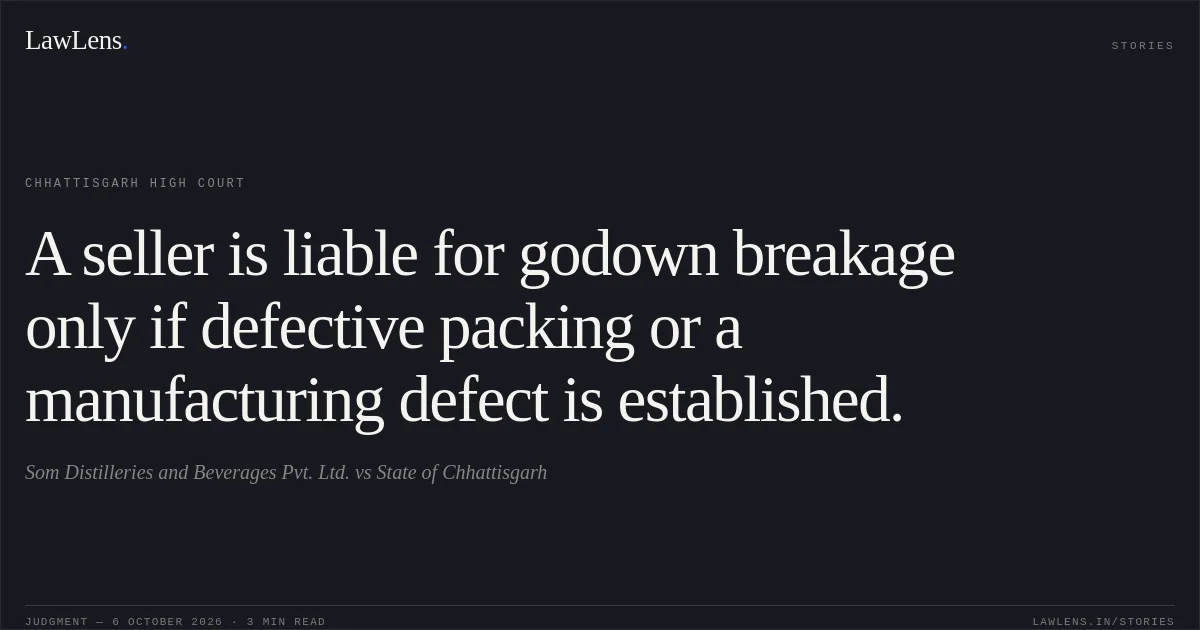
Whether the petitioners could be held liable for depot breakage without a finding that it resulted from defective or improper packing or a manufacturing defect, as specified in the agreement.
Source reference: paras 25–30Whether the availability of an alternative statutory remedy precluded the High Court from entertaining the writ petitions.
Source reference: paras 21–24, 34Whether the petitions should be rejected because multiple impugned orders were challenged in connected proceedings.
Source reference: para 35Law Applied
Rule 17(2) of the Chhattisgarh Foreign Liquor Rules, 1996 prohibits wastage allowance for specified licensees and permits recovery of duty and bottle fee where a deficiency is found; Rule 19 provides for penalties in the circumstances covered by the Rules.
Source reference: paras 11–16Under Clauses 2.3 and 3.10 of the parties’ agreement, risk and property in the stock lay with the purchaser, subject to the seller’s liability for godown breakage attributable to defective or improper packing or a manufacturing defect.
Source reference: paras 11–16The alternative-remedy rule is discretionary, not an absolute bar; *Harbanslal Sahnia v. Indian Oil Corporation Ltd.* recognises that writ jurisdiction may be exercised in appropriate cases despite an alternative remedy, including where the impugned action warrants writ intervention.
Source reference: paras 22–24The Court also referred to *State of Uttar Pradesh v. Ehsan*, which favours deciding an already-entertained writ petition on its merits absent compelling reasons to relegate the petitioner to another remedy.
Source reference: paras 22–24Reasoning
The Court held that the contractual terms required the authority to determine the cause of the breakage before shifting liability to the sellers.
Source reference: paras 26–35The impugned orders recorded shortage or breakage but did not clearly find that defective or improper packing or a manufacturing defect caused it.
Source reference: paras 26–35A panchnama signed by a petitioner’s representative could establish that breakage was observed and recorded, but not its cause.
Source reference: paras 26–35Nor could the existence of a deficiency alone justify liability without consideration of the relevant contractual terms.
Source reference: paras 26–35The orders therefore lacked a reasoned determination of the basis for attributing the loss to the petitioners.
Source reference: paras 26–35Given that defect, the alternative-remedy objection was not an absolute bar; and the Court declined to reject the connected petitions merely because they challenged multiple orders.
Source reference: paras 26–35Holding
The Court answered that the petitioners could not be held liable on the basis of breakage alone, without establishing that the contractual conditions for seller liability were met.
It allowed all the writ petitions, quashed the impugned orders and consequential recovery proceedings, and absolved the petitioners of the liabilities imposed under those orders.
Source reference: paras 36–38The decision did not preclude future action for a deficiency if adjudicated in accordance with the statutory provisions and applicable contractual terms.
Source reference: paras 36–38Acts & Sections Cited
2 provisions across 1 statute referred to in this judgment. Linked provisions open on LawLens.
Chhattisgarh Excise Act, 19152
Original Court PDF
Som Distilleries and Beverages Pvt. Ltd.vsState of Chhattisgarh
Click to open original judgment
Original judgment, available to read, download and summarize on LawLens.in