Facts
The petitioners were appointed as Junior Engineers (Civil) in July 1978, before private respondents Nos. 3 and 4, who were appointed on 21 and 24 July 1978 respectively. The petitioners were therefore senior in the feeder cadre.
Source reference: para. 2Respondents Nos. 3 and 4, belonging to the Scheduled Tribe category, were promoted as Assistant Engineers (Civil) in 2004 and 2005 under the reservation policy, while the petitioners were promoted to that post on 31 March 2008.
Source reference: para. 2In the seniority list of Assistant Engineers circulated in 2010, the reserved-category respondents were placed above the petitioners. Pursuant to the petitioners’ representation and an earlier direction of the High Court, the seniority list was revised on 14 January 2015, placing the petitioners above respondents Nos. 3 and 4.
Source reference: paras. 3–4Despite the revised seniority, respondents Nos. 3 and 4 were promoted as Executive Engineers against the vacancy years 2013 and 2014, whereas petitioners Nos. 1 and 3 were promoted only against the vacancy year 2015; petitioner No. 2 retired on 31 March 2015 without being considered for promotion.
Source reference: para. 5The petitioners sought promotion as Executive Engineers from the dates on which the private respondents were promoted, with consequential benefits.
Source reference: paras. 6, 19Issues
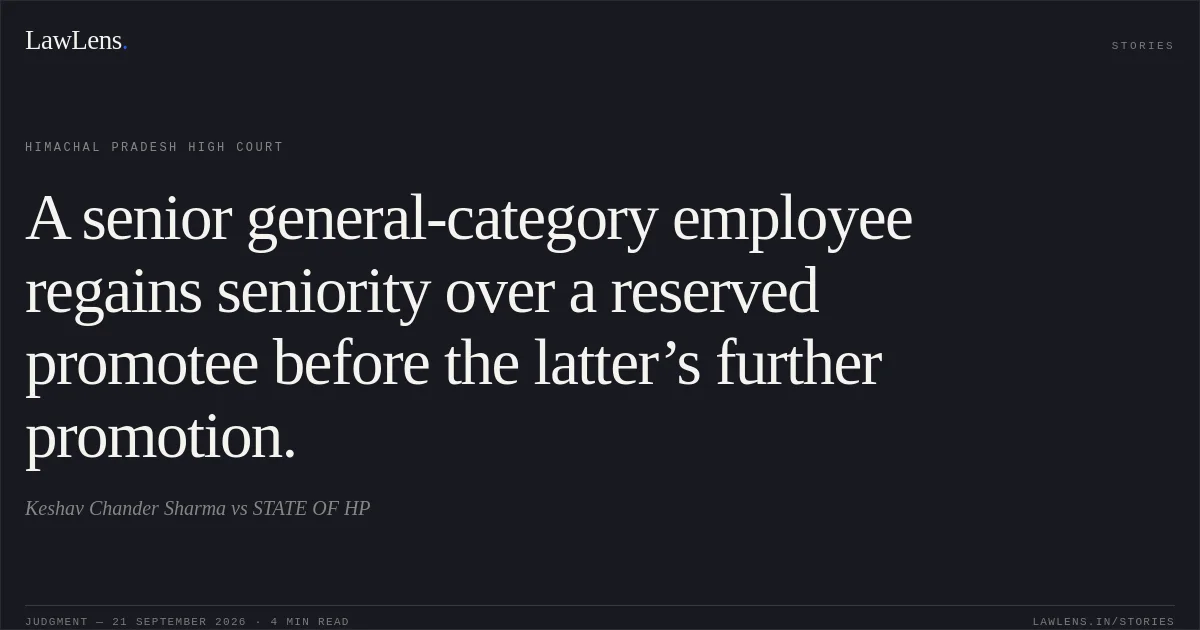
Whether senior general-category candidates who regained seniority upon promotion to the level of Assistant Engineer were entitled to be treated as senior to reserved-category candidates promoted earlier under the reservation policy, where the latter had not yet been further promoted as Executive Engineers.
Source reference: paras. 12–13Whether, under Rule 11 and Note (1) of the 1997 Recruitment and Promotion Rules, the petitioners were required to possess eight years’ service as Assistant Engineers independently, or whether they were deemed eligible for consideration once their junior candidates became eligible.
Source reference: paras. 14–15Whether the respondents’ failure to consider and promote the petitioners before respondents Nos. 3 and 4 was arbitrary, discriminatory, and violative of Articles 14 and 16 of the Constitution.
Source reference: paras. 16–18Law Applied
The Court applied the principle of “catch-up” seniority laid down by the Constitution Bench in Ajit Singh & Others (II) v. State of Punjab & Others, (1999) 7 SCC 209, namely that a senior general-category employee who reaches the promotional level after a reserved-category roster promotee, but before the latter’s further promotion, must be placed above the reserved-category promotee for purposes of subsequent promotion.
Source reference: paras. 12–13The Court also applied Rule 11 and Note (1) of the Himachal Pradesh Department of Irrigation and Public Health, Executive Engineer (Class-I Gazetted) Recruitment and Promotion Rules, 1997, under which, when a junior employee becomes eligible for consideration by virtue of the prescribed qualifying service, all senior employees in the relevant category, post, or cadre are deemed eligible and must be placed above the junior employee in the field of consideration, subject to the applicable minimum qualifying-service requirement.
Source reference: paras. 14–15The Court held that the rule was not confined only to cases in which ad hoc service had actually been counted for promotion.
Source reference: para. 18Reasoning
The petitioners were indisputably senior to respondents Nos. 3 and 4 as Junior Engineers. Although respondents Nos. 3 and 4 had reached the post of Assistant Engineer earlier through reservation, the petitioners entered that promotional cadre on 31 March 2008, before respondents Nos. 3 and 4 were promoted further as Executive Engineers in 2013–2014. Under Ajit Singh (II), the petitioners consequently regained their seniority over the reserved-category promotees at the Assistant Engineer level and were entitled to consideration for further promotion on that basis.
Source reference: para. 13The State’s objection that the petitioners lacked eight years’ service as Assistant Engineers was rejected because Rule 11 deemed senior employees eligible once their juniors became eligible; the rule did not permit the State to ignore the petitioners merely because the juniors’ eligibility did not depend on ad hoc service.
Source reference: paras. 15, 18After the State formally revised the seniority list on 14 January 2015, it was under a corresponding obligation to give effect to that seniority for promotion. Its failure to do so, despite knowledge that the petitioners had reached the feeder cadre before the juniors’ further promotion, was held arbitrary and discriminatory.
Source reference: paras. 16–18Holding
The petition was allowed. The competent authority was directed to promote the petitioners as Executive Engineers from the date on which respondent No. 3 was promoted, i.e., from 2013, with all consequential benefits.
If regular posts were unavailable, the respondents were directed to create supernumerary posts. The exercise was to be completed within three months, and arrears were to be paid within six months; delayed payment would carry interest at 6% per annum from the date of judgment until realization.
Source reference: para. 19Original Court PDF
Keshav Chander SharmavsSTATE OF HP
Click to open original judgment
Original judgment, available to read, download and summarize on LawLens.in