01Facts
The petitioner, a P.G. Assistant in a Government Higher Secondary School, claimed that he was entitled to stepping up of pay on par with his junior, Rajavelu.
p. 2 · ¶ 2The petitioner was awarded selection grade on 07 February 2007 and promoted as P.G. Assistant on 08 October 2007. His junior was promoted as B.T. Assistant on 16 July 2008 and, upon subsequent promotion as P.G. Assistant, allegedly drew higher pay than the petitioner, resulting in a pay anomaly.
p. 2 · ¶ 2The petitioner submitted a representation, pursuant to which the Joint Director of School Education forwarded a proposal to the Commissioner on 19 May 2022.
p. 2 · ¶ 2The proposal was rejected by order dated 02 July 2022, which was challenged in the present writ petition.
p. 2 · ¶ 1The respondents contended that the petitioner’s pay had been lower than that of his junior at every stage and that stepping up of pay was therefore unwarranted.
p. 2 · ¶ 402Issues
i.1. Whether the petitioner was entitled to consideration of stepping up of his pay when, after promotion to the same higher post, his junior was drawing higher pay.
pp. 2–5 · ¶ 2–7ii.2. Whether the impugned order dated 02 July 2022 rejecting the proposal for pay stepping-up was liable to be quashed for failing to apply the principles governing pay anomaly and stepping up.
pp. 5–8 · ¶ 7–10iii.3. If monetary relief was found payable, from what date could arrears be granted.
p. 8 · ¶ 1003Law Applied
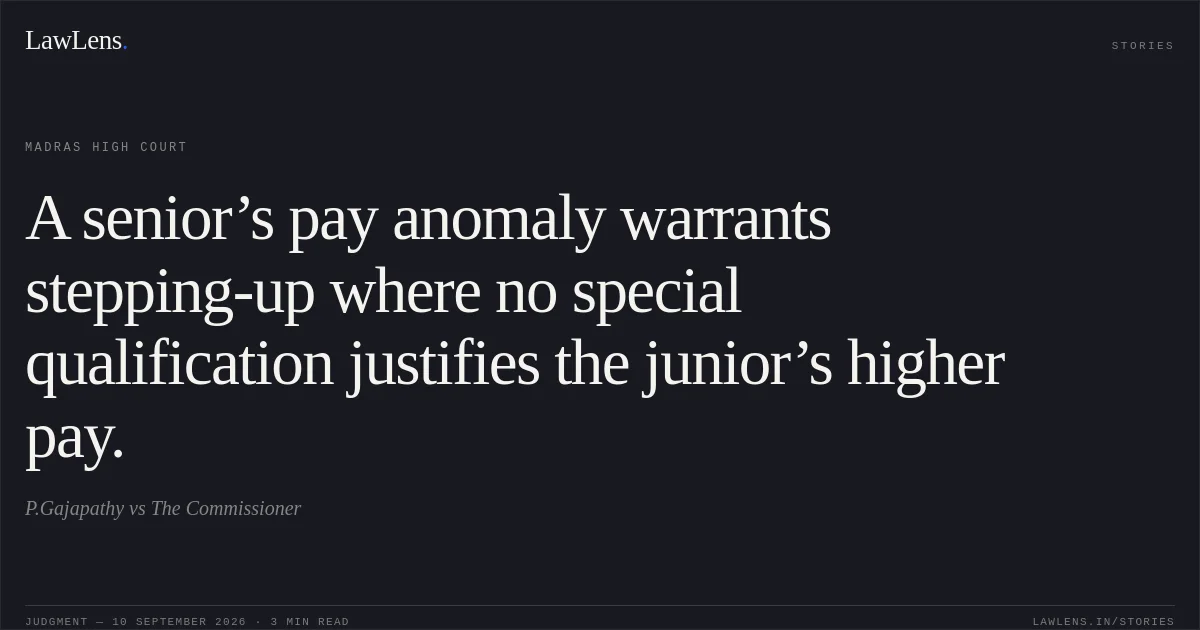
The Court applied the principle of stepping up of pay under the Fundamental Rules, under which the pay of a senior promoted earlier to a higher post may be stepped up to the level of a junior promoted later where the junior draws higher pay in the same promotional cadre, provided the anomaly is not attributable to a special qualification or additional ability possessed by the junior.
pp. 3–5 · ¶ 6Relying on Union of India v. P. Jagdish, AIR 1997 SC 1783, the Court held that stepping up is to take effect from the date on which the junior is promoted and receives higher pay, although consequential arrears are not automatically payable for the past period.
pp. 3–5 · ¶ 6The Court also relied upon State of Kerala v. E.K. Bhaskaran Pillai, (2007) 6 SCC 524, concerning the restriction of actual monetary benefits and arrears in cases involving delayed claims.
p. 8 · ¶ 10The reasoning in S.B. Meera v. State of Tamil Nadu, 2025::MHC::1161, was followed for the proposition that a pay anomaly arising from implementation of revised pay rules, rather than from a special qualification of the junior, may justify stepping up.
pp. 2–3, 6–7 · ¶ 3, 8–904Reasoning
The Court found that the present case was materially similar to S.B. Meera.
It noted that the petitioner and his junior belonged to the same service stream and that the petitioner’s junior allegedly drew higher pay after promotion to the same post.
Crucially, the Court recorded that the junior did not possess any special qualification or additional ability that could independently justify the higher pay.
p. 6 · ¶ 8Applying the principle in P. Jagdish, the Court held that a senior’s lower pay, when compared with that of a junior in the same promoted cadre, constitutes a matter requiring consideration under the stepping-up rules.
pp. 5–6 · ¶ 7–8However, instead of directly directing refixation, the Court remitted the matter to the Commissioner for fresh consideration of the departmental proposal, specifically in light of the applicable Supreme Court precedent.
The Court further directed that any monetary relief should be examined subject to the limitation on arrears recognised in E.K. Bhaskaran Pillai.
p. 8 · ¶ 1005Holding
The writ petition was allowed.
p. 8 · ¶ 10The impugned order dated 02 July 2022 was quashed, and the matter was remitted to the first respondent, the Commissioner of Education, to reconsider afresh the Joint Director’s proposal dated 19 May 2022 in light of the principles laid down in State of Kerala v. E.K. Bhaskaran Pillai and the law governing stepping up of pay.
p. 8 · ¶ 10If the petitioner was found entitled to monetary relief, arrears were restricted to the period commencing from the date of filing of the writ petition, namely 07 December 2022.
p. 8 · ¶ 10The exercise was directed to be completed within twelve weeks from receipt of the order.
p. 8 · ¶ 11No costs were awarded, and the connected miscellaneous petition was closed.
p. 8 · ¶ 11Original Court PDF
P.GajapathyvsThe Commissioner
Click to open original judgment
Original judgment, available to read, download and summarize on LawLens.in