Facts
Respondent no. 2, the petitioners’ step-sister and sister-in-law, lodged FIR No. 245/2025 at PS Vasant Kunj South alleging that a dispute over construction on a property led to abusive language and an assault.
Source reference: p. 2–3A chargesheet was subsequently filed, charging petitioner no. 1 under Sections 115(2), 79, 74, 3(5) and 351 of the Bharatiya Nyaya Sanhita, 2023 (BNS), and petitioner no. 2 and their father, since deceased, under Sections 79 and 3(5) BNS.
Source reference: p. 2–3The parties had a pending civil partition suit concerning the property.
Source reference: p. 2–3They later executed a Memorandum of Understanding (MoU), under which the petitioners agreed to transfer 2,000 square yards to respondent no. 2; a Gift Deed was executed, and respondent no. 2 agreed not to pursue the FIR.
Source reference: p. 2–3The petitioners sought quashing of the FIR and consequential proceedings under Section 528 of the Bharatiya Nagarik Suraksha Sanhita, 2023 (BNSS).
Source reference: p. 2–3Issues
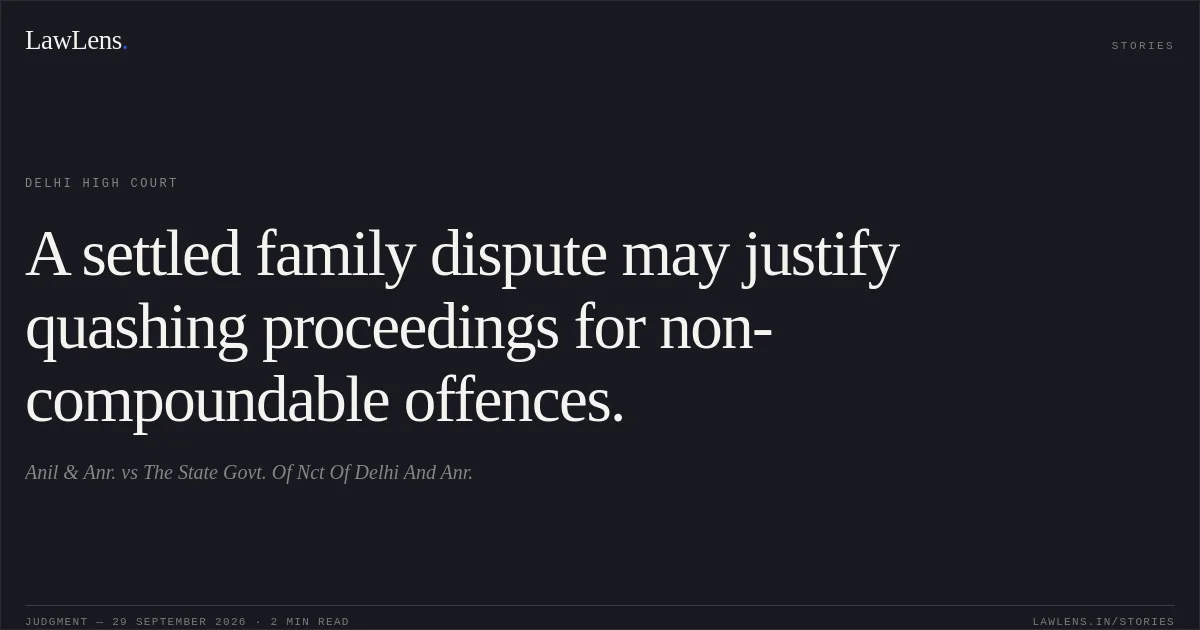
Whether the High Court should exercise its inherent jurisdiction under Section 528 BNSS to quash the FIR and consequential proceedings on the basis of the parties’ settlement, notwithstanding the allegation of a non-compoundable offence under Section 74 BNS.
Source reference: p. 3–6Whether continuation of the criminal proceedings would serve any useful purpose given the family dispute and the parties’ settlement.
Source reference: p. 5–6Law Applied
Section 528 BNSS, corresponding to Section 482 of the Code of Criminal Procedure, 1973 (CrPC), empowers the High Court to quash criminal proceedings, including those concerning non-compoundable offences, where doing so would secure the ends of justice or prevent abuse of process; this power is distinct from statutory compounding and must be exercised sparingly.
Source reference: p. 3–5Under Gian Singh v. State of Punjab, (2012) 10 SCC 303, proceedings arising from disputes with a predominantly civil or family character may be quashed after settlement where continuation would be futile and the interests of justice favour termination, subject to the nature and societal impact of the offence.
Source reference: p. 3–5Narinder Singh v. State of Punjab, (2014) 6 SCC 466, further directs courts to consider the character of the dispute, the likelihood of conviction, and whether continuation would cause oppression or injustice; serious offences with significant public impact ordinarily should not be quashed merely on compromise.
Source reference: p. 5–6Reasoning
The Court treated the dispute as a family dispute connected to a pending property-partition suit.
Source reference: p. 2–3It noted that the parties had executed an MoU, the agreed Gift Deed had been executed, and respondent no. 2 confirmed that her settlement was voluntary and that she did not wish to pursue the FIR.
Source reference: p. 2–3, 6Although the chargesheet included a non-compoundable offence under Section 74 BNS, the Court applied its inherent jurisdiction under Section 528 BNSS, concluding that continuation of the proceedings would not serve a useful purpose and would prolong discord between the parties.
Source reference: p. 3, 6Holding
The Court allowed the petition and quashed FIR No. 245/2025, dated 30 May 2025, registered at PS Vasant Kunj South, together with all consequential proceedings.
It directed that the parties remain bound by the MoU and disposed of the petition and pending applications.
Source reference: p. 6Acts & Sections Cited
8 provisions across 3 statutes referred to in this judgment. Each provision opens on LawLens.
Bharatiya Nagarik Suraksha Sanhita, 20231
Code of Criminal Procedure, 19732
Bharatiya Nyaya Sanhita, 20235
Original Court PDF
Anil & Anr.vsThe State Govt. Of Nct Of Delhi And Anr.
Click to open original judgment
Original judgment, available to read, download and summarize on LawLens.in