Facts
The petition was filed under Article 227 of the Constitution challenging three orders of the Trial Court in Regular Civil Suit No. 82 of 2024: (i) an order dated 07.05.2026 below Exh. 22 concerning an application under Order I Rule 10(2) read with Section 151 CPC to implead petitioner Nos. 2.1 to 3.3; (ii) an order dated 07.05.2026 below Exh. 20 rejecting the plaintiff’s application to produce documents; and (iii) an order dated 15.06.2026 below Exh. 25 rejecting the plaintiff’s amendment application under Order VI Rule 17 read with Section 151 CPC
Source reference: paras. 2, 4–4.2; pp. 1–3The Trial Court had kept the impleadment application in abeyance while an application under Order VII Rule 11 CPC was pending, rejected the amendment application on grounds including prejudice and lack of bona fides, and returned the documents after finding that their relevance had not been established
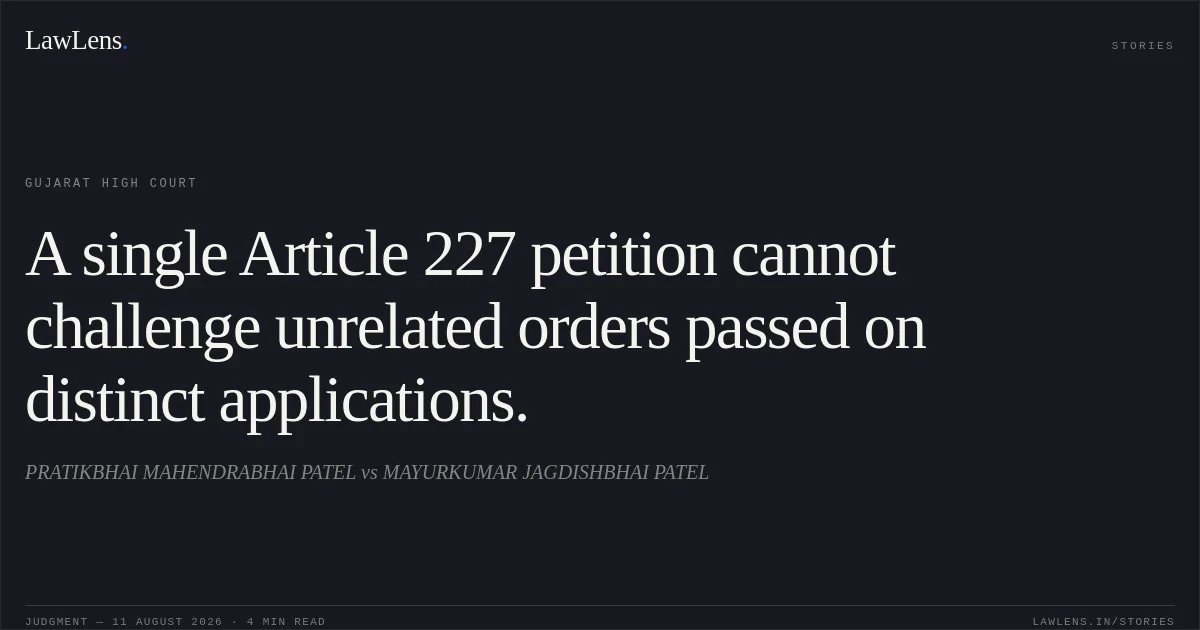
Source reference: paras. 8.1, 8.4–8.8; pp. 7–11The High Court also noted that the petition challenged three distinct orders arising from different applications and that the petitioners had been advised to file separate petitions
Source reference: para. 3; p. 2Issues
1. Whether a single petition under Article 227 could properly challenge three separate orders passed on different applications under different provisions of the CPC, particularly when the orders and grounds of challenge were not directly connected
Source reference: paras. 3, 5–5.2; pp. 2, 42. Whether the Trial Court was justified in keeping the impleadment application under Order I Rule 10(2) CPC in abeyance until deciding the defendant’s application under Order VII Rule 11 CPC
Source reference: paras. 7, 8.1–8.3; pp. 5, 7–93. Whether the Trial Court erred in rejecting the plaintiff’s amendment application under Order VI Rule 17 CPC at the stage when arguments on the Order VII Rule 11 application were underway
Source reference: paras. 7.1, 8.4–8.5; pp. 6, 9–104. Whether the Trial Court was justified in rejecting the plaintiff’s application for production of documents where their relevance had not been stated or demonstrated
Source reference: paras. 7.2, 8.6–8.8; pp. 6, 10–115. Whether any interference under Article 227 was warranted against the impugned orders
Source reference: paras. 8, 10, 12; pp. 7, 12–13Law Applied
The Court applied Article 227 of the Constitution, under which interference with interlocutory orders is supervisory and is warranted only in cases of gross illegality, material irregularity, or jurisdictional error
Source reference: para. 8; p. 7Under Order I Rule 10(2) CPC, impleadment is discretionary and may be considered in the procedural context of the suit; the Court accepted that the Trial Court could defer the application while first deciding the pending Order VII Rule 11 CPC application
Source reference: paras. 8.1–8.3; pp. 7–9Order VI Rule 17 CPC governs amendment of pleadings, and the Court accepted that an amendment may be refused where it appears prejudicial, lacking in bona fides, or improperly sought at a belated procedural stage; the plaintiff remained free to seek amendment later if the suit survived the Order VII Rule 11 application
Source reference: paras. 8.4–8.5; pp. 9–10An application for production of documents must disclose their relevance, and documents may be returned where the applicant fails to establish why they are necessary for adjudication
Source reference: paras. 8.6–8.8; pp. 10–11The Court also reaffirmed the professional obligation of an advocate to maintain the dignity and decorum of the court
Source reference: para. 9; p. 11Reasoning
The Court first held that the petition was procedurally defective because it combined challenges to three unrelated orders passed on separate applications, and because petitioner Nos. 2.1 to 3.3, who had sought impleadment, could not properly challenge the other orders
Source reference: paras. 5–5.2; p. 4On the merits, the Trial Court’s decision to defer impleadment was considered reasonable because arguments on the defendant’s Order VII Rule 11 application were already in progress, and the plaintiff had originally filed the suit as the sole plaintiff despite knowing that other co-owners existed
Source reference: paras. 8.1–8.3; pp. 7–9The amendment was validly rejected at that stage because it could prejudice the defendant and appeared to have been filed during the Order VII Rule 11 proceedings without bona fide justification; the plaintiff could renew the request if the suit survived
Source reference: paras. 8.4–8.5; p. 9The rejection of document production was also upheld because the application did not explain the documents’ relevance, and the plaintiff’s advocate failed to provide a satisfactory explanation when questioned by the Trial Court
Source reference: paras. 8.6–8.8; pp. 10–11Consequently, no jurisdictional error, gross illegality, or material irregularity warranting Article 227 intervention was established
Source reference: paras. 8, 10; pp. 7, 12Holding
The High Court dismissed the petition in limine, holding that it was not maintainable in the form presented and that none of the three impugned orders disclosed any ground for supervisory interference under Article 227
The Court imposed no costs.
Source reference: paras. 11–11.1; p. 12It directed the advocate who had appeared for the plaintiff before the Trial Court to tender an unconditional apology to that court, and directed the petitioners’ advocate to communicate this direction to him
Source reference: paras. 11–11.1; p. 12Acts & Sections Cited
1 provisions across 1 statute referred to in this judgment. Each provision opens on LawLens.
Code of Civil Procedure, 19081
Original Court PDF
PRATIKBHAI MAHENDRABHAI PATELvsMAYURKUMAR JAGDISHBHAI PATEL
Click to open original judgment
Original judgment, available to read, download and summarize on LawLens.in