Facts
The applicant, a retired Executive Engineer, was accused of demanding a ₹6.5 lakh bribe from a government contractor and receiving ₹1.5 lakh, with ₹5 lakh allegedly remaining.
Source reference: para. 2–5The contractor later complained to the Lokayukta; audio recordings were made, and a forensic voice analysis reportedly matched the applicant’s voice.
Source reference: para. 2–5Attempts to conduct a physical trap were unsuccessful.
Source reference: para. 2–5The investigating officer filed a closure report in 2019, reasoning that the demand was not established, including because the trap had failed.
Source reference: para. 6–7The Special Judge rejected the report and directed that the investigation records be placed before the competent authority for consideration of prosecution sanction within three months, while recording that a prima facie offence under Section 7 of the Prevention of Corruption Act was made out.
Source reference: para. 6–7The applicant challenged that order under Section 528 of the Bharatiya Nagarik Suraksha Sanhita, 2023, seeking acceptance of the closure report and arguing that the Special Judge’s finding could improperly influence the sanctioning authority.
Source reference: para. 1, 8–9Issues
Whether the Special Judge was entitled to reject the closure report on the material in the investigation record and direct that the records be placed before the competent authority for consideration of prosecution sanction.
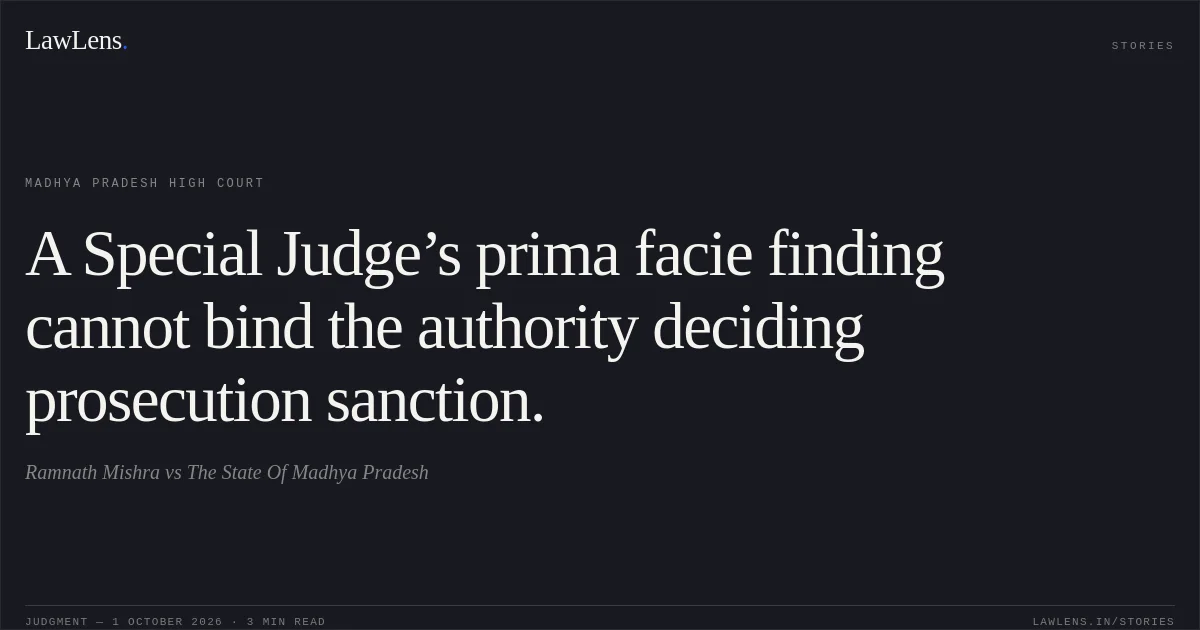
Source reference: para. 14–15, 23Whether the Special Judge’s statement that a prima facie offence under Section 7 of the Prevention of Corruption Act was made out should be treated as binding on, or capable of influencing, the sanctioning authority.
Source reference: para. 16–21Law Applied
Under the principles stated in Minu Kumari v. State of Bihar, (2006) 4 SCC 359, a court receiving a police report may accept a closure report, disagree with the investigating officer’s conclusion and proceed on the material in the record, or direct further investigation; it is not bound by the police’s opinion.
Source reference: para. 14Arun Kumar Aggarwal v. State of M.P., (2014) 13 SCC 707, distinguishes the operative decision rejecting a closure report from incidental observations that are not essential to that decision; such observations may constitute obiter and are not binding directions.
Source reference: para. 19Section 19 of the Prevention of Corruption Act requires the competent sanctioning authority to assess the material and apply its independent mind when deciding whether to grant sanction.
Source reference: para. 17–18, 25The Court also relied on Dr. Subramanian Swamy v. Dr. Manmohan Singh, AIR 2012 SC 1185, in upholding the three-month period for the sanction decision.
Source reference: para. 22Reasoning
The High Court held that the Special Judge could reject the closure report because the case record included digital recordings and a forensic voice-analysis report, and the investigating officer’s reliance on the failed trap did not prevent the court from independently assessing the material.
Source reference: para. 15However, the Special Judge’s categorical statement that a Section 7 offence was prima facie made out risked appearing to predetermine the sanction decision.
Source reference: para. 17–21, 23Applying Arun Kumar Aggarwal, the High Court treated that statement as obiter, while preserving the decision to reject the closure report and refer the records to the competent authority.
Source reference: para. 17–21, 23Holding
The petition was partly allowed.
The Special Judge’s order was upheld insofar as it rejected the closure report and directed placement of the records before the competent authority.
Source reference: para. 22–26The statement that a prima facie offence under Section 7 was made out was directed to be treated as obiter dictum.
Source reference: para. 22–26The sanctioning authority was directed to decide independently, on the investigation report and material on record, whether to grant or refuse sanction, without being influenced by the Special Judge’s observations.
Source reference: para. 22–26The three-month period was left undisturbed.
Source reference: para. 22–26Acts & Sections Cited
9 provisions across 3 statutes referred to in this judgment. Each provision opens on LawLens.
Bharatiya Nagarik Suraksha Sanhita, 20232
Prevention of Corruption Act, 19882
Code of Criminal Procedure, 19735
Original Court PDF
Ramnath MishravsThe State Of Madhya Pradesh
Click to open original judgment
Original judgment, available to read, download and summarize on LawLens.in