01Facts
The suit property formed part of a larger property originally owned by Arumuga Gramani and devolved upon his grandsons, S. Vinayagamurthy and S. Rajamanickam. They executed three sale agreements in 1980, 1980 and 1982 in favour of the first defendant and her husband.
¶ 3–3.3Upon the vendors’ failure to execute the sale deed, the vendees instituted O.S. No.5500 of 1983 for specific performance, which was decreed ex parte on 16 November 1983 without fixing a time for payment of the balance consideration.
¶ 3–3.3, 15The vendees deposited the balance consideration only on 22 December 1987 and thereafter initiated execution proceedings.
¶ 4.1, 16During the pendency of those proceedings, Rajamanickam and Pushpa conveyed the remaining 4,049 sq. ft. to the plaintiffs by a registered sale deed dated 19 September 1988.
¶ 3.1, 3.3Rajamanickam subsequently applied under Section 28 of the Specific Relief Act, 1963, for rescission of the specific-performance decree. The application was allowed, the decree was rescinded, the review application was dismissed, and the execution petition failed.
¶ 3.4, 16, 20–21The plaintiffs then filed O.S. No.6774 of 1996 seeking declaration of title, a declaration that the ex parte decree was invalid and not binding on them, recovery of possession, and permanent injunction. The Trial Court decreed the suit, and the First Appellate Court affirmed the decree.
¶ 3.5, 6–902Issues
i.Whether the vendors, after suffering an ex parte decree for specific performance in favour of the appellants, could validly convey their right, title and interest in the suit property to the plaintiffs?
¶ 10, Substantial Question of Law No.1 · ¶ 23ii.Whether the specific-performance decree could be rescinded after the appellants deposited the balance sale consideration?
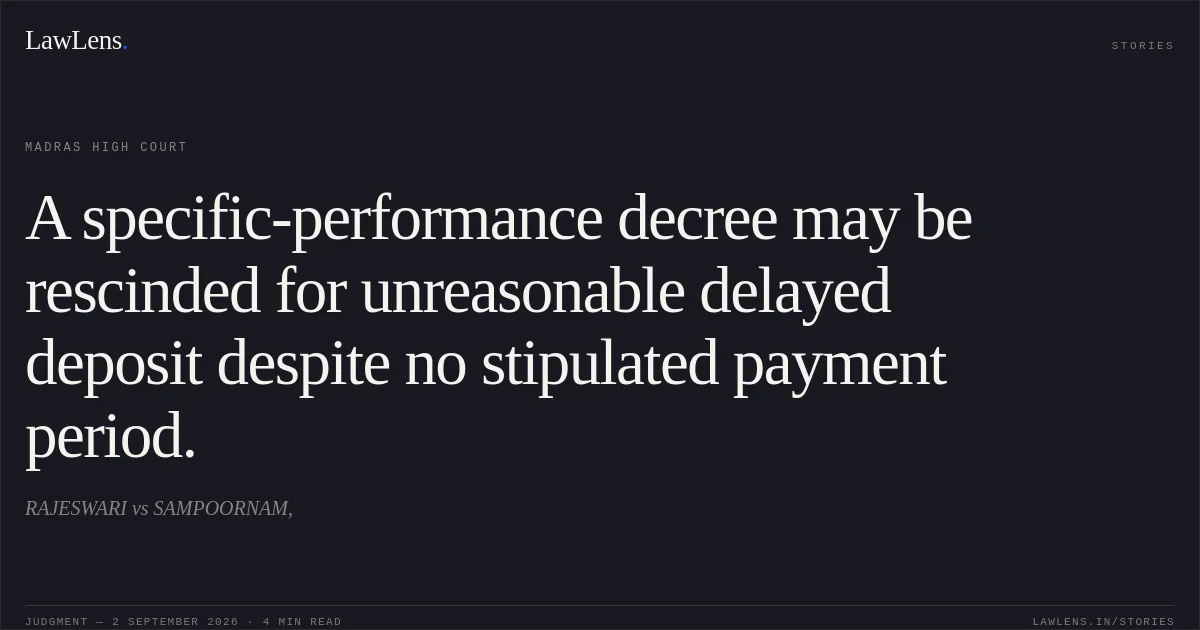
¶ 10, Substantial Question of Law No.2 · ¶ 24iii.Whether delayed payment or deposit of the balance sale consideration could justify rescission where the decree did not stipulate a time limit for such deposit?
¶ 10, Substantial Question of Law No.3 · ¶ 18–20, 2403Law Applied
The Court applied Section 28 of the Specific Relief Act, 1963, under which the court passing a decree for specific performance retains jurisdiction until execution of the sale deed and may, depending on the circumstances and conduct of the decree-holder, either extend the time for compliance or rescind the contract/decree.
¶ 18–18.3Under Order XX Rule 12-A CPC, a decree for specific performance involving payment of purchase money must specify the period for payment; where no period is specified, payment must nevertheless be made within a reasonable time.
¶ 17 · ¶ 18.3(vii)Relying on Hungerford Investment Trust Ltd. v. Haridas Mundhra, (1972) 3 SCC 684, Sardar Mohar Singh v. Mangilal alias Mangtya, (1997) 9 SCC 217, and Bhupinder Kumar v. Angrej Singh, (2009) 8 SCC 766, the Court held that a decree for specific performance is in the nature of a preliminary decree and that the contract continues until completion or lawful rescission.
¶ 18–18.2It also relied on Narasimhan v. Balammal, 1988 SCC OnLine Mad 297, for the proposition that a deposit made several years after the decree may be beyond reasonable time, depending on the facts.
¶ 19The principles summarised in Anand Narayan Shukla v. Jagat Dhari, 2026 SCC OnLine SC 827, were also applied: rescission is not automatic, extension is discretionary, and the court must consider the parties’ conduct, attending circumstances, equity, and whether the delay indicates wilful negligence or lack of intention to perform.
¶ 18.3Provisions in the judgment · 5 · Linked ones open on LawLens
Code of Civil Procedure, 1908 Section 100Section 37
Specific Relief Act, 1963 Section 28
Limitation Act, 1963 Section 137Section 5
04Reasoning
Although the ex parte decree did not prescribe a period for depositing the balance consideration, the appellants were required to comply within a reasonable time. Their deposit occurred approximately four years after the decree, and no satisfactory explanation for the delay was established.
¶ 16, 18–20, 24More importantly, the competent court had already exercised its discretion under Section 28 of the Specific Relief Act and rescinded the decree. That order was unsuccessfully challenged in review and revision and therefore attained finality; its correctness, including the limitation objection, could not be reopened in the present title suit.
¶ 20–21Once the specific-performance decree and the underlying agreements were rescinded, no enforceable right remained in favour of the appellants.
¶ 23Consequently, although the plaintiffs’ 1988 sale was a pendente lite transaction subject to the outcome of the earlier litigation, the eventual rescission of the decree removed the impediment to the vendors’ title and rendered the sale deed legally effective.
¶ 23The concurrent findings that the plaintiffs had established title and were entitled to possession and injunction were therefore not shown to suffer from any legal error.
¶ 2205Holding
The Court answered all three substantial questions against the appellants. It held that the rescinded ex parte specific-performance decree created no subsisting enforceable right, that the vendors could validly convey the property to the plaintiffs, and that the four-year delay in depositing the balance consideration could support rescission notwithstanding the absence of a stipulated time limit.
¶ 23–24The Second Appeal was dismissed, the judgments and decrees of the Trial Court and First Appellate Court were confirmed, and there was no order as to costs.
¶ 26The appellants were left at liberty to seek, in accordance with law, the amounts deposited towards the balance consideration and interest, which had subsequently lapsed into the Government account.
¶ 25Original Court PDF
RAJESWARIvsSAMPOORNAM,
Click to open original judgment
Original judgment, available to read, download and summarize on LawLens.in