Facts
The workman, a KSRTC conductor, was punished on 20 March 2004 by reduction of basic pay by three stages with cumulative effect and by treating his suspension period as not on duty, after a domestic enquiry found that he had permitted passengers to carry bags containing liquor bottles on a bus.
Source reference: p. 6–8The Government referred his dispute to the Industrial Tribunal on 23 May 2012.
Source reference: p. 8–9The Tribunal partly allowed his claim, reducing the pay penalty to one stage with cumulative effect, while retaining the direction that the suspension period be treated as not on duty.
Source reference: p. 8–9The Single Judge dismissed KSRTC’s writ petition challenging the award.
Source reference: p. 10–11KSRTC appealed, arguing that the dispute was stale and that the Tribunal lacked power under Section 11-A of the Industrial Disputes Act, 1947, to modify a minor punishment.
Source reference: p. 10–11Issues
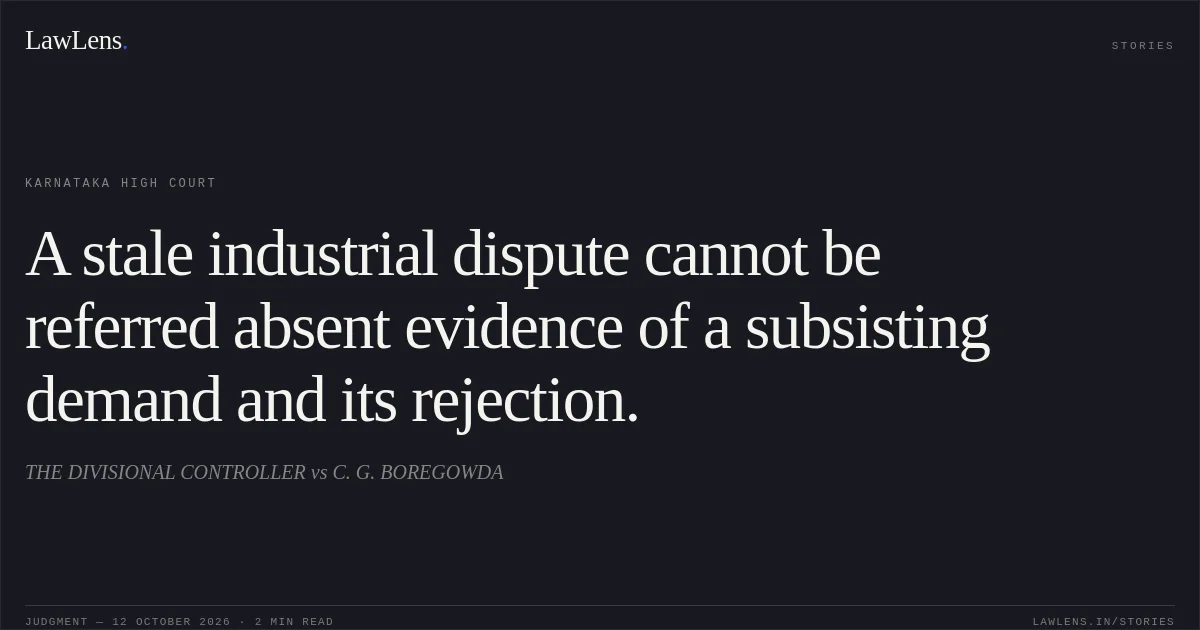
Whether the dispute, referred more than eight years after the punishment order, remained an existing industrial dispute or had become stale.
Source reference: p. 12–15Whether the Tribunal had jurisdiction under Section 11-A of the Industrial Disputes Act to modify the minor punishment imposed on the workman.
Source reference: p. 11, 15–16Law Applied
Section 10(1) of the Industrial Disputes Act prescribes no limitation period for a reference, but the absence of a limitation period does not permit adjudication of a stale claim; an industrial dispute must exist on the date of reference.
Source reference: p. 13–14Under Section 2(k), a dispute arises when one party makes a demand and the other rejects it. In Prabhakar v. Joint Director, Sericulture Department, (2015) 15 SCC 1, the Supreme Court explained that a workman must establish a continuing protest or demand; absent such evidence, acquiescence may be inferred.
Source reference: p. 13–14The Court also relied on South Indian Cashew Factory Workers’ Union v. Kerala State Cashew Development Corporation Ltd., (2006) 5 SCC 201, KSRTC v. Satish Honnali, W.A. No. 3678/2013, and Veerabasappa Kupasad v. Divisional Controller, KSRTC, W.A. No. 1109/2020, for the proposition that Section 11-A does not empower the Tribunal to modify a minor punishment.
Source reference: p. 16Reasoning
Although the workman claimed that he had appealed and made representations to KSRTC, he produced no material establishing either a demand or its rejection.
Source reference: p. 14–15The Court therefore held that the Tribunal could not treat the dispute as continuing: the reference was made over eight years after the punishment, and the absence of evidence of protest supported the conclusion that the workman had accepted the punishment and the dispute had become stale.
Source reference: p. 15The Court further held that the Tribunal exceeded its jurisdiction by modifying a minor punishment under Section 11-A.
Source reference: p. 16Holding
The Court answered against the workman on both grounds.
The Court allowed KSRTC’s appeal, and set aside the Single Judge’s order dated 26 November 2024 and the Tribunal’s award dated 8 February 2021.
Source reference: p. 16–17Acts & Sections Cited
1 provisions across 1 statute referred to in this judgment. Each provision opens on LawLens.
KARNATAKA HIGH COURT ACT, 19611
Original Court PDF
THE DIVISIONAL CONTROLLERvsC. G. BOREGOWDA
Click to open original judgment
Original judgment, available to read, download and summarize on LawLens.in
![Competent authority must reconsider transfer-waiting-list priority through a reasoned order.. Prabhat Kumar Srivastwa vs NORTH CENTRAL RAILWAY. CAT - ['Allahabad']. LawLens](/stories/thumbnails/competent-authority-must-reconsider-transfer-waiting-list-priority-through-a-reasoned-orde-e23ccd4eaf154e82b09ea183b25e32fb.webp)
![Excess-pay recovery from retired Group C employees is impermissible absent fraud or misrepresentation.. SATYA NAND YADAV vs NORTH EASTERN RAILWAY. CAT - ['Allahabad']. LawLens](/stories/thumbnails/excess-pay-recovery-from-retired-group-c-employees-is-impermissible-absent-fraud-or-misrep-c357cbdd195c44d68331385eea2a3c9a.webp)