Facts
The petitioner, claiming that his family had continuously resided in Assam for generations, applied online on 12.03.2025 for a Permanent Residential Certificate (PRC) for Higher Education.
Source reference: pp. 3–5; para. 18His supporting documents included electoral-roll entries, land records, and the 1951 NRC, in which his grandfather’s name appeared as “Abed Ali” instead of “Jabed Ali.”
Source reference: pp. 3–5; para. 18The application was rejected on 04.04.2025; the online status merely displayed “Rejected,” without communicating reasons, the appellate period, or the particulars of the appellate authority.
Source reference: pp. 3–5; para. 18In the affidavit-in-opposition, the respondents subsequently stated that the rejection was due to a break in linkage between the petitioner and the legacy person because of variations in names.
Source reference: pp. 6–9; para. 15The petitioner challenged the rejection under Article 226 of the Constitution, alleging arbitrariness, non-application of mind, and failure to consider his supporting documents.
Source reference: p. 2; para. 1Issues
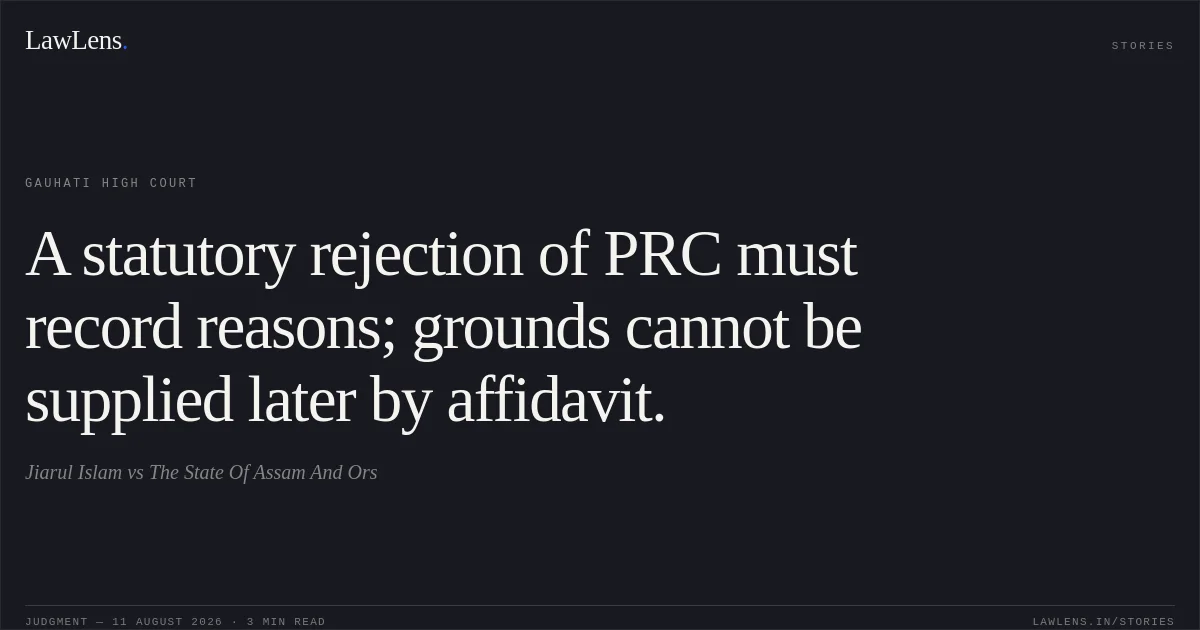
Whether the cryptic rejection of the petitioner’s PRC application, merely displaying the status as “Rejected,” violated Section 7(2) of the Assam Right to Public Services Act, 2012 and the principles of natural justice
Source reference: pp. 9–11; paras. 18–21Whether the reasons subsequently disclosed in the affidavit-in-opposition could supplement or validate the otherwise unreasoned rejection order
Source reference: pp. 11–12; para. 20Whether the discrepancy in the petitioner’s grandfather’s name in the 1951 NRC constituted a sustainable ground for rejecting the PRC application, particularly in light of the Circular dated 01.04.2022
Source reference: pp. 8–12; paras. 15–20Whether the matter should be remitted to the Designated Public Servant for fresh consideration in accordance with the applicable PRC guidelines and statutory framework
Source reference: pp. 12–13; paras. 21–24Law Applied
The Court applied the Office Memorandum dated 01.04.2013 and Circular dated 01.04.2022 governing the issuance of PRCs for Higher Education, under which eligible applicants include persons whose parents or forefathers have continuously resided in Assam for at least fifty years, persons continuously residing in Assam for at least twenty years, and children of persons falling within those categories.
Source reference: p. 8; para. 14The Court further applied Sections 2(h), 5, 6 and 7(1)–(2) of the Assam Right to Public Services Act, 2012, which confer a right to timely public services and require the Designated Public Servant, when rejecting an application, to record reasons in writing and communicate the reasons, the period for appeal, and the particulars of the appellate authority.
Source reference: pp. 9–10; para. 18The principles of natural justice and fair play require statutory authorities to pass reasoned and speaking orders, particularly where the decision affects a person’s rights.
Source reference: pp. 10–11; para. 19Relying on Mohinder Singh Gill v. Chief Election Commissioner, (1978) 1 SCC 405, the Court held that the validity of an administrative order must be judged by the reasons stated in the order and cannot be supplemented by new reasons in a subsequent affidavit.
Source reference: p. 12; para. 20Reasoning
The Court found that the rejection order did not disclose any reason and therefore failed to satisfy the mandatory requirements of Section 7(2) of the ARTPS Act.
Source reference: pp. 9–11; paras. 18–19The absence of reasons deprived the petitioner of a meaningful opportunity to understand or challenge the decision through the statutory appellate mechanism and demonstrated a failure of conscious application of mind.
Source reference: pp. 9–11; paras. 18–19The respondents’ attempt to explain the rejection through the affidavit-in-opposition was impermissible under the rule in Mohinder Singh Gill.
Source reference: p. 12; para. 20In any event, the alleged discrepancy in the 1951 NRC could not, by itself, sustain the rejection because the Circular dated 01.04.2022 clarified that applicants for PRCs should not be required to rely upon unfinalised NRC material as a supporting document.
Source reference: p. 11; para. 16Since the order was legally defective, the Court set it aside and directed fresh consideration rather than itself determining the petitioner’s eligibility for the PRC.
Source reference: pp. 12–13; paras. 21–23Holding
The Court held that the rejection order dated 04.04.2025 was non-speaking, contrary to Section 7(2) of the ARTPS Act, and legally unsustainable.
It accordingly quashed and set aside the order and remitted the petitioner’s application to the Designated Public Servant for fresh consideration under the applicable Office Memoranda, Circulars, Citizen Charter, and the ARTPS Act.
Source reference: pp. 12–13; paras. 21–23The authority was directed to complete the process within thirty days of receiving a certified copy of the judgment; if any further document was required, the petitioner was to be informed in writing within fifteen days, with the thirty-day period to run from the date of curing the deficiency.
Source reference: p. 13; para. 23The writ petition was allowed to that extent, with no order as to costs.
Source reference: p. 13; para. 24Acts & Sections Cited
5 provisions across 1 statute referred to in this judgment. Linked provisions open on LawLens.
Assam Right to Public Services Act, 20125
Original Court PDF
Jiarul IslamvsThe State Of Assam And Ors
Click to open original judgment
Original judgment, available to read, download and summarize on LawLens.in