Facts
Respondent No. 2 issued Tender No. OSC-13013/5/2022-Outsrc.Cell-Dr. RMLH/307 dated 11 July 2024 for management of hospital parking and traffic control on a monthly licence-fee basis.
Source reference: pp. 2, 5The petitioner and Respondent No. 3 were declared technically qualified; Respondent No. 3 emerged as L1 with a bid of ₹2,95,801.86 per month, while the petitioner was L2 with a bid of ₹2,31,346.98 per month.
Source reference: pp. 2, 5The petitioner challenged Respondent No. 3’s technical qualification, alleging that it had failed to disclose a DUSIB blacklisting order dated 13 February 2020 and had submitted an incorrect undertaking dated 8 August 2024 stating that it had not been blacklisted by any Government or Autonomous Body.
Source reference: pp. 2–3Respondent No. 3 relied on interim orders of the Commercial Court staying operation of the blacklisting order.
Source reference: p. 4The procuring authority subsequently obtained clarification from DUSIB and concluded that Respondent No. 3 need not be disqualified.
Source reference: pp. 4–5During the proceedings, the petitioner undertook to pay the L1 licence fee from 24 July 2025, since it had continued operating at the earlier fee of ₹84,643 per month, causing alleged revenue loss to Respondent No. 2.
Source reference: pp. 5, 9–10Issues
Whether Respondent No. 3’s undertaking dated 8 August 2024, which did not disclose the DUSIB blacklisting order dated 13 February 2020, constituted a correct and compliant declaration under the tender conditions.
Source reference: p. 6 / para. 7Whether the interim orders staying operation of the blacklisting order entitled Respondent No. 3 to omit disclosure of that order in its tender documents.
Source reference: pp. 7–8 / para. 11Whether Respondent No. 3’s bid was liable to be declared non-responsive and the tender process set aside.
Source reference: p. 8 / para. 13What consequential directions were appropriate concerning the petitioner’s continued operation, payment of licence fee, and conduct of a fresh tender process.
Source reference: pp. 9–11 / paras. 14–17Law Applied
The Court applied the express tender conditions contained in Clauses 7.3, 10.3, 18.2 and 18.4(viii) of the General Instructions to Tenders, Clause 2.2 of Section IV, and the declaration formats in Sections VI and XII.
Source reference: pp. 6–7 / paras. 8–9These provisions rendered a bidder ineligible, or its bid non-responsive, where it had been blacklisted by a Government authority, Government body or Autonomous Body, and required an express declaration regarding blacklisting.
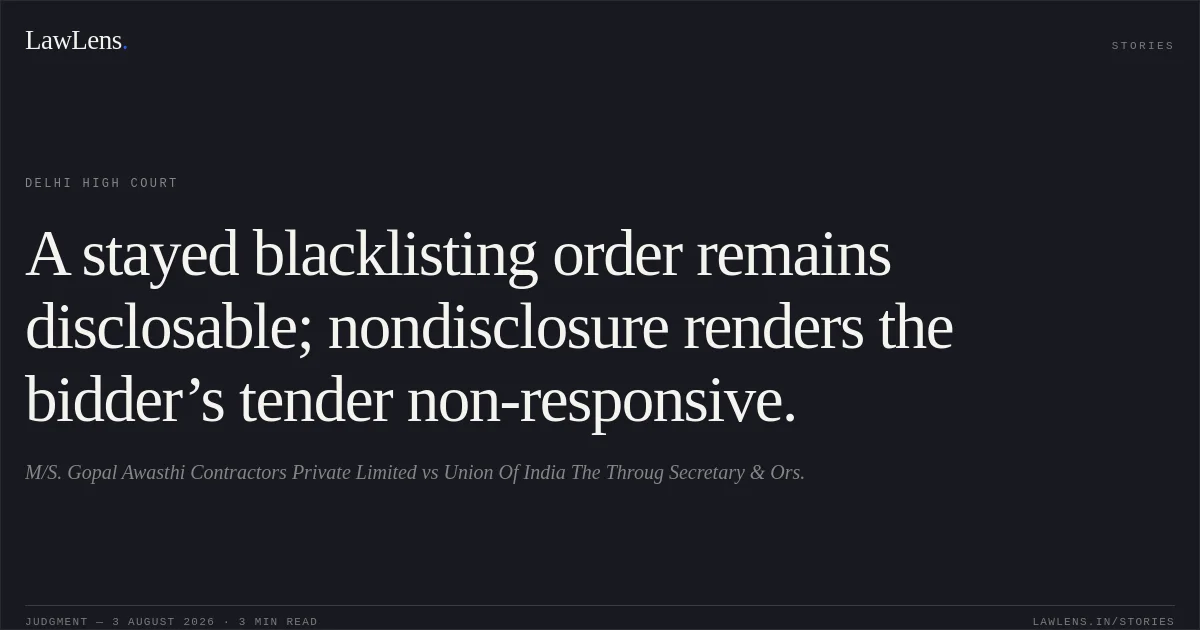
Source reference: pp. 6–7 / paras. 8–9An interim order staying the operation of an administrative order does not extinguish or obliterate that order; until set aside, the blacklisting order continues to exist and must be disclosed where the tender requires full disclosure.
Source reference: pp. 7–8 / para. 11The Court exercised its extraordinary jurisdiction under Article 226 of the Constitution to set aside the tender process and issue consequential directions.
Source reference: pp. 9–11 / paras. 15–18Reasoning
The tender conditions made absence of blacklisting a fundamental eligibility requirement and required an absolute declaration on that subject.
Source reference: pp. 6–7 / paras. 8–10Respondent No. 3’s undertaking omitted the DUSIB order dated 13 February 2020, which remained in existence notwithstanding the Commercial Court’s interim orders staying its operation.
Source reference: pp. 7–8 / para. 11Those orders did not authorise Respondent No. 3 to withhold the material fact; it was required to disclose both the blacklisting order and the orders staying its effect so that the procuring authority could independently assess the bidder’s eligibility and technical capacity.
Source reference: pp. 7–8 / para. 11The omission was therefore inconsistent with the express tender requirements and caused the procuring authority to undertake avoidable clarificatory and litigative proceedings.
Source reference: p. 8 / para. 12Accordingly, Respondent No. 3’s bid, though technically accepted by the Tender Committee, was non-responsive.
Source reference: p. 8 / para. 13In balancing the consequences, the Court also considered that the petitioner had benefited from continuing at a substantially lower licence fee while challenging the tender, and therefore made its undertaking to pay the L1 rate binding.
Source reference: pp. 9–10 / paras. 14–15Holding
The Court held that Respondent No. 3 was bound to disclose the DUSIB blacklisting order despite the interim stay of its operation.
Its failure to do so rendered the undertaking dated 8 August 2024 non-compliant and its bid non-responsive.
Source reference: pp. 7–8 / paras. 11–13The tender process dated 11 July 2024 was set aside, with liberty to Respondent No. 2 to issue a fresh tender and endeavour to complete it within four months.
Source reference: pp. 10–11 / para. 16The petitioner was directed to pay ₹2,95,801.86 per month from 24 July 2025 until termination of its contract, clear arrears up to 31 July 2026 within four weeks, and continue payment at that rate from August 2026; failure would attract 18% annual interest and could expose the petitioner to contempt and disqualification from future tenders.
Source reference: p. 10 / para. 15The writ petition was allowed and pending applications were disposed of.
Source reference: p. 11 / para. 18Original Court PDF
M/S. Gopal Awasthi Contractors Private LimitedvsUnion Of India The Throug Secretary & Ors.
Click to open original judgment
Original judgment, available to read, download and summarize on LawLens.in