Facts
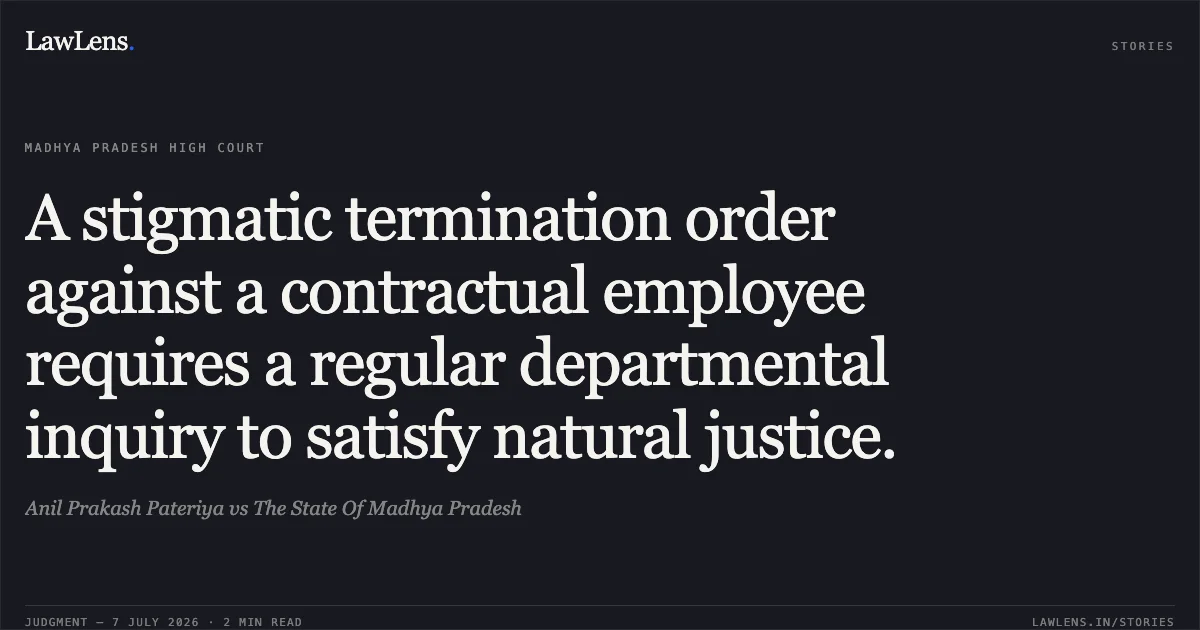
The petitioner was appointed as a Sub Engineer on a contractual basis, with his last attachment at the Zila Panchayat, Shivpuri
Source reference: para. 3Following a complaint, a fact-finding enquiry was conducted ex parte, during which the petitioner was held guilty of financial irregularities without being given an opportunity to cross-examine witnesses
Source reference: para. 3, 6A show-cause notice was issued on March 11, 2024, and despite the petitioner’s detailed reply, the respondents terminated his services via a stigmatic order dated March 27, 2024
Source reference: para. 3, 6Crucially, three other individuals facing similar allegations were reinstated, but the petitioner’s appeal to the appellate authority was rejected
Source reference: para. 3, 6The petitioner subsequently challenged the termination and the appellate order under Article 226 of the Constitution
Source reference: para. 2Issues
1. Whether a contractual employee’s services can be terminated through a stigmatic order without conducting a regular departmental enquiry
Source reference: para. 3, 62. Whether the termination order violated the principles of natural justice and the state's own policy regarding contractual service evaluations
Source reference: para. 10, 14Law Applied
The Court applied the settled legal principle that a stigmatic termination order entails serious consequences for future prospects and cannot be passed without a regular departmental enquiry
Source reference: para. 6, 8It relied on Rahul Tripathi v. Rajeev Gandhi Shiksha Mission [2001 (3) MPLJ 616] and Jitendra v. State of M.P. [2008 (4) MPLJ 670], which mandate an enquiry for stigmatic removals
Source reference: para. 8The Court further invoked the concept of "reasonable opportunity" as summarized in Khem Chand v. Union of India [1958 SC 300], emphasizing the right to deny guilt and cross-examine witnesses
Source reference: para. 8Additionally, the Court cited Clause 9.2 of the State Policy dated July 22, 2023, which requires a formal enquiry for serious allegations against contractual employees
Source reference: para. 14Reasoning
The Court examined the termination order (Annexure P/5) and found it explicitly stigmatic, as it branded the petitioner’s conduct as "serious financial irregularity, negligence, and misconduct"
Source reference: para. 9, 10The Court reasoned that since the order carried a stigma, a mere fact-finding enquiry followed by a show-cause notice was insufficient
Source reference: para. 6, 10By denying the petitioner the right to cross-examine witnesses and by failing to hold a regular departmental enquiry, the respondents violated the principles of natural justice and the specific mandates of the 2023 Policy
Source reference: para. 10, 14Furthermore, the Court noted that the respondents had unfairly singled out the petitioner while reinstating others similarly situated, thereby failing to provide equal treatment
Source reference: para. 3, 6Holding
The Court answered the issues in favor of the petitioner, holding that a stigmatic termination of a contractual employee without a full enquiry is legally unsustainable
The Court quashed the termination order dated March 27, 2024, and the appellate order dated July 22, 2025. The respondents were directed to reinstate the petitioner with all consequential benefits as granted to similarly situated persons within two months. However, back wages were denied on the principle of "no work, no pay," and the state was granted liberty to initiate a fresh enquiry in accordance with the law if deemed necessary
Source reference: para. 11, 15Original Court PDF
Anil Prakash PateriyavsThe State Of Madhya Pradesh
Click to open original judgment
Original judgment, available to read, download and summarize on LawLens.in