Facts
The petitioner, a contractor, claimed that private respondents Nos. 5 to 8—unemployed graduate civil engineers—had engaged him to execute retaining-wall works under the Minimata Hasdeo Bango Project pursuant to tenders issued in 2018.
Source reference: para. 1–2He asserted that he completed the works by deploying the necessary labour, materials, and expertise, but that the State authorities had not released the amounts payable to the private respondents.
Source reference: para. 1–2The petitioner sought production of the tender and payment records, directions for release of amounts due to the private respondents, and payment to him for the work allegedly executed on their behalf.
Source reference: para. 1–2The State contended that no work order had been issued in the petitioner’s favour and that he was merely a sub-contractor without any contractual relationship with the authorities.
Source reference: para. 3The work orders were found to have been issued only in favour of private respondents Nos. 5 to 8.
Source reference: para. 5Issues
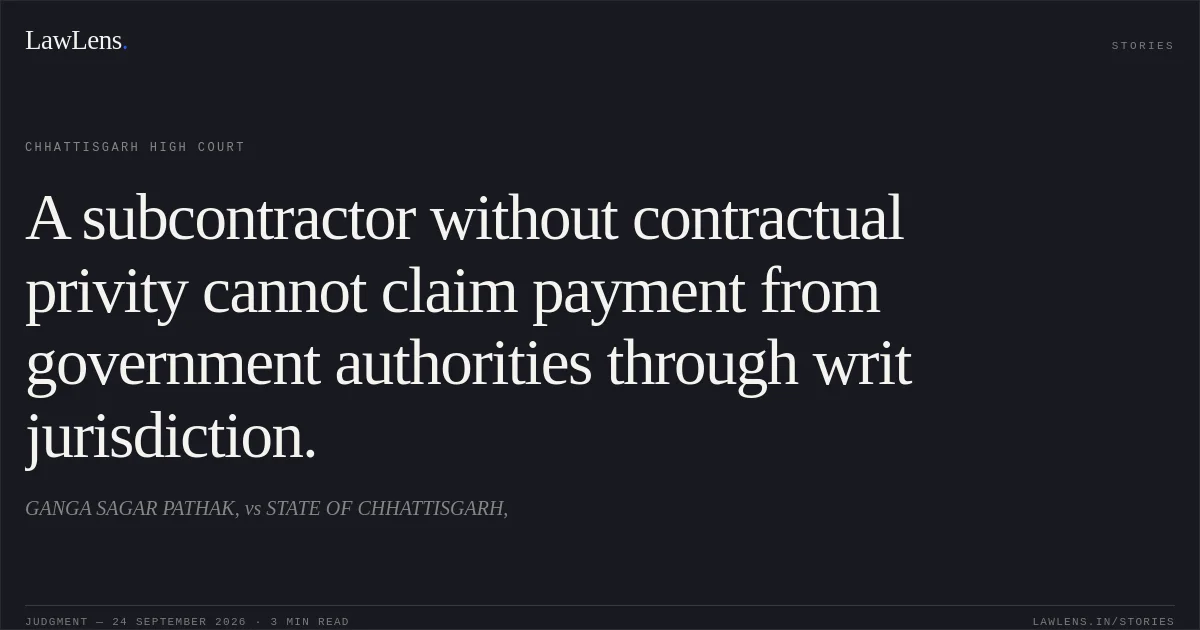
Whether the petitioner, who was not issued any work order and was not a party to the contracts between the State authorities and private respondents Nos. 5 to 8, could claim payment directly from the State authorities through a writ petition.
Source reference: para. 5–6Whether a dispute concerning payment allegedly due from the private respondents to the petitioner could be adjudicated in the present writ petition against the State authorities.
Source reference: para. 6Law Applied
The Court applied the principle of contractual privity, namely that a person who is not a party to a government contract and has no direct contractual relationship with the contracting authority cannot ordinarily enforce payment obligations arising under that contract against the authority.
Source reference: para. 5It further applied the principle that a writ petition under Article 226 is not the appropriate remedy for adjudication of a purely private contractual dispute, particularly where the alleged liability is between a contractor or sub-contractor and the private contracting parties rather than the State authorities.
Source reference: para. 6The Court also recognised that an aggrieved party may pursue any other remedy available in law against the persons with whom the contractual arrangement was made.
Source reference: para. 8Reasoning
The work orders were issued by the respondent authorities exclusively in favour of private respondents Nos. 5 to 8, and the petitioner neither held a work order from the authorities nor was a party to their contracts.
Source reference: para. 5Accordingly, even assuming that the petitioner had executed the works as a sub-contractor, his claim for payment arose, if at all, from his separate arrangement with the private respondents.
Source reference: para. 6The State authorities could not be directed to pay him in the absence of contractual privity or an enforceable right against them.
Source reference: para. 6Any dispute regarding the amount allegedly payable by the private respondents was therefore a private contractual dispute unsuitable for adjudication in the writ proceedings.
Source reference: para. 6Holding
The Court held that the petitioner had no enforceable claim against the respondent authorities because no work order or contractual relationship existed between them.
The writ petition was dismissed as devoid of merit and not maintainable against the State authorities.
Source reference: para. 7The dismissal did not prevent the petitioner from pursuing any remedy available in law against private respondents Nos. 5 to 8 for recovery of the alleged outstanding payment.
Source reference: para. 8Original Court PDF
GANGA SAGAR PATHAK,vsSTATE OF CHHATTISGARH,
Click to open original judgment
Original judgment, available to read, download and summarize on LawLens.in