Facts
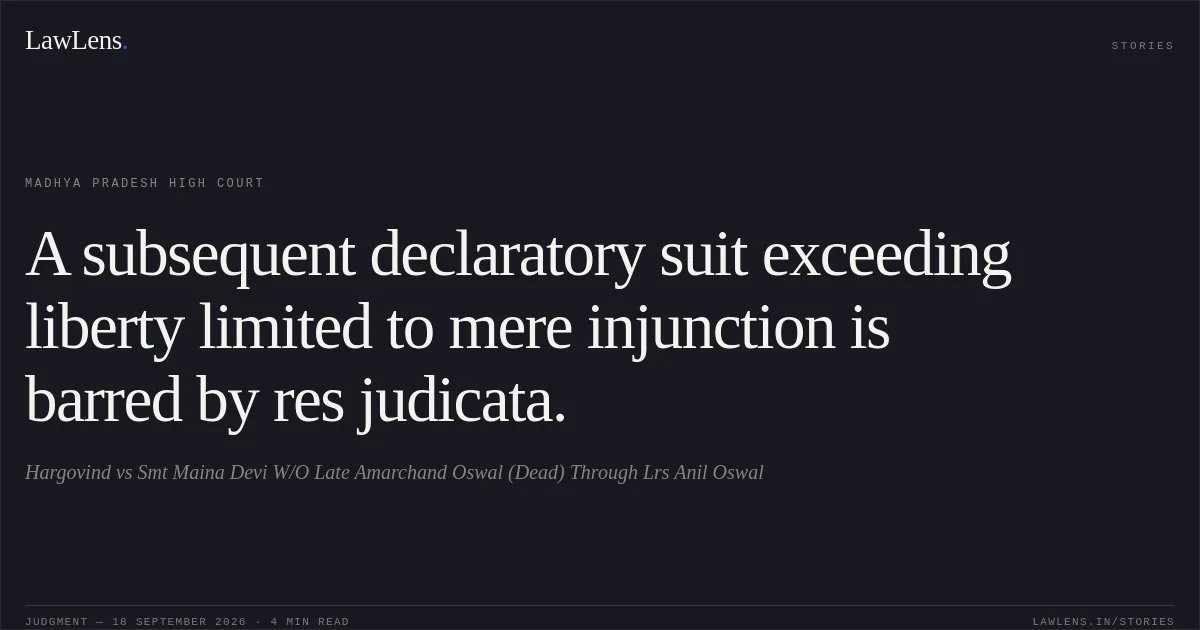
The plaintiff filed a suit under Section 96 CPC challenging the trial court’s order dated 24 January 2018, by which the plaint was rejected under Order VII Rule 11(d) CPC as barred by res judicata under Section 11 CPC.
Source reference: p.1, para. 1In an earlier suit, the plaintiff had claimed ownership and possession over the disputed land on the basis of adverse possession and had sought permanent injunction against the defendant.
Source reference: pp.8–10, paras. 9–12The earlier suit was dismissed because, although the plaintiff was found to be in possession, the possession was not peaceful and therefore did not satisfy the requirements of adverse possession.
Source reference: pp.8–10, paras. 9–12The dismissal was affirmed in appeal and in Second Appeal No. 321/2003.
Source reference: pp.11–12, para. 13In the second appeal, the High Court granted limited liberty to approach a civil court for “merely injunction” if the plaintiff was forcibly dispossessed, while clarifying that the order would not constitute a defence in proceedings under Section 250 of the M.P. Land Revenue Code or other proceedings initiated in accordance with law.
Source reference: pp.11–12, para. 13The plaintiff thereafter instituted the present suit seeking a declaration that the defendant had no legal right to dispossess him and that the defendant’s right to recover possession had been extinguished under the Limitation Act, along with a decree of permanent injunction.
Source reference: pp.6–7, para. 8The trial court held that the subsequent suit, though differently worded, substantially sought to re-agitate the claim based on adverse possession and was barred by res judicata.
Source reference: pp.12–13, paras. 16–18Issues
1. Whether the plaint could be rejected under Order VII Rule 11(d) CPC on the ground that the subsequent suit was barred by res judicata, despite res judicata ordinarily involving mixed questions of law and fact?
Source reference: pp.5–6, paras. 7–72. Whether the subsequent suit for declaration and permanent injunction fell within the limited liberty granted in the earlier second appeal to seek merely an injunction against forcible dispossession?
Source reference: pp.11–12, paras. 13–153. Whether the plaintiff could reassert, through the subsequent suit, that the defendant’s right to recover possession had been extinguished by limitation, when the earlier suit had already rejected the plaintiff’s claim based on adverse possession?
Source reference: pp.6–7, 12–13, paras. 8, 16–17Law Applied
The Court applied Order VII Rule 11(d) CPC, under which a plaint must be rejected where the suit appears from the statements in the plaint to be barred by law, and Section 11 CPC concerning res judicata.
Source reference: no citationIt noted the general principle that res judicata is ordinarily pleaded in the written statement and may involve consideration of the defence and evidence, relying on Srihari Hanumandas Totala v. Hemant Vithal Kamat, AIR 2021 SC 3802.
Source reference: p.5, para. 7However, where the plaint itself contains sufficient pleadings regarding the earlier litigation and its result, the bar may be considered at the Order VII Rule 11 stage.
Source reference: pp.5–6, para. 7The Court also applied the principles governing adverse possession stated in Karnataka Wakf Board v. Government of India, (2004) 10 SCC 779: possession must be peaceful, open, continuous, actual, exclusive and hostile, and the plea is a mixed question of fact and law requiring proof of the date, nature, publicity, duration and continuity of possession.
Source reference: pp.9–10, para. 12The Court further considered Section 27 of the Limitation Act and Section 250 of the M.P. Land Revenue Code, as well as the limited liberty granted in the earlier second appeal to seek only an injunction against forcible dispossession in accordance with law.
Source reference: pp.6–7, 11–12, paras. 8, 13Reasoning
The High Court held that although res judicata is normally unsuitable for determination under Order VII Rule 11(d) CPC because it may require examination of the defence, the present plaint itself disclosed the earlier suit, the judgments rendered therein and the basis on which the subsequent suit was filed.
Source reference: pp.5–6, para. 7Consequently, the court could determine the legal effect of the earlier proceedings from the plaint and the admitted litigation history.
Source reference: pp.5–6, para. 7The earlier suit had already rejected the plaintiff’s claim that his long possession matured into title by adverse possession, and the proceedings under Section 250 of the M.P. Land Revenue Code had not been displaced by that judgment.
Source reference: pp.9–12, paras. 11–16The liberty granted in the second appeal was narrow: it permitted a proceeding for a mere injunction if the plaintiff faced forcible dispossession, but expressly preserved the defendant’s right to pursue lawful remedies, including proceedings under Section 250.
Source reference: pp.11–12, para. 13The present suit exceeded that liberty because it sought a declaration that the defendant had no legal right to dispossess the plaintiff and that the defendant’s right to recover possession had been extinguished under the Limitation Act.
Source reference: pp.6–7, 12–13, paras. 8, 15–17In substance, these reliefs sought to revive and repackage the previously rejected adverse-possession claim, notwithstanding the different wording of the plaint.
Source reference: pp.6–7, 12–13, paras. 8, 15–17The subsequent suit was therefore barred by res judicata.
Source reference: no citationHolding
The Court answered the issues against the plaintiff.
It held that, in the circumstances of the case, the trial court was entitled to examine the bar of res judicata under Order VII Rule 11(d) CPC because the plaint itself disclosed the earlier litigation and its outcome.
Source reference: pp.5–6, para. 7The subsequent suit for declaration and permanent injunction was beyond the limited liberty granted in the earlier second appeal and substantially re-agitated the plaintiff’s unsuccessful claim based on adverse possession and extinguishment of the defendant’s right to recover possession.
Source reference: pp.11–13, paras. 13–18Finding no error or perversity in the trial court’s order, the High Court dismissed the first appeal and affirmed rejection of the plaint under Order VII Rule 11(d) CPC.
Source reference: p.13, paras. 18–19Acts & Sections Cited
4 provisions across 3 statutes referred to in this judgment. Each provision opens on LawLens.
Code of Civil Procedure, 19082
MP Land Revenue Code 19591
Limitation Act, 19631
Original Court PDF
HargovindvsSmt Maina Devi W/O Late Amarchand Oswal (Dead) Through Lrs Anil Oswal
Click to open original judgment
Original judgment, available to read, download and summarize on LawLens.in