Facts
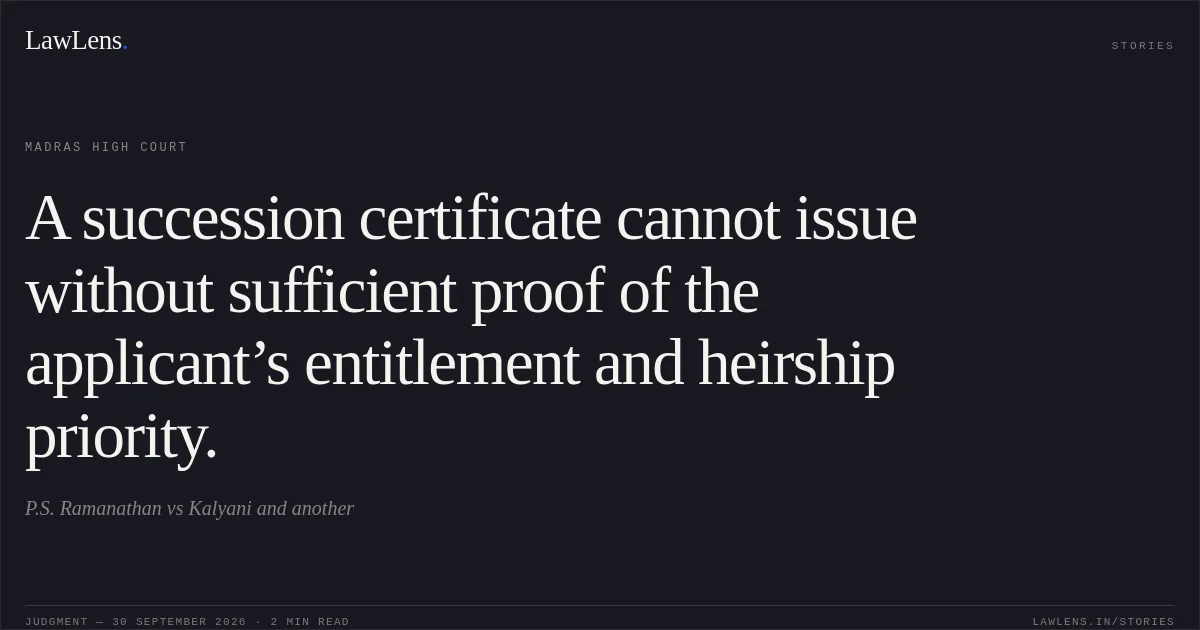
The petitioner sought a succession certificate under Section 372 of the Indian Succession Act, 1925, for debts and securities worth Rs.59,02,778.45 belonging to S.N. Jayalakshmi, who died intestate, unmarried and without children.
Source reference: paras. 1–4, pp. 1–3He claimed through a maternal cousin relationship. The two respondents, his sisters, consented to the grant.
Source reference: paras. 1–4, pp. 1–3The genealogy disclosed several other branches of the deceased’s family, but the descendants of those branches and the position of heirs on her father’s side were not established.
Source reference: paras. 1–4, pp. 1–3The Court directed the petitioner to produce a legal-heir certificate; he later stated that he could not trace it, and produced neither that certificate nor equivalent evidence addressing the gaps.
Source reference: para. 5, pp. 3–4Issues
1. Whether the petitioner established that he was entitled to a succession certificate, or had prima facie the best title to it, despite the unresolved questions concerning other potential heirs.
Source reference: para. 6, p. 42. Whether the respondents’ consent, absence of objections after publication, or the deceased’s lifetime power of attorney established the petitioner’s entitlement.
Source reference: para. 6, p. 4Law Applied
Section 372 of the Indian Succession Act, 1925, provides for an application for a succession certificate.
Source reference: para. 6, p. 4Under Section 373(2), the Court must be satisfied that the applicant’s right to the certificate belongs to them; under Section 373(3), where entitlement cannot be finally determined, the Court may consider who appears to have prima facie the best title.
Source reference: para. 6, p. 4Section 15 of the Hindu Succession Act, 1956, governs the order of succession to a female Hindu’s property, requiring consideration of the relevant lines of kinship and, where applicable, the source of the property.
Source reference: para. 4, p. 3Reasoning
The genealogy showed five family branches beyond the petitioner’s branch, but the descendants of those branches had not been identified; the evidence also did not establish whether there were heirs on the deceased’s father’s side.
Source reference: paras. 4, 6, pp. 3–4The Court therefore could not determine the applicable succession priority under Section 15 or conclude that the petitioner had the right to the certificate or prima facie the best title under Section 373.
Source reference: paras. 4, 6, pp. 3–4The respondents’ consent and the lack of objections following publication did not resolve the rights of unidentified persons, while the power of attorney did not establish succession rights.
Source reference: paras. 5–7, pp. 3–4The petitioner’s failure to produce the directed certificate or equivalent evidence left the material gaps unresolved.
Source reference: paras. 5–7, pp. 3–4Holding
The Court held that the petitioner had not sufficiently proved his entitlement to a succession certificate.
It dismissed the petition for non-compliance with its order dated 7 September 2026 and made no order as to costs.
Source reference: paras. 7–8, p. 4Acts & Sections Cited
4 provisions across 3 statutes referred to in this judgment. Each provision opens on LawLens.
Indian Succession Act, 19252
Bharatiya Sakshya Adhiniyam, 20231
Hindu Succession Act, 19561
Original Court PDF
P.S. RamanathanvsKalyani and another
Click to open original judgment
Original judgment, available to read, download and summarize on LawLens.in