Facts
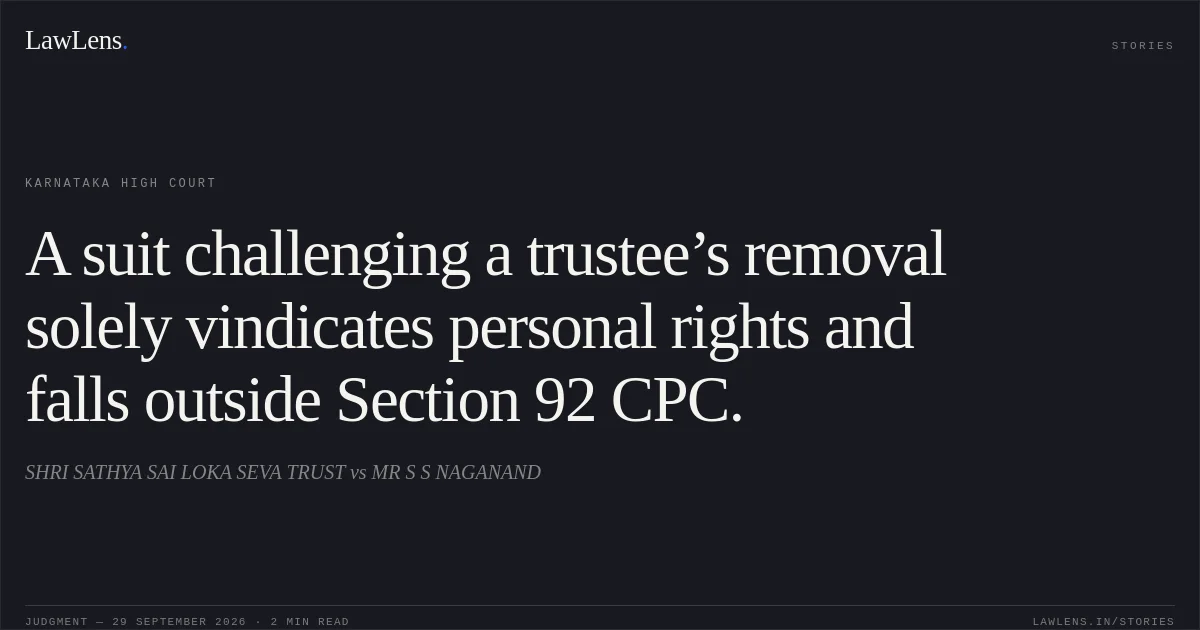
The plaintiff sued to challenge a resolution allegedly passed at a Board of Trustees meeting on 21–23 January 2017, which removed him as a trustee of the first defendant trust. He sought declarations that the resolution and meeting were invalid, together with injunctions against giving effect to his removal or interfering with his discharge of trustee duties.
Source reference: pp. 4–5, 45–47; paras. 2, 33The defendants applied under Order VII Rule 11(d) CPC to reject the plaint, contending that the suit was barred by Section 92 CPC. The trial court dismissed the application on 2 March 2026, and the defendants challenged that order in revision.
Source reference: pp. 5–6; paras. 3–4The judgment also noted an earlier suit concerning the trust and subsequent proceedings, including disposal of an SLP in which the Supreme Court left the parties’ contentions open.
Source reference: pp. 22–25; paras. 17–18Issues
1. Whether, on the plaint read as a whole, the suit was in substance a representative action to vindicate public rights or an action to enforce the plaintiff’s personal right to the office of trustee, thereby attracting Section 92 CPC.
Source reference: pp. 44–48; paras. 31–352. Whether the plaint disclosed a bar under Section 92 CPC apparent on its face, warranting rejection under Order VII Rule 11(d) CPC.
Source reference: pp. 47–49; para. 35Law Applied
Section 92 CPC applies to a suit concerning a public charitable or religious trust where the plaint alleges a breach of trust or the need for the court’s directions in the trust’s administration, seeks one or more of the statutory reliefs or an analogous relief, and is brought to vindicate public rights in a representative capacity.
Source reference: pp. 40–44; paras. 28–31The court must look beyond the form of the reliefs and assess the plaint as a whole, including the capacity in which the plaintiff sues and the suit’s dominant purpose; a claim primarily to vindicate an individual or personal right falls outside Section 92 [*Swami Paramatmanand Saraswati v. Ramji Tripathi*, (1974) 2 SCC 695; *Vidyodaya Trust v. Mohan Prasad R*, (2008) 4 SCC 115]. Under Order VII Rule 11(d), rejection is warranted only where the legal bar is apparent from the plaint; the defence cannot supply the basis for rejection.
Source reference: pp. 26–30, 48; paras. 31–32, 35Reasoning
The court examined the reliefs and the plaint’s substance, rather than treating the allegations about the trust’s history and administration as decisive. The reliefs focused on whether the plaintiff had been validly removed and on protecting his ability to discharge his own duties as trustee; they did not seek a scheme, accounts, removal or appointment of trustees for the trust’s general administration, or other relief directed to vindicating public rights.
Source reference: pp. 45–48; paras. 33–35The surrounding allegations therefore did not convert the personal dispute into a representative action under Section 92. Since the plaint itself did not establish that Section 92 barred the suit, rejection under Order VII Rule 11(d) was not justified.
Source reference: p. 48; para. 35Holding
The High Court held that the suit, as framed, sought to vindicate the plaintiff’s individual right concerning his removal from trusteeship and was not barred by Section 92 CPC.
It dismissed the civil revision petition as devoid of merit and directed that any pending interlocutory applications stand closed.
Source reference: p. 49; final orderActs & Sections Cited
5 provisions across 2 statutes referred to in this judgment. Each provision opens on LawLens.
Indian Trust Act, 18823
Code of Civil Procedure, 19082
Original Court PDF
SHRI SATHYA SAI LOKA SEVA TRUSTvsMR S S NAGANAND
Click to open original judgment
Original judgment, available to read, download and summarize on LawLens.in