Facts
Reena Devi, the appellant’s wife, was found dead at their matrimonial home on 21 October 2013.
Source reference: p. 2–4Her father’s report alleged that the appellant and his mother had assaulted and poisoned her.
Source reference: p. 2–4The appellant was charged under Sections 302 and 328 IPC and was convicted under Section 302 IPC by the Sessions Court, which sentenced him to life imprisonment and a fine.
Source reference: p. 2–4, 8At trial, no witness testified to seeing the appellant administer poison or otherwise cause the death; several prosecution witnesses were hostile or had no knowledge of the incident.
Source reference: p. 5–7The post-mortem doctor described suspected poisoning but was unable to confirm that poison had been administered or determine the cause of death with certainty.
Source reference: p. 5–7The appellant appealed against his conviction and sentence.
Source reference: p. 1–2, 8Issues
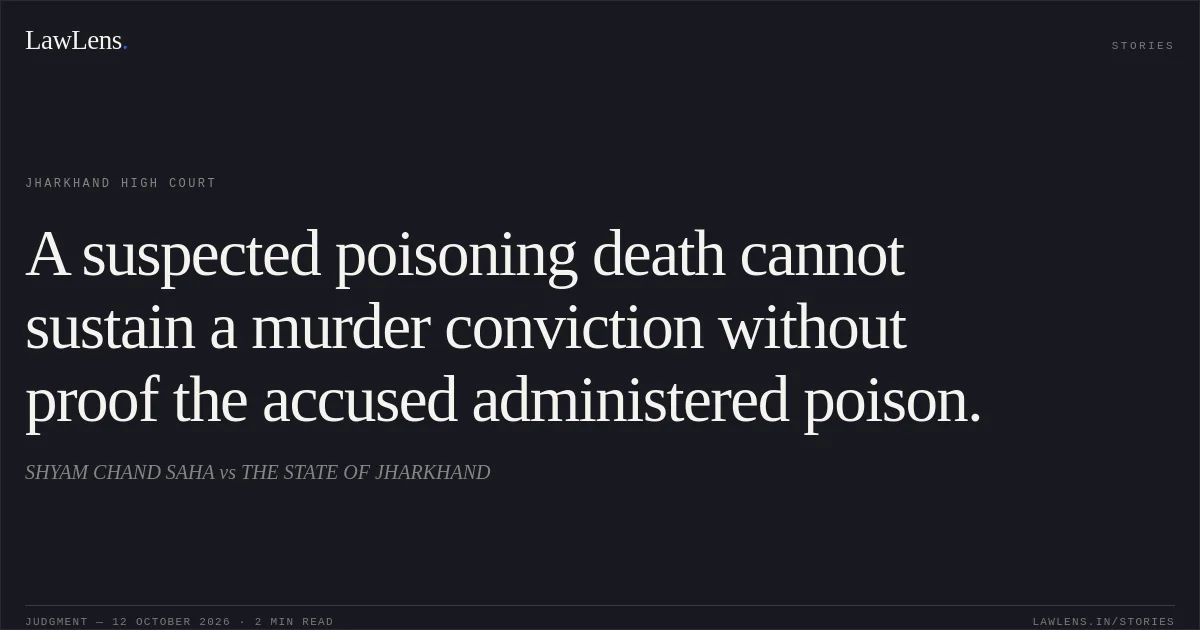
1. Whether the evidence established beyond reasonable doubt that the deceased’s death was caused by poisoning administered by the appellant, sustaining his conviction under Section 302 IPC.
Source reference: p. 8–92. Whether the circumstantial evidence formed a complete chain sufficient to prove the appellant’s guilt.
Source reference: p. 9Law Applied
The Court considered Section 302 IPC, under which the prosecution had to establish the appellant’s criminal responsibility for murder, and the prosecution’s allegations under Sections 328 and 34 IPC.
Source reference: p. 2–4It applied the principle that, in a case based on circumstantial evidence, each circumstance must be proved beyond reasonable doubt and the circumstances must form a complete chain establishing guilt; conjecture or suspicion is insufficient.
Source reference: p. 9Reasoning
The Court found that no witness placed the appellant at the scene or saw him administer poison. The room was locked from the outside and had to be opened by breaking the lock; the evidence did not establish who had locked it or that the appellant was present.
Source reference: p. 9The medical evidence did not conclusively establish poisoning or show forceful administration, and the doctor was uncertain about both the cause of death and whether poison had been administered.
Source reference: p. 5–6, 9The Court also noted inconsistencies in the informant’s account of who had telephoned him about the incident.
Source reference: p. 8–9It held that additional evidence sought by the State would not cure the failure to connect the appellant to the death, and that the circumstances did not complete the chain required to prove guilt.
Source reference: p. 9Holding
The Court held that the prosecution had failed to prove the appellant’s guilt under Section 302 IPC beyond reasonable doubt.
It set aside the conviction and sentence, acquitted the appellant, and directed his release from custody; the appeal was allowed and the pending interlocutory applications were disposed of.
Source reference: p. 10Acts & Sections Cited
4 provisions across 2 statutes referred to in this judgment. Each provision opens on LawLens.
Indian Penal Code, 18603
Code of Criminal Procedure, 19731
Original Court PDF
SHYAM CHAND SAHAvsTHE STATE OF JHARKHAND
Click to open original judgment
Original judgment, available to read, download and summarize on LawLens.in