Facts
Dahod Kharid Vechan Sangh Ltd., a cooperative society and owner of City Survey No. 7598, admeasuring 81.06 sq. metres, issued a tender notice inviting sealed offers for sale of the property, reserving the right to accept or reject any tender.
Source reference: paras. 3, 14–15; pp. 2, 16–17The plaintiff claimed that he submitted the highest bid of Rs.10,50,000 on 15 January 2004 and subsequently agreed to enhance it to Rs.11,50,000 at the request of the society’s office-bearers.
Source reference: paras. 3.1–3.3; pp. 2–3He alleged that, despite his bid, the society executed a registered sale deed dated 22 March 2004 in favour of defendant No.2, showing consideration of Rs.3,01,000, although the actual consideration was allegedly Rs.11,50,300.
Source reference: para. 3.2; p. 3The plaintiff instituted Special Civil Suit No.8 of 2005 seeking cancellation of the sale deed, specific performance of the alleged oral agreement, and injunctive relief.
Source reference: para. 3.4; p. 3Defendant No.1 did not contest the suit, while defendant No.2 denied the plaintiff’s bid and contended that a tender was merely an invitation to offer, that no concluded contract existed, and that he was a bona fide purchaser for value without notice.
Source reference: para. 3.5; pp. 3–4Although the trial court had earlier rejected the plaintiff’s temporary-injunction application for failure to establish even a prima facie case, it subsequently partly decreed the suit, set aside the sale deed, and directed execution of a sale deed in favour of the plaintiff.
Source reference: paras. 1.1–1.2, 3.6–3.7, 9; pp. 1–2, 4, 12–14Defendant No.2 preferred the present first appeal under Section 96 of the Code of Civil Procedure, 1908.
Source reference: para. 1; p. 1Issues
Whether the plaintiff proved that he had submitted a valid bid pursuant to the tender notice issued by defendant No.1?
Source reference: para. 13(i); p. 16Whether mere submission of a bid pursuant to a tender notice created an enforceable contractual right or a concluded contract entitling the plaintiff to specific performance?
Source reference: para. 13(ii); p. 16Whether the trial court committed a manifest error in decreeing cancellation of the registered sale deed and specific performance in favour of the plaintiff?
Source reference: para. 13(iii); p. 16Whether the appellant established that he was a bona fide purchaser for value without notice?
Source reference: Trial Court Issue Nos. 7–8; para. 11; pp. 15–16Law Applied
The Court applied Section 96 of the Code of Civil Procedure, 1908, governing first appeals.
Source reference: para. 1; p. 1It held that a tender notice is ordinarily an invitation to offer and that a bid is merely an offer; no enforceable contract arises until the bid is accepted by the inviting authority. Relying on Meerut Development Authority v. Association of Management Studies, (2009) 6 SCC 171, the Court reiterated that a bidder has no vested right to compel acceptance of his bid.
Source reference: paras. 16–18; pp. 18–19Under Section 16(c) of the Specific Relief Act, 1963, as it stood before the 2018 amendment, a plaintiff seeking specific performance must plead and prove continuous readiness and willingness to perform his contractual obligations; “readiness” concerns financial capacity, while “willingness” concerns conduct and intention.
Source reference: paras. 18–21; pp. 19–23The Court relied on Mayawanti v. Kaushalya Devi, (1990) 3 SCC 1, N.P. Thirugnanam v. Dr. R. Jagan Mohan Rao, (1995) 5 SCC 115, His Holiness Acharya Swami Ganesh Dassji v. Sita Ram Thapar, (1996) 4 SCC 526, Umabai v. Nilkanth Dhondiba Chavan, (2005) 6 SCC 243, Man Kaur v. Hartar Singh Sangha, (2010) 10 SCC 512, and Mohammed Khaleel v. Jayamma, 2026 LiveLaw (SC) 638.
Source reference: paras. 18–21; pp. 19–23The Court also referred to Sections 101 and 114(g) of the Indian Evidence Act, 1872 concerning the burden of proof and adverse inference.
Source reference: paras. 5.2, 6.3; pp. 6, 10Section 54 of the Transfer of Property Act, 1882 was noted in relation to the transfer of title through a registered sale deed.
Source reference: para. 22; p. 24Reasoning
The Court found that the plaintiff failed to prove the foundational fact that his alleged bid, marked Exhibit 80, was ever submitted to or received by defendant No.1. The document was merely a loose sheet without an inward stamp or acknowledgment, and the plaintiff produced no postal receipt, certificate of posting, acknowledgment card, or other evidence of dispatch or delivery.
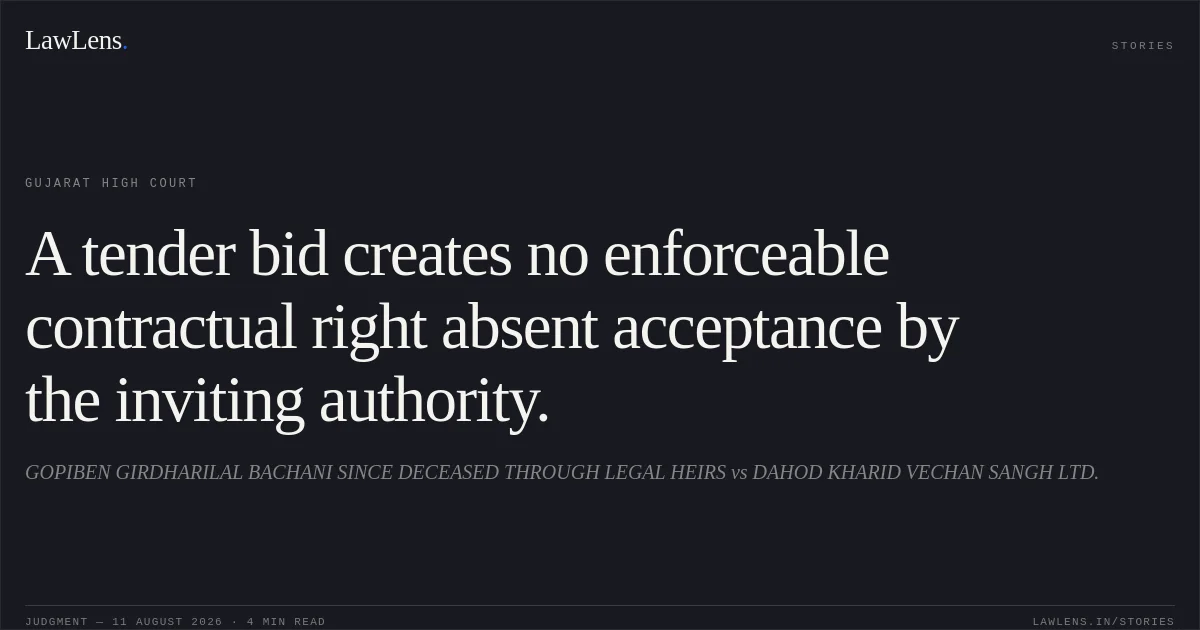
Source reference: paras. 15–16; pp. 17–18Even assuming that a bid had been submitted, the tender notice expressly reserved defendant No.1’s right to accept or reject any tender; therefore, submission of the bid did not create a concluded contract or an enforceable right to purchase the property.
Source reference: paras. 14–18; pp. 16–19The plaintiff also neither established any oral agreement nor proved continuous readiness and willingness, having neither paid nor tendered any part of the consideration or demonstrated an enforceable contractual obligation.
Source reference: para. 20; p. 23Consequently, the essential foundation for specific performance was absent under Section 16(c) of the Specific Relief Act.
Source reference: para. 20; p. 23The Court further held that the trial court’s final findings were irreconcilable with its earlier order rejecting temporary injunction for want of a prima facie case, demonstrating a manifest error in appreciation of the same material.
Source reference: paras. 9–10, 20, 23; pp. 12–14, 23–25Holding
The High Court held that the plaintiff did not prove submission of a valid bid, the existence of a concluded contract, or continuous readiness and willingness to perform his alleged contractual obligations. Mere participation in or submission of a tender did not confer a right to specific performance.
The appeal filed by defendant No.2 was accordingly allowed, and the judgment and decree dated 11 December 2006 in Special Civil Suit No.8 of 2005 were quashed and set aside. The decree was directed to be drawn accordingly, and any connected civil application was disposed of as not surviving.
Source reference: paras. 23–25; p. 25Acts & Sections Cited
9 provisions across 4 statutes referred to in this judgment. Each provision opens on LawLens.
Code of Civil Procedure, 19081
Gujarat Cooperative societies Act-19615
Specific Relief Act, 19632
Transfer of Property Act, 18821
Original Court PDF
GOPIBEN GIRDHARILAL BACHANI SINCE DECEASED THROUGH LEGAL HEIRSvsDAHOD KHARID VECHAN SANGH LTD.
Click to open original judgment
Original judgment, available to read, download and summarize on LawLens.in