Facts
Javarayigowda sued for partition and separate possession of a one-half share in properties covered by a compromise decree in an earlier partition suit, contending that the properties had been allotted jointly to him and his son, defendant No. 1.
Source reference: paras. 4–7, 16–17During the suit, he amended the plaint to plead that he had made a registered Will bequeathing his share to his four daughters; after his death, they continued the suit as his legal representatives and claimed under the Will.
Source reference: paras. 9, 39–42The Trial Court decreed the suit, but the First Appellate Court reversed the decree, holding, among other things, that the compromise limited Javarayigowda’s rights and that the Will was not proved.
Source reference: paras. 10–13The daughters appealed to the High Court.
Source reference: para. 14Issues
1. Whether the absence of a prayer to set aside the compromise decree in O.S. No. 109/1989 barred the appellants from claiming a share in the suit properties.
Source reference: para. 142. Whether the First Appellate Court’s finding that Javarayigowda’s Will dated 21 October 2000 was not proved was perverse, palpably erroneous, or contrary to the amended pleadings.
Source reference: para. 15Law Applied
A compromise decree must be read as a whole, giving effect to its terms without implying a relinquishment of a vested proprietary interest unless the intention to relinquish is clearly expressed.
Source reference: paras. 19, 22–28A party seeking to enforce a right recognised by a decree need not seek to set it aside unless the relief would impeach or nullify it.
Source reference: paras. 33–36The Court considered Section 63 of the Indian Succession Act, 1925 and Sections 68 and 70 of the Indian Evidence Act, 1872 concerning execution and proof of a Will; it cited H. Venkatachala Iyengar v. B.N. Thimmajamma, AIR 1959 SC 443, on proof of due execution and the need to address suspicious circumstances.
Source reference: paras. 43–44It also relied on Order VIII Rules 2 and 9 of the Code of Civil Procedure in considering the defendant’s failure to file an additional written statement specifically disputing the amended Will pleading.
Source reference: para. 43Reasoning
The High Court construed the compromise as jointly allotting the properties to Javarayigowda and defendant No. 1.
Source reference: paras. 17–32It read the later devolution clause as governing defendant No. 1’s interest and excluding a future claim by Timmegowda, rather than as divesting Javarayigowda of his own share.
Source reference: paras. 17–32Because the appellants relied on rights arising from the compromise itself, their partition claim did not require a prayer to set the decree aside.
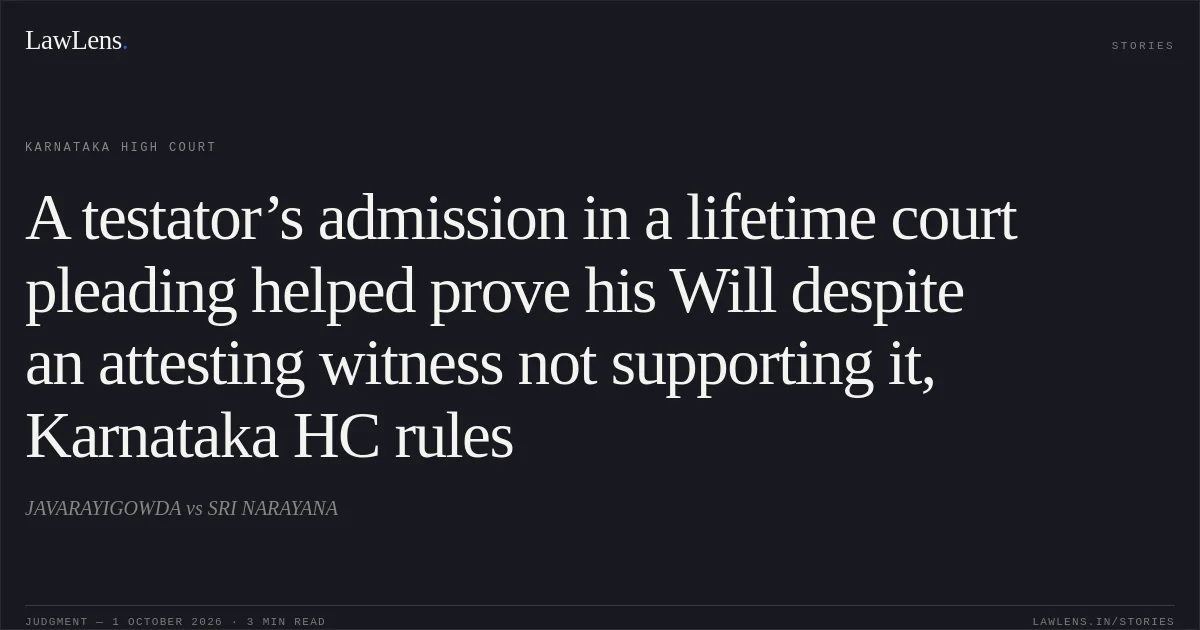
Source reference: paras. 33–38On the Will, the Court emphasised that Javarayigowda had pleaded its execution, registration, beneficiaries, and voluntariness during his lifetime, and that the defendant had not specifically controverted the amended pleading.
Source reference: paras. 39–44It held that the First Appellate Court had failed to assess that pleading and the surrounding evidence cumulatively; the attesting witness’s failure to support the execution did not, in the circumstances, justify rejecting the Will.
Source reference: paras. 45–48Holding
The Court answered the first substantial question of law in the negative: absence of a prayer to set aside the compromise decree did not bar the appellants’ claim.
It answered the additional question in the affirmative, set aside the First Appellate Court’s judgment and restored the Trial Court’s decree.
Source reference: paras. 48–49, 53The appellants were held entitled, under the Will, to Javarayigowda’s share, and the Trial Court was directed to proceed with drawing the final decree, if not already drawn; no order as to costs was made.
Source reference: para. 53Acts & Sections Cited
2 provisions across 2 statutes referred to in this judgment. Each provision opens on LawLens.
Code of Civil Procedure, 19081
Indian Succession Act, 19251
Original Court PDF
JAVARAYIGOWDAvsSRI NARAYANA
Click to open original judgment
Original judgment, available to read, download and summarize on LawLens.in