Facts
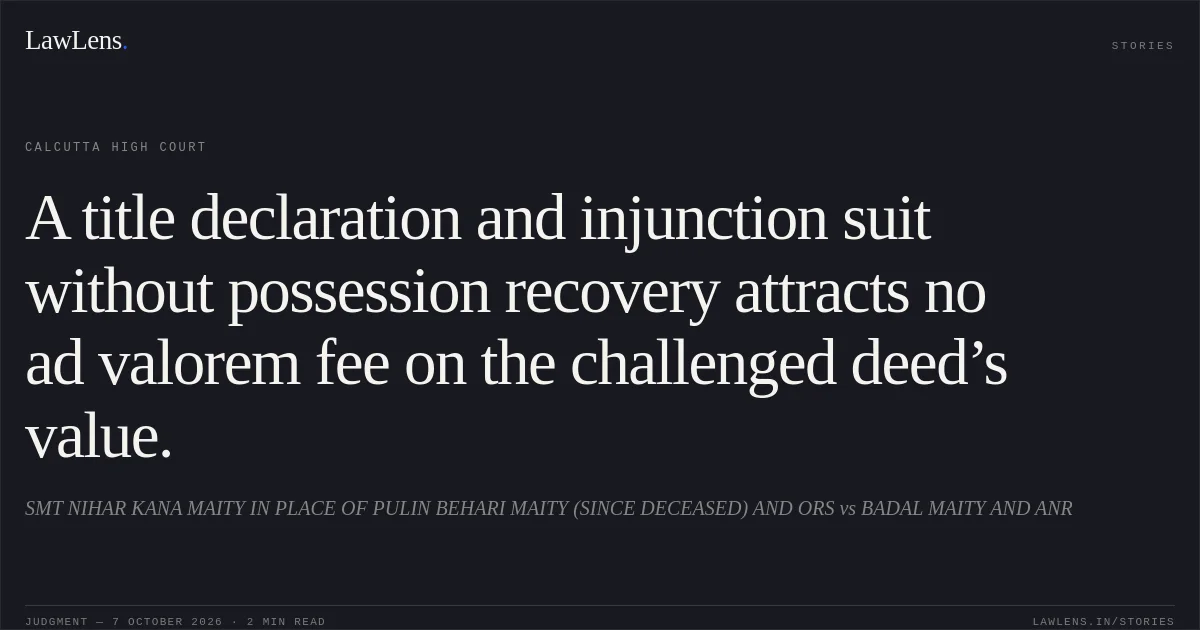
Pulin Behari Maity alleged that his son had fraudulently obtained a gift deed from him by representing that the document was a power of attorney. He sued for declaration of title and possession, a declaration that the deed was illegal and not binding on him, and permanent injunction; he did not seek recovery of possession or expressly seek cancellation of the deed.
Source reference: para. 13–15, 22After Pulin’s death, his heirs were substituted.
Source reference: para. 8–11The defendant applied for an order requiring payment of ad valorem court fees based on the deed’s valuation. The trial court allowed the application and directed payment, failing which the plaint would be rejected under Order VII Rule 11(c) CPC. The plaintiffs challenged that order in revision.
Source reference: para. 8–12Issues
1. Whether plaintiffs who seek a declaration that a deed allegedly obtained by fraud is illegal and not binding, while asserting possession and not seeking recovery of possession, must pay ad valorem court fees based on the deed’s valuation?
Source reference: para. 15–18, 222. Whether the trial court’s direction to pay ad valorem court fees on the valuation of the deed could be sustained under the West Bengal Court-fees Act, 1970?
Source reference: para. 17–23Law Applied
Section 7 of the West Bengal Court-fees Act, 1970 provides for computation of court fees according to the category of relief sought; under Section 7(iv)(b), a suit seeking a declaratory decree with consequential relief is valued by the plaintiff, subject to the Act’s provisions.
Source reference: para. 18The Court relied on Umapada Jati v. Manas Jati and Paresh Chandra Nath v. Naresh Chandra Nath, which support the position that, where plaintiffs allege fraud, assert possession, and seek a declaration rather than cancellation, ad valorem fees need not be calculated on the deed’s consideration or valuation.
Source reference: para. 19–20It distinguished Suhrid Singh alias Sardool Singh v. Randhir Singh and Agra Diocesan Trust Association v. Anil David because the relevant court-fee provisions in those cases were not pari materia with the West Bengal Act.
Source reference: para. 21Reasoning
The plaint alleged that the deed had been procured by misrepresentation and sought declarations of title and that the deed was not binding, together with an injunction. The plaintiffs claimed possession and did not seek its recovery or expressly seek cancellation of the deed.
Source reference: para. 13–15, 22The Court therefore treated the suit as one for declaration with consequential relief, not as a suit requiring court fees computed on the deed’s valuation under the provisions concerning possession.
Source reference: para. 22It held that Section 7(iv)(b) governed the court-fee question and that the authorities relied on by the defendant did not justify the trial court’s direction.
Source reference: para. 19–22Holding
The Court held that the impugned direction to pay ad valorem court fees based on the valuation of the deed could not be sustained and set aside the trial court’s order.
The revisional application was disposed of without costs, and the trial court was directed to proceed with the suit in accordance with law.
Source reference: para. 24–25Acts & Sections Cited
2 provisions across 1 statute referred to in this judgment. Each provision opens on LawLens.
west bengal court-fees act, 19702
Original Court PDF
SMT NIHAR KANA MAITY IN PLACE OF PULIN BEHARI MAITY (SINCE DECEASED) AND ORSvsBADAL MAITY AND ANR
Click to open original judgment
Original judgment, available to read, download and summarize on LawLens.in