Facts
The Applicant was initially employed by Halliburton Offshore Services Inc. (“HOSI”) under an Appointment Letter dated 18 March 2019, which contained an arbitration clause in Clause 37 providing for arbitration of disputes arising out of or relating to the employment agreement.
Source reference: paras. 12; p. 6His employment with HOSI was terminated on 31 January 2020 and he was simultaneously offered employment by Halliburton India Operations Pvt. Ltd. (“HIOPL”) from 1 February 2020 on terms and conditions “not less favourable” than those applicable to his employment with HOSI.
Source reference: para. 13; p. 7Following workplace complaints and an internal investigation, his employment was terminated with immediate effect on 28 July 2025.
Source reference: paras. 2–4; pp. 2–3The Applicant challenged the termination and sought invocation of the arbitration clause.
Source reference: paras. 5–6, 26–27; pp. 3–4, 13–15The Applicant therefore filed the present application under Section 11(6) of the Arbitration and Conciliation Act, 1996, seeking appointment of an arbitrator.
Source reference: para. 1; p. 1Issues
Whether, prima facie, an arbitration agreement existed between the Applicant and HIOPL, notwithstanding that the Appointment Letter dated 18 March 2019 was originally issued by HOSI and not by HIOPL?
Source reference: paras. 11, 13–17; pp. 6–9Whether the transfer of employment and the Respondent’s subsequent statement that the Applicant’s employment was governed strictly by the Appointment Letter dated 18 March 2019 incorporated or continued the arbitration clause contained in Clause 37 of that letter?
Source reference: paras. 21–25, 34–37; pp. 11–13, 17–19Whether the Applicant’s earlier mistake in referring to an appointment agreement dated 4 April 2022 defeated the subsequent invocation of arbitration?
Source reference: paras. 26–27, 40; pp. 13–15, 19–20Whether an arbitrator ought to be appointed to adjudicate the disputes arising from the Applicant’s termination and employment relationship?
Source reference: paras. 42–47; pp. 20–22Law Applied
The Court applied Section 11(6) of the Arbitration and Conciliation Act, 1996, under which the Court may appoint an arbitrator where the agreed appointment procedure has failed, while examining at the referral stage whether an arbitration agreement exists on a prima facie basis.
Source reference: paras. 1, 17, 37; pp. 1, 9, 18–19Section 7 of the Act permits an arbitration agreement to be established through written correspondence, electronic communications, exchanged statements, or other material evidencing agreement; a formal signature is not invariably necessary where the parties’ conduct and documents demonstrate acceptance.
Source reference: para. 28; pp. 14–15Relying on Glencore International AG v. Shree Ganesh Metals, 2025 SCC OnLine SC 1815, and the principles referred to from Govind Rubber Ltd. v. Louis Dreyfus Commodities Asia Pvt. Ltd., the Court held that the existence of an arbitration agreement may be inferred from the parties’ correspondence, conduct, and acceptance of contractual terms.
Source reference: paras. 18–20, 28–29; pp. 9–11, 14–16The Court also applied the principle that disputed questions concerning the scope, applicability, or ultimate enforceability of the arbitration agreement may be left open for determination by the arbitral tribunal once a prima facie arbitration agreement is established.
Source reference: paras. 30, 37, 44; pp. 16, 18–19, 21–22Reasoning
The Court accepted that the original Appointment Letter was between the Applicant and HOSI, not HIOPL, but held that this fact was not determinative because the employment relationship subsequently moved to HIOPL under the Transfer of Employment dated 1 February 2020.
Source reference: paras. 13–14, 23–25; pp. 7–8, 12–13The Transfer Letter preserved the connection with the earlier employment by providing that the new employment would be on terms and conditions not less favourable than those applicable with HOSI.
Source reference: paras. 23–25; pp. 12–13More significantly, the Respondent itself expressly stated in its reply dated 11 September 2025 that the Applicant’s employment with HIOPL was governed “strictly in accordance with” the Appointment Letter dated 18 March 2019.
Source reference: paras. 15–17, 23–24; pp. 8–9, 12–13Since Clause 37 formed part of that Appointment Letter and contained the arbitration agreement, the Respondent’s statement supplied prima facie material showing acceptance or continuation of that clause.
Source reference: paras. 24, 29, 36–39; pp. 12–13, 15–19The Applicant’s earlier erroneous reference to the date 4 April 2022 was treated as a curable mistake because the correct Appointment Letter, the Transfer Letter, and the Respondent’s own reply collectively identified the governing contractual document.
Source reference: paras. 26–27, 40; pp. 13–15, 19–20Questions concerning the validity of the termination, the merits of the allegations, reinstatement, compensation, and the ultimate scope of the arbitration clause were held to be matters for the arbitral tribunal.
Source reference: paras. 43–45; pp. 21–22Holding
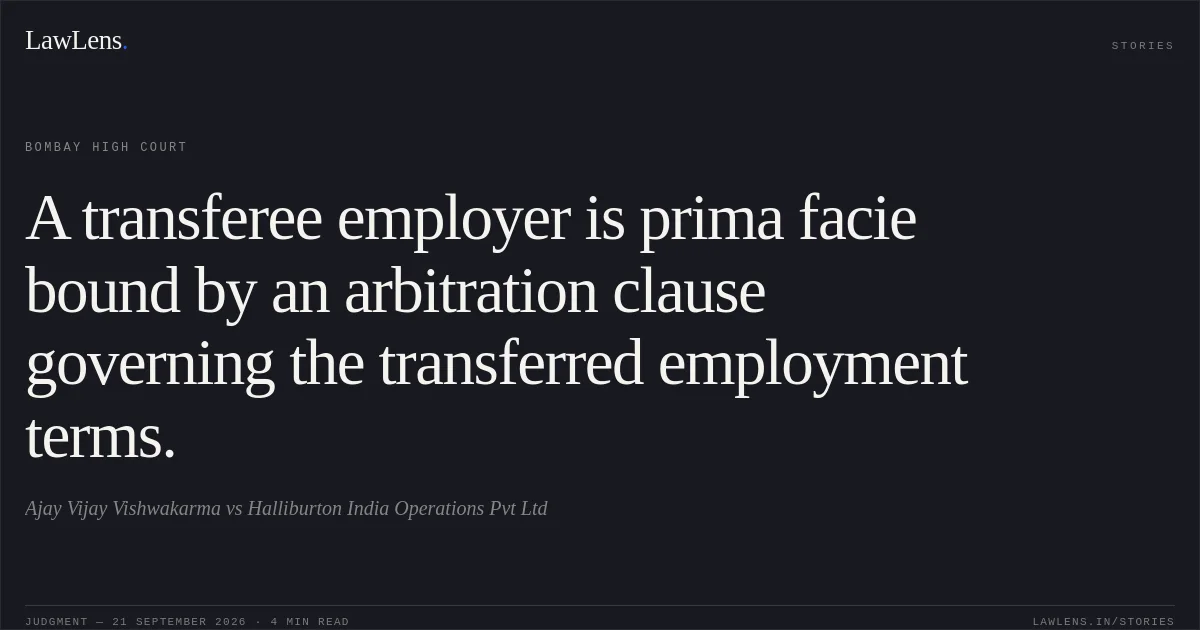
The Court held that the Applicant had established, on a prima facie basis, the existence of an arbitration agreement between himself and HIOPL through Clause 37 of the Appointment Letter dated 18 March 2019, read with the Transfer of Employment dated 1 February 2020 and the Respondent’s subsequent written admission regarding the governing terms of employment.
The Respondent’s objection that the Appointment Letter was issued by HOSI was therefore rejected, and the earlier mistake regarding the date of the appointment agreement was held not to defeat the arbitration claim.
Source reference: paras. 40, 45–46; pp. 19–22With the parties’ consent that a sole arbitrator could be appointed, the Court appointed Ms. Arti Raghavan, Advocate, as the Sole Arbitrator to adjudicate all disputes and claims arising out of or connected with the Appointment Letter and the subsequent transfer of employment, including claims and counterclaims.
Source reference: para. 47(A); p. 22The Court issued directions concerning communication of the order, filing of the statutory disclosure under Sections 11(8) and 12(1), appearance before the arbitrator, procedural directions, and equal payment of arbitral costs in the first instance, subject to the final award on costs.
Source reference: para. 47(B)–(F); pp. 22–24All merits issues were expressly left open for determination by the arbitral tribunal.
Source reference: para. 48; p. 24Acts & Sections Cited
4 provisions across 1 statute referred to in this judgment. Each provision opens on LawLens.
Arbitration and Conciliation Act, 19964
Original Court PDF
Ajay Vijay VishwakarmavsHalliburton India Operations Pvt Ltd
Click to open original judgment
Original judgment, available to read, download and summarize on LawLens.in