Facts
The plaintiff brought O.S. No. 51/2014 claiming a 1/10th share in the suit properties.
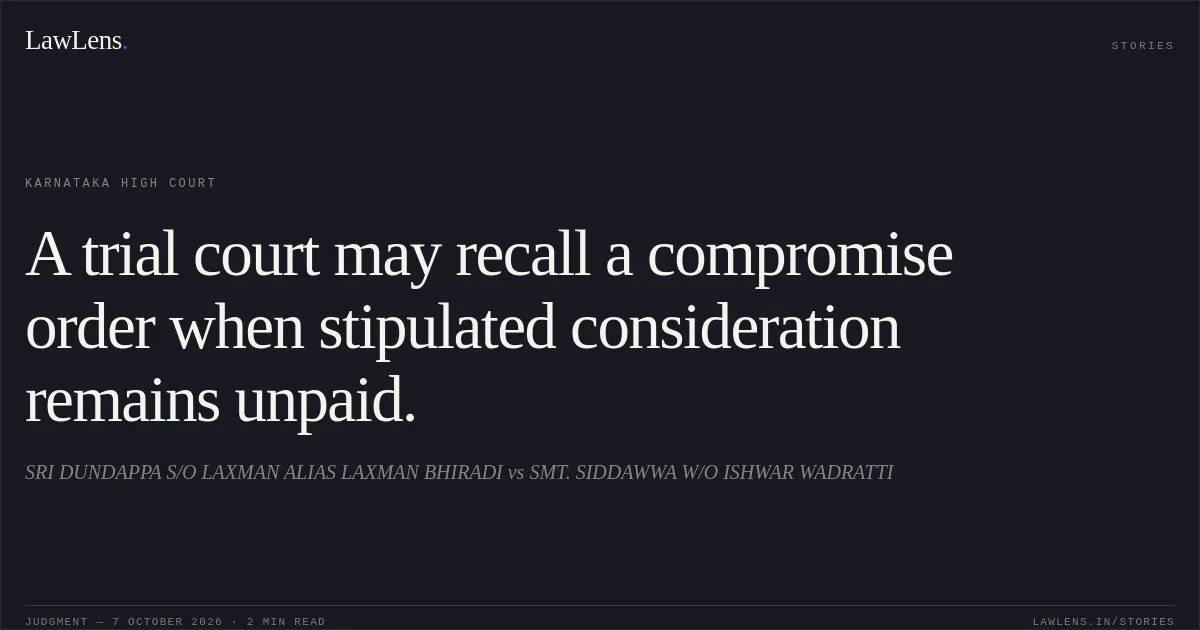
Source reference: no citationOn 28 November 2017, the parties filed a compromise petition, under which the defendants were to pay her ₹10,00,000, stated to have been tendered by cheque, in return for her relinquishing her claims.
Source reference: no citationOn 4 July 2022, the plaintiff applied under Order XXIII Rule 3 read with Section 151 CPC and Section 5 of the Limitation Act to recall the compromise order, alleging that she had not received the money.
Source reference: no citationThe trial court allowed the applications and restored the suit on 6 July 2022.
Source reference: no citationThe defendants challenged that order in these revision petitions.
Source reference: no citationAt the ensuing enquiry, the defendants’ assertion that they had paid the amount in cash after taking back the cheque was not substantiated
Source reference: pp. 5–8Issues
1. Whether the trial court was justified in entertaining the plaintiff’s application to recall the order recording the compromise, on the ground that the agreed payment had not been made
Source reference: pp. 6–8, 102. Whether the trial court’s order allowing the applications and restoring the suit disclosed a material irregularity warranting interference in revision
Source reference: pp. 6–10Law Applied
Order XXIII Rule 3 read with Section 151 CPC was the procedural basis for the plaintiff’s application to recall the order recording the compromise; Section 5 of the Limitation Act was invoked in seeking condonation of delay; and Section 115 CPC governed the defendants’ revision petitions.
Source reference: pp. 2–4, 9The High Court noted that the trial court had relied on 2015 (5) KCCR 631 (DB) in entertaining the recall applications and 2010 (2) Civil LJ 356 in condoning the delay; the judgment does not state the names of those cases or elaborate their governing propositions
Source reference: pp. 2–4, 9Reasoning
The compromise included payment of ₹10,00,000 as consideration for the plaintiff giving up her claims.
Source reference: pp. 7–10She alleged that the payment was never received, while the defendants asserted that they had paid in cash after recovering the cheque.
Source reference: pp. 7–10After holding an enquiry, the trial court found that the defendants had failed to substantiate their account.
Source reference: pp. 7–10In those circumstances, the High Court held that the trial court was justified in entertaining the applications and recalling the compromise order, and found no material irregularity warranting revisionary interference
Source reference: pp. 7–10Holding
The High Court dismissed both revision petitions and thereby left in force the trial court’s order recalling the compromise and restoring O.S. No. 51/2014
The defendants were permitted to withdraw the ₹10,00,000 deposited pursuant to the High Court’s interim order, together with accrued interest, except ₹10,000, which was directed to be paid to the plaintiff as compensatory costs
Source reference: pp. 9–10Acts & Sections Cited
3 provisions across 2 statutes referred to in this judgment. Each provision opens on LawLens.
Code of Civil Procedure, 19082
Limitation Act, 19631
Original Court PDF
SRI DUNDAPPA S/O LAXMAN ALIAS LAXMAN BHIRADIvsSMT. SIDDAWWA W/O ISHWAR WADRATTI
Click to open original judgment
Original judgment, available to read, download and summarize on LawLens.in