Facts
The employee was dismissed from service on 4 December 2004 following disciplinary proceedings initiated in 1994.
Source reference: no citationIn 2005, he filed an original application before the Tribunal, which directed him to file a departmental appeal within one month; he was represented by counsel in that proceeding.
Source reference: pp. 2–3, para. 2(j)–(l)Instead, he filed the appeal on 21 August 2019, relying on his acquittal in the criminal case in June 2019.
Source reference: p. 3, para. 2(m)–(n)In 2022, the Tribunal directed the employer to decide the appeal, which the employer rejected in 2023, noting that it had been filed approximately 16 years after the Tribunal’s direction.
Source reference: pp. 3–4, para. 2(o)–(q)The employee then filed O.A. No. 146 of 2025.
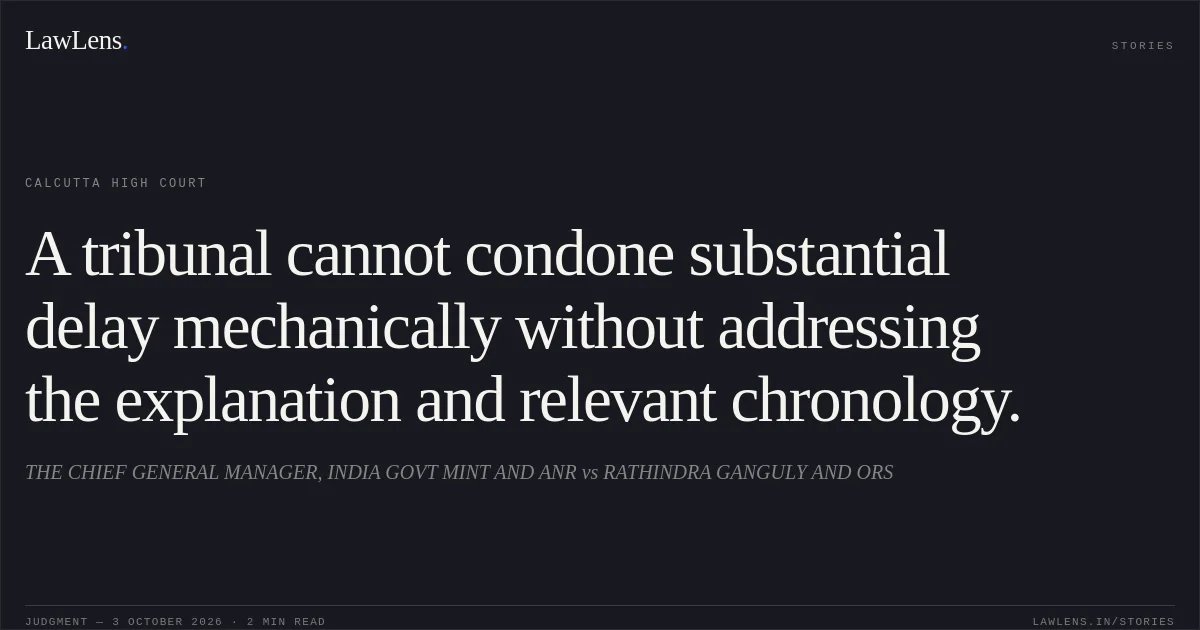
Source reference: no citationThe High Court considered whether the Tribunal’s order dated 13 July 2026 condoning delay had adequately addressed the relevant chronology and the delay in filing the departmental appeal.
Source reference: p. 4, paras. 2(r)–3Issues
1. Whether the Tribunal rightly condoned the delay without accounting for the relevant dates and procedural history, particularly the approximately 16-year delay in filing the departmental appeal.
Source reference: p. 4, paras. 2–32. Whether the Tribunal’s order condoning delay could stand without reasons addressing the employee’s claimed ignorance of the Tribunal’s 27 May 2005 direction.
Source reference: p. 4, para. 3Law Applied
Delay may be considered liberally, but condonation is not a formality and must be supported by consideration of the relevant circumstances and reasons for the delay.
Source reference: p. 4, para. 3Delay cannot be condoned on misplaced sympathy; the decision must address the explanation offered and the material chronology.
Source reference: p. 4, para. 3Reasoning
The High Court found that the Tribunal’s order did not account for the sequence of events, including the 2005 direction to file an appeal within one month, the employee’s representation by counsel in that proceeding, and the eventual filing of the appeal in 2019.
Source reference: pp. 2–4, para. 2(j)–(r)Nor did the impugned order give reasons addressing the claimed ignorance of the 2005 direction or the resulting 16-year delay. Because liberal consideration does not dispense with reasoned consideration, the order could not stand.
Source reference: p. 4, para. 3Holding
The High Court partly allowed the petition, quashed the Tribunal’s order dated 13 July 2026, and restored M.A. No. 216 of 2026 to the Tribunal’s file.
It directed the parties to appear on 14 October 2026 and the Tribunal to reconsider the application in light of the chronology set out in the judgment and pass a reasoned order.
Source reference: p. 5, para. 5Rule was made absolute in those terms.
Source reference: p. 5, para. 6Original Court PDF
THE CHIEF GENERAL MANAGER, INDIA GOVT MINT AND ANRvsRATHINDRA GANGULY AND ORS
Click to open original judgment
Original judgment, available to read, download and summarize on LawLens.in