Facts
Respondent No. 2, a Head Cashier at the Bank’s Berhampore Branch, reported a cash shortage of ₹8.30 lakh on 10 March 2009.
Source reference: para. 3–8The Bank made good the shortage through its Suspense Account, suspended him, and initiated disciplinary proceedings.
Source reference: para. 3–8Respondent No. 2 later deposited the amount.
Source reference: para. 3–8Following an enquiry, the Bank imposed compulsory retirement, which the Appellate Authority upheld.
Source reference: para. 3–8The CGIT set aside the punishment and directed reinstatement with stoppage of three increments, relying on a certificate describing the employee as honest; it denied back wages.
Source reference: para. 10, 26The Bank challenged the award.
Source reference: no citationWhile the writ petition was pending, it paid wages under Section 17B of the Industrial Disputes Act, 1947.
Source reference: para. 12–16The High Court found that payments continued after the employee’s superannuation and that ₹15,59,981.48 had been paid for the period from September 2021 to February 2026.
Source reference: para. 12–16Issues
Whether the CGIT was justified in setting aside compulsory retirement and substituting a lesser penalty on the basis of the employee’s character certificate, despite the proved cash-shortage charge
Source reference: para. 25–30Whether the Bank could recover wages paid under Section 17B after the employee’s superannuation
Source reference: para. 14–16, 31Law Applied
Section 11A of the Industrial Disputes Act, 1947, empowers an industrial tribunal to interfere with a dismissal or discharge and impose a lesser punishment;
Source reference: para. 18–21the respondent relied on The Workmen of M/s Firestone Tyre and Rubber Co. of India (P) Ltd. v. The Management, (1973) 1 SCC 813, and Nand Kumar Verma v. State of Jharkhand, (2012) 3 SCC 580
Source reference: para. 18–21Section 17B provides for payment of last-drawn wages during the pendency of proceedings challenging an award of reinstatement, as reflected in the interim directions in this case.
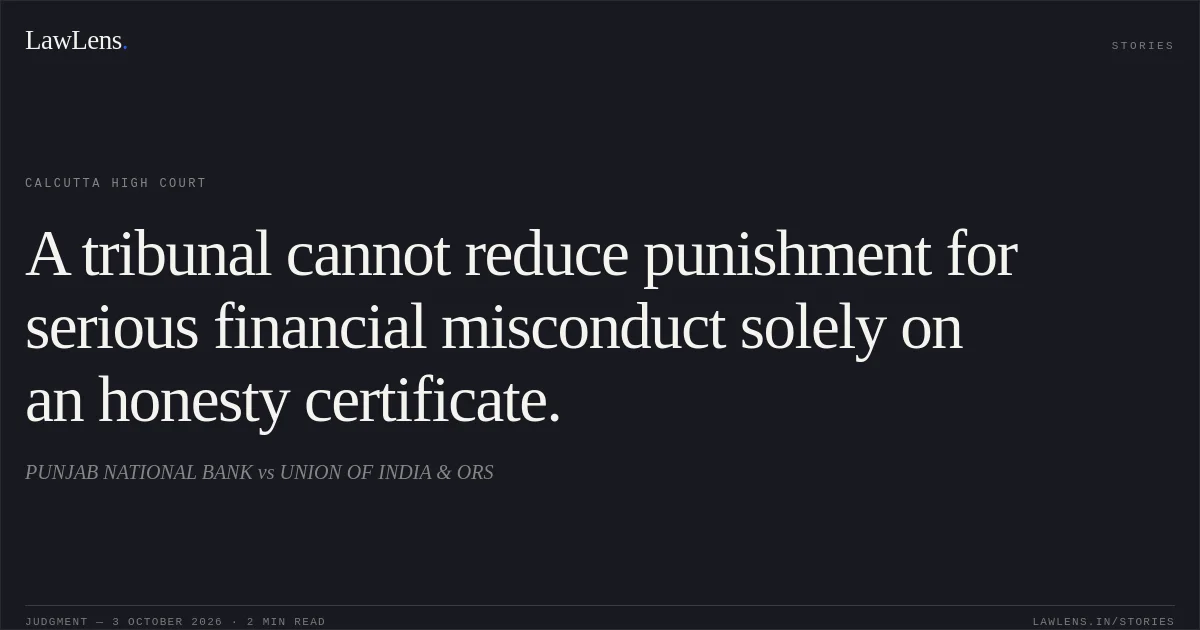
Source reference: para. 12–13The Court’s stated principle was that a character certificate could not prevail over valid disciplinary proceedings concerning a serious financial charge.
Source reference: para. 27–28Reasoning
The Court found that the Tribunal’s decision rested solely on a certificate describing the employee as honest, whereas the disciplinary proceedings established the cash shortage and the employee had admitted it and later reimbursed the amount.
Source reference: para. 25–27In the Court’s view, the certificate did not justify displacing the Bank’s disciplinary decision or reducing the penalty for a serious charge involving financial irregularity; the award was therefore perverse and not in accordance with law.
Source reference: para. 27–30Separately, the Court accepted that Section 17B payments continued after the employee’s superannuation and permitted recovery of the excess amount through due process.
Source reference: para. 14–16, 31Holding
The High Court allowed the writ petition and set aside the CGIT’s award of 28 November 2018.
It permitted the Bank to recover ₹15,59,981.48, paid after the employee’s superannuation, through due process, including adjustment against any arrears payable to him.
Source reference: para. 31Acts & Sections Cited
2 provisions across 1 statute referred to in this judgment. Linked provisions open on LawLens.
Industrial Disputes Act, 19472
Original Court PDF
PUNJAB NATIONAL BANKvsUNION OF INDIA & ORS
Click to open original judgment
Original judgment, available to read, download and summarize on LawLens.in