Facts
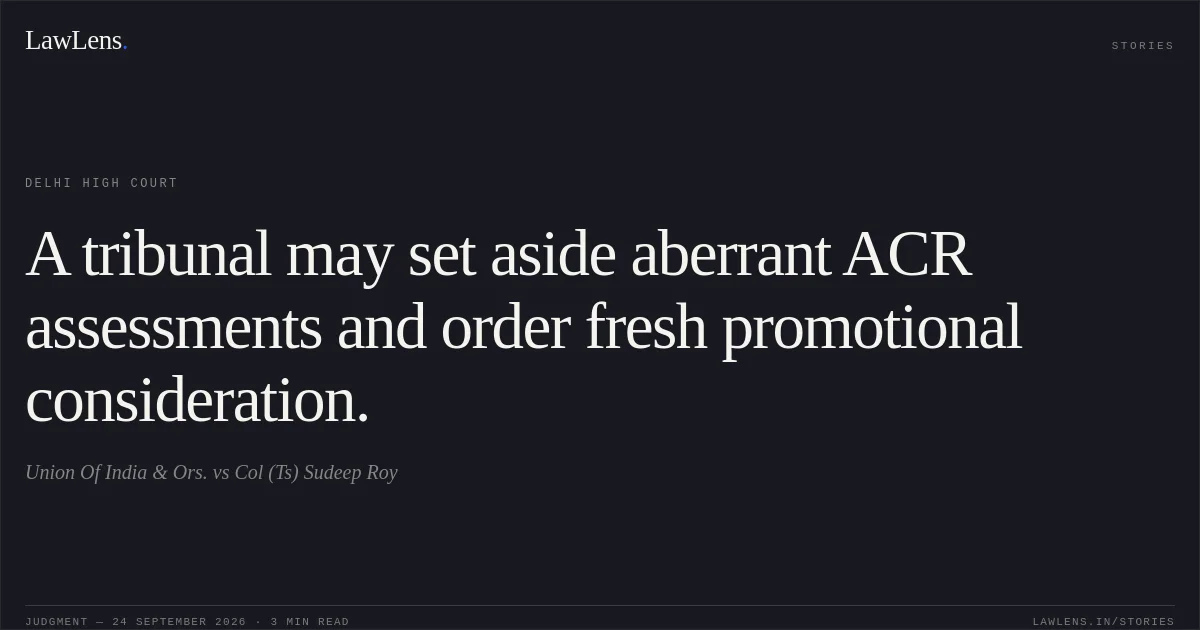
The respondent was commissioned as a Lieutenant in the Army Dental Corps on 28 November 1991 and was promoted to Lieutenant Colonel in May 2005.
Source reference: p. 3Upon consideration for promotion to Colonel, he was found “Not Selected” by Promotion Board (Medical) No. 3 in 2008, and was similarly unsuccessful in the first and final review cases held in 2009 and 2010, respectively, on grounds of comparative merit and limited vacancies.
Source reference: p. 3His statutory complaints challenging the non-empanelment on grounds including bias, subjectivity and inconsistency were rejected in 2010 and 2015.
Source reference: p. 3The respondent thereafter filed O.A. No. 606/2017 before the Armed Forces Tribunal, Principal Bench, New Delhi.
Source reference: p. 3By order dated 6 January 2026, the Tribunal directed the authorities to expunge specified assessments in his ACRs and reconsider his promotion with the modified profile; if found within merit, he was to be notionally promoted with consequential benefits.
Source reference: pp. 3, 6The Union of India and other authorities challenged that order under Article 226 of the Constitution.
Source reference: p. 2Issues
Whether the Armed Forces Tribunal exceeded the permissible scope of judicial review by reappreciating or rewriting the respondent’s ACRs while directing expunction of certain assessments?
Source reference: pp. 4, 7; paras. 4, 7Whether the Tribunal was justified in finding aberration and inconsistency in the ACR assessments, particularly the HTO’s adverse grading, where the relevant remarks had not been communicated to the respondent?
Source reference: pp. 4–6; para. 5Whether the Tribunal’s direction for fresh consideration of the respondent’s promotion, and possible notional promotion with consequential benefits, warranted interference under Article 226?
Source reference: pp. 6–8; paras. 6–10Law Applied
The Court applied Article 226 of the Constitution, under which interference with an Armed Forces Tribunal decision is warranted only where there is illegality, perversity, or jurisdictional error.
Source reference: p. 8; para. 9It recognized the distinction between permissible judicial review of ACRs for aberrations, inconsistency and procedural unfairness, and impermissible rewriting or reappreciation of assessments.
Source reference: pp. 4, 7; paras. 4, 7The Court further applied Special Army Order SAO 8/S/91, particularly paragraphs 72(f) and 73(b), which require adverse remarks and guidance for improvement to be supported by the officer’s figurative assessment and demonstrated performance, and require such remarks to be communicated to the ratee rather than excluded to avoid communication.
Source reference: pp. 4–6; para. 5Non-communication of adverse remarks, where required, constitutes denial of a fair opportunity to respond and is not merely a procedural irregularity.
Source reference: p. 6; para. 5Reasoning
The Tribunal found that the respondent had been graded from “Outstanding” to “Exceptionally Outstanding” by the other grading officers, whereas the HTO had made a substantially lower assessment, relying partly on events dating from 1998 rather than the period covered by the relevant report.
Source reference: pp. 4–6; para. 5It also found that the HTO’s adverse remarks and justification for downgrading had not been communicated to the respondent, contrary to SAO 8/S/91.
Source reference: pp. 4–6; para. 5The High Court held that these findings concerned identifiable aberrations, inconsistency and denial of procedural fairness, rather than an impermissible rewriting of the ACRs.
Source reference: p. 7; para. 7Since the Tribunal had examined the relevant ACRs and applicable reporting requirements, and its directions remained within the scope of judicial review, the authorities failed to establish any illegality, perversity or jurisdictional error warranting interference under Article 226.
Source reference: pp. 7–8; paras. 7–9Holding
The High Court answered the issues against the petitioners and upheld the Armed Forces Tribunal’s order dated 6 January 2026.
It held that the Tribunal had validly identified aberrations and non-compliance with the requirements governing ACR assessment and communication of adverse remarks, and had not impermissibly reappreciated the ACRs.
Source reference: p. 7; para. 7The writ petition was dismissed, thereby sustaining the direction to reconsider the respondent’s promotion to Colonel on the basis of the modified profile and, if found within merit, to grant notional promotion with consequential benefits.
Source reference: pp. 6, 8; paras. 5, 10Pending applications were also disposed of.
Source reference: p. 8; para. 11Original Court PDF
Union Of India & Ors.vsCol (Ts) Sudeep Roy
Click to open original judgment
Original judgment, available to read, download and summarize on LawLens.in