Facts
The complainant, a student, paid admission fees of ₹1,30,500 to the institution run by the accused. After applying to withdraw from the course on 27 January 2017, he received a cheque for that amount, which was dishonoured with the endorsement “cheque payment stopped.”
Source reference: para. 4, 22, 39–43The Trial Court convicted the accused under Section 138 of the Negotiable Instruments Act and ordered payment of a fine of ₹1,62,500, including ₹1,60,500 as compensation; the Appellate Court affirmed the conviction and sentence.
Source reference: para. 7–8The accused challenged both decisions in revision, arguing, among other things, that the institution or Trust was not made a party.
Source reference: para. 10–11Issues
Whether the concurrent findings of conviction and sentence were so perverse, erroneous, or unreasonable as to warrant interference in revision.
Source reference: para. 15Whether the complaint was maintainable without joining the institution or Trust on whose behalf the cheque was issued.
Source reference: para. 26–27Whether the accused rebutted the statutory presumptions under Sections 118 and 139 of the NI Act by relying on the complainant’s later request to continue his admission.
Source reference: para. 38–45Law Applied
Section 138 of the NI Act applies where the statutory requirements concerning presentation, dishonour, notice, and failure to pay are met; Sections 118 and 139 raise rebuttable presumptions concerning consideration and the existence of a legally enforceable debt or liability.
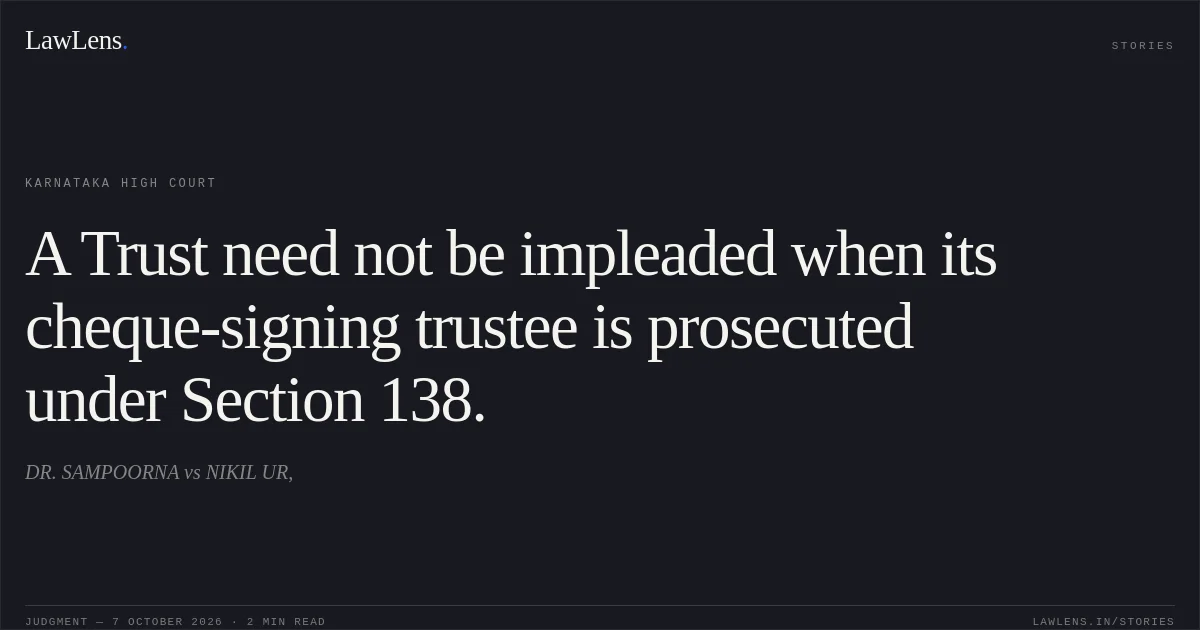
Source reference: para. 19–20, 22–24The Court relied on Sankar Padam Thapa v. Vijaykumar Dineshchandra Agarwal, 2025 INSC 1210, for the rule that a Trust need not itself be impleaded in a cheque-dishonour complaint where the trustee who signed the cheque is proceeded against, because the Trust lacks independent legal status.
Source reference: para. 32–37Revisional jurisdiction is supervisory, not a second appeal: interference is warranted only on grounds such as perversity, gross error, consideration of irrelevant or no material, or failure to consider relevant material; ordinarily, the revisional court should not reappreciate evidence already considered by the trial and appellate courts.
Source reference: para. 17–18Reasoning
The Court found that the cheque had been issued following the complainant’s withdrawal application, and that presentation, dishonour, notice, and non-payment were established.
Source reference: para. 22It held that the absence of the Trust or institution as a party did not defeat the complaint: the accused admitted that the institution was run as a Trust, and the cheque had been issued on its behalf; applying Sankar Padam Thapa, the Court concluded that proceeding against the relevant authorised signatories was sufficient.
Source reference: para. 28–37The accused’s reliance on the complainant’s signed document did not establish that he had resumed his studies. The Trial Court and Appellate Court had considered the document and accepted the complainant’s explanation that his signature had been obtained on forms when he collected his original documents; the High Court found no basis to disturb that concurrent assessment in revision.
Source reference: para. 41–45Holding
The Court answered the revisional-interference question in the negative and held that neither the challenge to maintainability nor the defence based on the complainant’s later signed document warranted interference.
Finding no qualifying error in the concurrent decisions, it dismissed the criminal revision petition and left the conviction and sentence undisturbed.
Source reference: para. 16, 45–46Acts & Sections Cited
10 provisions across 3 statutes referred to in this judgment. Each provision opens on LawLens.
Code of Criminal Procedure, 19734
Bharatiya Nagarik Suraksha Sanhita, 20232
Negotiable Instruments Act, 18814
Original Court PDF
DR. SAMPOORNAvsNIKIL UR,
Click to open original judgment
Original judgment, available to read, download and summarize on LawLens.in