Facts
The applicants sought review or modification of the High Court’s order dated 16 April 2026 passed in W.P. No. 14329 of 2007.
Source reference: para. 1The writ petition concerned an order dated 13 September 2007 by which an earlier order granting exemption to a Public Charitable Trust was recalled.
Source reference: para. 2The applicant, claiming to be one of the trustees and the person who had applied for the exemption, contended that neither he nor any trustee had been given notice or an opportunity of hearing before the exemption was withdrawn.
Source reference: para. 7The relevant note-sheet recorded that, after an application by respondent No. 4, no notices were issued to the applicant or the trustees.
Source reference: para. 7The respondents argued that the Trust had been represented through its statutory representative, namely, the Registrar under the Madhya Pradesh Public Charitable Trust Act, 1951, who is the Collector of the district.
Source reference: paras. 4, 8–9The Collector had submitted a report dated 9 October 2005, which formed the basis for the decision to withdraw the exemption.
Source reference: paras. 4, 8–9Respondent No. 5 also asserted that although he was impleaded as a petitioner, he had not signed the vakalatnama and that the petition had been filed by the applicant in his individual capacity.
Source reference: para. 5Issues
Whether the order withdrawing the exemption granted to the Public Charitable Trust was invalid for violation of natural justice because the applicant or the trustees were not individually heard?
Source reference: paras. 2, 7–10Whether the High Court’s order dated 16 April 2026 disclosed an error apparent on the face of the record warranting review or modification?
Source reference: paras. 1, 3, 10–12Law Applied
The Court applied the principle that the State, while acting in an administrative capacity, may recall an earlier order by invoking the applicable provisions of the General Clauses Act.
Source reference: para. 3It further considered the statutory scheme under the Madhya Pradesh Public Charitable Trust Act, 1951, under which the Registrar of a Public Charitable Trust is the Collector and may represent the Trust in the relevant proceedings.
Source reference: paras. 4, 8The Court relied on Kamlesh Verma v. Mayawati, (2013) 8 SCC 320, which holds that review is not an appeal in disguise; repetition of previously rejected arguments, appreciation of evidence, or the mere possibility of another view does not justify review.
Source reference: para. 11Review lies only for a patent or manifest error apparent on the face of the record that undermines the decision or causes miscarriage of justice.
Source reference: para. 11Reasoning
Although the note-sheet indicated that the applicant and individual trustees were not issued notices, the Court distinguished the applicant’s individual capacity from the legal representation of the Trust.
Source reference: paras. 8–9The Trust itself had participated through the Collector, acting as its statutory representative, and the Collector’s report dated 9 October 2005 was considered before the exemption was withdrawn.
Source reference: paras. 8–9Consequently, the Court held that the Trust had not been deprived of an opportunity of being heard merely because the applicant was not separately heard in his personal capacity, even though the exemption had originally been granted on his application.
Source reference: para. 10Since this conclusion did not disclose a patent error or miscarriage of justice, the applicant failed to satisfy the restrictive grounds for review identified in Kamlesh Verma.
Source reference: paras. 10–12Holding
The Court held that no ground was made out for recalling, reviewing, or modifying the order dated 16 April 2026.
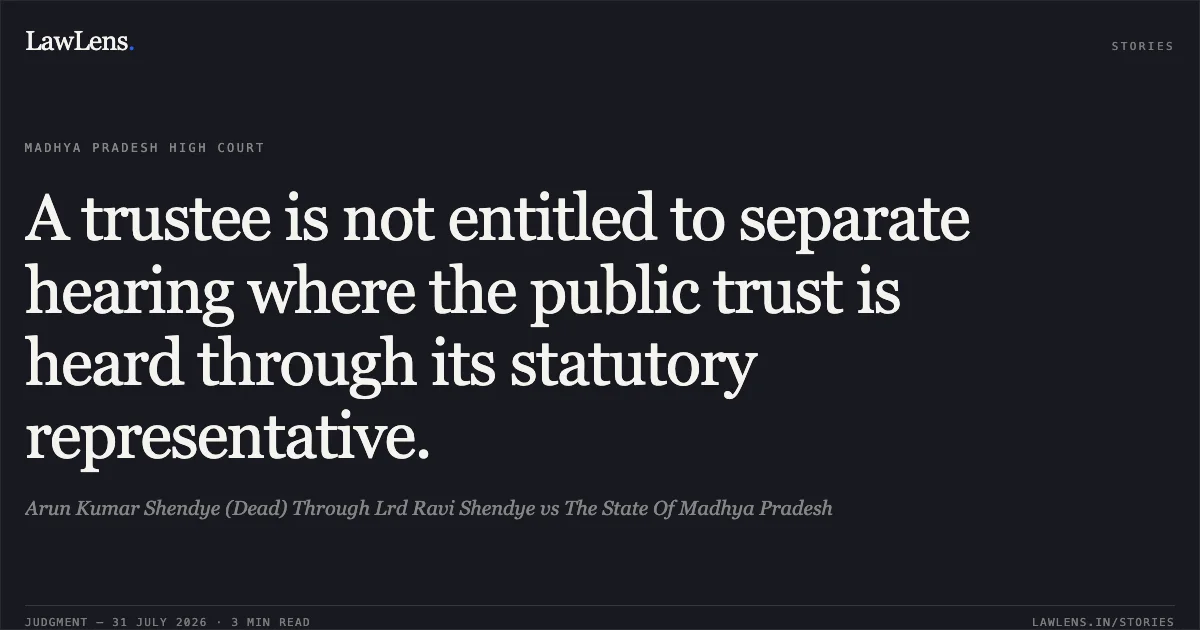
The Trust had been represented through the Collector, and the impugned withdrawal of exemption was based on the Collector’s report; therefore, the alleged failure to provide the applicant or individual trustees a separate hearing did not warrant interference.
Source reference: para. 10The review petition was accordingly dismissed, with no order as to costs.
Source reference: para. 12Original Court PDF
Arun Kumar Shendye (Dead) Through Lrd Ravi ShendyevsThe State Of Madhya Pradesh
Click to open original judgment
Original judgment, available to read, download and summarize on LawLens.in


