Facts
The appellant challenged the judgment and order dated 22 January 2024 and sentence dated 25 January 2024 passed by the Special Judge, Goalpara, under the POCSO Act. He was convicted under Section 376 IPC read with Section 4 of the POCSO Act and sentenced to imprisonment for life with a fine of ₹25,000, with six months’ simple imprisonment in default of payment.
Source reference: p.2, para. 2The prosecution alleged that on 26 June 2017 the appellant took the minor victim, then stated to be about 14 years old, on the promise of marriage to Rakshyasini Pahar, where he sexually assaulted her and allegedly handed her over to other boys who also assaulted her. The victim returned the following day and disclosed the incident to her family, following which an FIR was lodged on 27 June 2017.
Source reference: pp.2–3, paras. 3–4The trial court framed charges under Section 376 IPC read with Section 4 of the POCSO Act. The prosecution examined eight witnesses, including the victim, her father, her friend, the medical officer and the investigating officer. The appellant denied the allegations in his Section 313 Cr.P.C. statement and did not lead defence evidence.
Source reference: p.4, paras. 5–8In appeal, the appellant contended that there was no eyewitness, the investigation was defective, material witnesses such as the auto-rickshaw driver and the alleged co-accused were not examined, the medical evidence placed the victim’s age between 18 and 20 years, and the appellant himself was a juvenile on the date of occurrence.
Source reference: pp.5–6, paras. 9–10Issues
Whether the prosecution proved beyond reasonable doubt that the appellant committed rape upon the victim, thereby attracting Section 376 IPC?
Source reference: p.4, para. 7(i)Whether the victim was below 18 years of age on the date of occurrence so as to attract Section 4 of the POCSO Act?
Source reference: pp.14–16, paras. 21–23Whether the absence of eyewitnesses, non-examination of the auto-rickshaw driver and alleged co-accused, investigative lapses, and the medical age opinion entitled the appellant to acquittal?
Source reference: pp.5–6, 13–14, paras. 9, 20Whether the victim’s testimony, supported by surrounding circumstances and medical evidence, was sufficient to sustain the conviction?
Source reference: pp.24–30, paras. 32–38Law Applied
The Court applied Section 374(2) Cr.P.C. governing appeals against conviction, Section 376 IPC relating to rape, and Section 4 of the POCSO Act concerning penetrative sexual assault.
Source reference: p.2, para. 2; p.4, paras. 5–7Sections 34(2) of the POCSO Act and 94 of the Juvenile Justice (Care and Protection of Children) Act, 2015 require determination of a child’s age by the Special Court, giving priority to a school or matriculation certificate, thereafter a birth certificate issued by a competent local authority, and only in their absence, medical age determination.
Source reference: pp.14–15, para. 21The Court relied on the birth certificate as admissible and reliable official evidence, referring to Harpal Singh v. State of Himachal Pradesh, (1981) 1 SCC 560.
Source reference: p.16, para. 22It further applied Sections 29 and 30 of the POCSO Act, which create statutory presumptions regarding culpable mental state and commission of the offence once the foundational facts are established.
Source reference: p.30, para. 39The Court reiterated that the trustworthy and confidence-inspiring testimony of a prosecutrix can, by itself, sustain a conviction without mandatory corroboration, relying on Narender Kumar v. State (NCT of Delhi), (2012) 7 SCC 171, and Vijay alias Chinee v. State of Madhya Pradesh, (2010) 8 SCC 191.
Source reference: pp.25–30, paras. 36–38Investigative deficiencies or non-examination of witnesses do not necessarily discredit otherwise reliable testimony.
Source reference: pp.28–29, para. 37Reasoning
The Court found the victim’s testimony consistent, detailed and materially unshaken in cross-examination. Her evidence established that the appellant took her away, brought her to the hill area and sexually assaulted her. Her friend, PW-6, corroborated the appellant’s presence with the victim and the fact that he sent the friend away while remaining with the victim.
Source reference: pp.19–20, 24–25, paras. 26, 32The medical officer found injuries including vulval laceration, swelling of the perineum and tenderness of the vagina and cervix, and opined that rape could not be excluded, thereby lending assurance to the victim’s account.
Source reference: pp.11–12, 20–21, paras. 18, 27The Court rejected the age challenge because the victim’s birth certificate recorded her date of birth as 15 December 2003. Since the incident occurred on 26 June 2017, she was below 18 years of age, notwithstanding the radiological opinion estimating her age between 18 and 20 years.
Source reference: pp.14–16, paras. 21–23Under Section 94 of the JJ Act, documentary proof prevailed over medical estimation where the document was reliable and its credibility had not been shaken.
Source reference: pp.14–16, paras. 21–23The Court also noted that the appellant admitted in his Section 313 Cr.P.C. statement that he had been with the victim and her friend on the relevant day, although he denied the sexual assault. This admission supported the prosecution’s evidence regarding his association with the victim.
Source reference: pp.23–25, paras. 30–34The absence of an eyewitness was not fatal because rape is ordinarily committed in circumstances where direct witnesses are unavailable, and the victim’s reliable testimony was independently supported by PW-6 and the medical evidence.
Source reference: pp.23–25, paras. 30–34The alleged investigative lapses, including failure to trace the other alleged offenders or examine the auto-rickshaw driver, did not undermine the core prosecution case.
Source reference: pp.5–6, 28–29, paras. 9, 37Holding
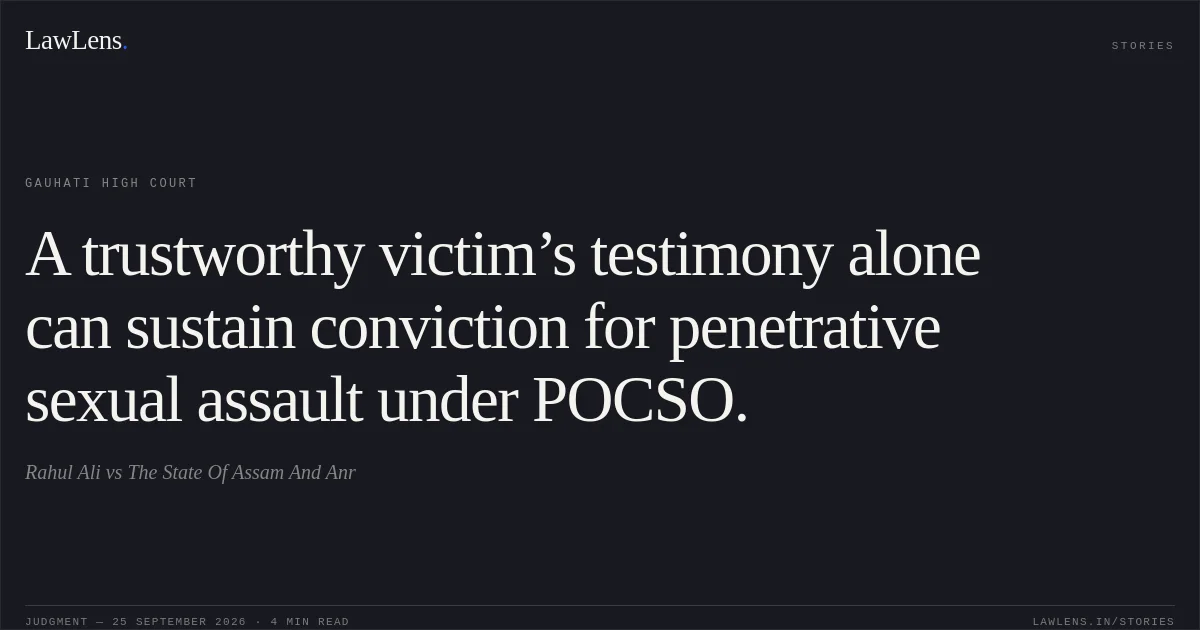
The High Court held that the victim was a child under the POCSO Act and that her trustworthy testimony, corroborated by PW-6 and the medical evidence, proved the appellant’s guilt beyond reasonable doubt.
The Court therefore found no ground to interfere with the conviction and sentence.
Source reference: pp.30–31, para. 39The appeal was dismissed, the conviction under Section 376 IPC read with Section 4 of the POCSO Act and the sentence of life imprisonment with a ₹25,000 fine were affirmed, and the trial court records were directed to be returned.
Source reference: p.31, paras. 39–40Acts & Sections Cited
10 provisions across 4 statutes referred to in this judgment. Each provision opens on LawLens.
Code of Criminal Procedure, 19734
Protection of Children from Sexual Offences Act, 20124
Indian Penal Code, 18601
Juvenile Justice (Care and Protection of Children) Act, 2015.1
Original Court PDF
Rahul AlivsThe State Of Assam And Anr
Click to open original judgment
Original judgment, available to read, download and summarize on LawLens.in