Facts
Fouziya sustained injuries in a road traffic accident on 21 November 2019 involving a scooter owned by Sharath.
Source reference: pp. 4–6, paras. 1–5The Motor Accident Claims Tribunal awarded her approximately Rs. 2,23,000 with interest at 6% per annum, but directed the insurer to pay and recover the amount from the owner.
Source reference: pp. 4–6, paras. 1–5Sharath appealed against the pay-and-recover direction, while Fouziya appealed seeking enhancement of compensation.
Source reference: pp. 4–6, paras. 1–5The Tribunal had found that the scooter rider held a learner’s licence on the date of the accident.
Source reference: p. 8, para. 13Issues
1. Whether the Tribunal erred in directing the insurer to pay the compensation and recover it from the owner, despite finding that the rider held a valid learner’s licence.
Source reference: pp. 6–9, paras. 7, 132. Whether the compensation awarded by the Tribunal required enhancement in light of the claimant’s injuries, disability, medical expenses, and period of recovery.
Source reference: pp. 6–11, paras. 8, 14–17Law Applied
The appeals were brought under Section 173(1) of the Motor Vehicles Act.
Source reference: pp. 2–3The Court relied on Senior Divisional Manager, National Insurance Co. Ltd. v. Jyotiba Appaji and Others (2020 ACJ 1), as cited in the judgment, for the proposition that a learner’s licence is valid for riding a two-wheeler and that an instructor is not required in that situation.
Source reference: p. 8, para. 13For assessing compensation, the Court applied the Karnataka State Legal Services Authority’s notional income of Rs. 14,000 per month for 2019, treated one-third of the assessed lower-limb disability as whole-body disability, and applied the multiplier appropriate to the claimant’s age.
Source reference: pp. 10–11, para. 16Reasoning
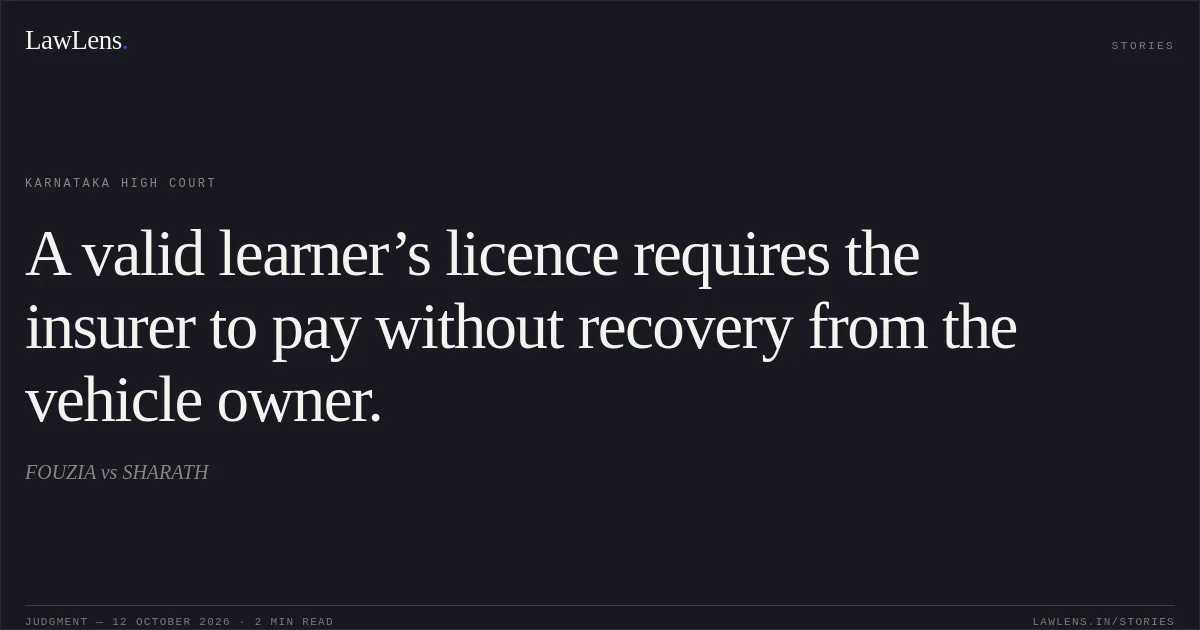
The Tribunal’s finding that the rider held a learner’s licence was consistent with the cited authority on two-wheeler learner’s licences.
Source reference: pp. 8–9, para. 13Accordingly, the Court held that the Tribunal had no basis to direct pay and recovery and that the insurer was liable to satisfy the award.
Source reference: pp. 8–9, para. 13On enhancement, the Court reassessed compensation to account for the claimant’s fractures and other injuries, allowed supported handwritten medical bills, and added compensation for loss of amenities and income during the 16-week recovery period.
Source reference: pp. 9–12, paras. 14–18It also revised the notional income to Rs. 14,000 per month and the whole-body disability to 5.11%, applying multiplier 16.
Source reference: pp. 9–12, paras. 14–18Holding
The Court allowed Sharath’s appeal and set aside the pay-and-recover direction, holding the insurer liable for the full compensation.
It partly allowed Fouziya’s appeal, enhancing the total compensation to Rs. 4,40,174—an increase of Rs. 2,17,174—with interest at 6% per annum from the petition date, except for the 537-day delay period in filing her appeal.
Source reference: pp. 12–14, para. 19 and order clauses (iii)–(viii)The insurer was directed to deposit the enhanced compensation within six weeks, and the claimant was entitled to its release; Sharath was also entitled to a refund of his statutory deposit.
Source reference: pp. 12–14, para. 19 and order clauses (iii)–(viii)Acts & Sections Cited
1 provisions across 1 statute referred to in this judgment. Each provision opens on LawLens.
Motor Vehicles Act, 19881
Original Court PDF
FOUZIAvsSHARATH
Click to open original judgment
Original judgment, available to read, download and summarize on LawLens.in
![Competent authority must reconsider transfer-waiting-list priority through a reasoned order.. Prabhat Kumar Srivastwa vs NORTH CENTRAL RAILWAY. CAT - ['Allahabad']. LawLens](/stories/thumbnails/competent-authority-must-reconsider-transfer-waiting-list-priority-through-a-reasoned-orde-e23ccd4eaf154e82b09ea183b25e32fb.webp)
![Excess-pay recovery from retired Group C employees is impermissible absent fraud or misrepresentation.. SATYA NAND YADAV vs NORTH EASTERN RAILWAY. CAT - ['Allahabad']. LawLens](/stories/thumbnails/excess-pay-recovery-from-retired-group-c-employees-is-impermissible-absent-fraud-or-misrep-c357cbdd195c44d68331385eea2a3c9a.webp)