Facts
The complainant alleged that the accused borrowed ₹20,00,000 in April 2014 and later issued two cheques for ₹10,00,000 each, which were dishonoured.
Source reference: p. 3–6, 18–22The accused relied on a 2014 notice (Ex.D.1) asserting a ₹2,00,000 transaction; the complainant relied on a handwritten acknowledgment of ₹20,00,000 (Ex.P.14) and the subsequent cheques.
Source reference: p. 3–6, 18–22The Magistrate convicted the accused under Section 138 of the Negotiable Instruments Act but imposed a fine of ₹2,00,000.
Source reference: p. 6–7The appellate court dismissed both the accused’s appeal and the complainant’s appeal, holding that an appeal against inadequate sentence was not maintainable.
Source reference: p. 6–7The complainant sought revision of the sentence.
Source reference: p. 2, 7–8Issues
1. Whether the concurrent decisions were perverse or otherwise sufficiently erroneous to warrant interference in revision, particularly as to the amount due and sentence.
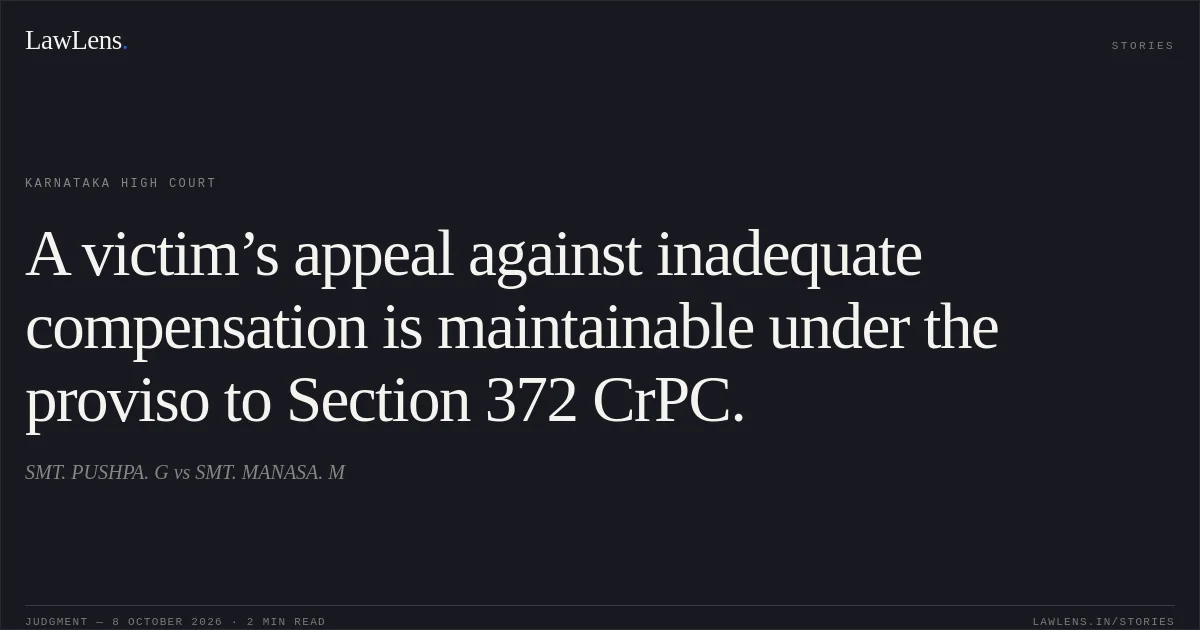
Source reference: p. 10–152. Whether the complainant’s appeal against inadequate sentence or compensation was maintainable under the proviso to Section 372 Cr.P.C.
Source reference: p. 27–28Law Applied
Sections 118 and 139 of the Negotiable Instruments Act raise rebuttable presumptions that a cheque was issued for consideration and in discharge of a legally enforceable debt or liability; the accused may rebut them on a preponderance of probabilities.
Source reference: p. 15–16, 23Section 138 applies where the statutory requirements concerning a cheque, its dishonour, notice and non-payment are satisfied.
Source reference: p. 15–16Under Sections 397 and 401 Cr.P.C., revisional jurisdiction is supervisory and does not ordinarily permit reappreciation of evidence; intervention is warranted where the lower court’s finding or order is perverse, grossly erroneous, unreasonable or legally untenable, or rests on irrelevant or no material, relying on Kuntegowda v. Thurubaiah, 2026 SCC OnLine SC 1485.
Source reference: p. 11–14The proviso to Section 372 Cr.P.C. permits a victim to appeal against, among other things, an inadequate sentence or compensation.
Source reference: p. 27–28Section 357 Cr.P.C. permits compensation to be directed from a fine.
Source reference: p. 29Reasoning
The High Court found that the accused’s signed cheques, their dishonour and receipt of statutory notice were undisputed, attracting the presumptions under Sections 118 and 139.
Source reference: p. 20, 23Ex.D.1 referred to a ₹2,00,000 loan and did not identify cheque numbers; it also pre-dated the cheques relied on in the complaint.
Source reference: p. 21–22, 24–26By contrast, Ex.P.14 recorded the ₹20,00,000 borrowing in the accused’s handwriting and was not challenged in cross-examination as forged or involuntary.
Source reference: p. 21–22, 24–26The Court therefore held that the trial court’s reliance on Ex.D.1 to limit the liability to ₹2,00,000 was grossly erroneous.
Source reference: p. 21–22, 24–26It also held that the appellate court had wrongly dismissed the complainant’s appeal, because the proviso to Section 372 permits an appeal against inadequate sentence or compensation.
Source reference: p. 27–29, 38Holding
The revision petition was allowed.
The conviction was left unaltered, but the sentence was modified: the accused was directed to pay a fine of ₹20,50,000, of which ₹20,40,000 was to be paid to the complainant as compensation under Section 357 Cr.P.C. and ₹10,000 defrayed towards State expenses.
Source reference: p. 29In default, the accused was to undergo six months’ simple imprisonment.
Source reference: p. 29Acts & Sections Cited
11 provisions across 3 statutes referred to in this judgment. Each provision opens on LawLens.
Code of Criminal Procedure, 19736
Bharatiya Nagarik Suraksha Sanhita, 20232
Negotiable Instruments Act, 18813
Original Court PDF
SMT. PUSHPA. GvsSMT. MANASA. M
Click to open original judgment
Original judgment, available to read, download and summarize on LawLens.in